
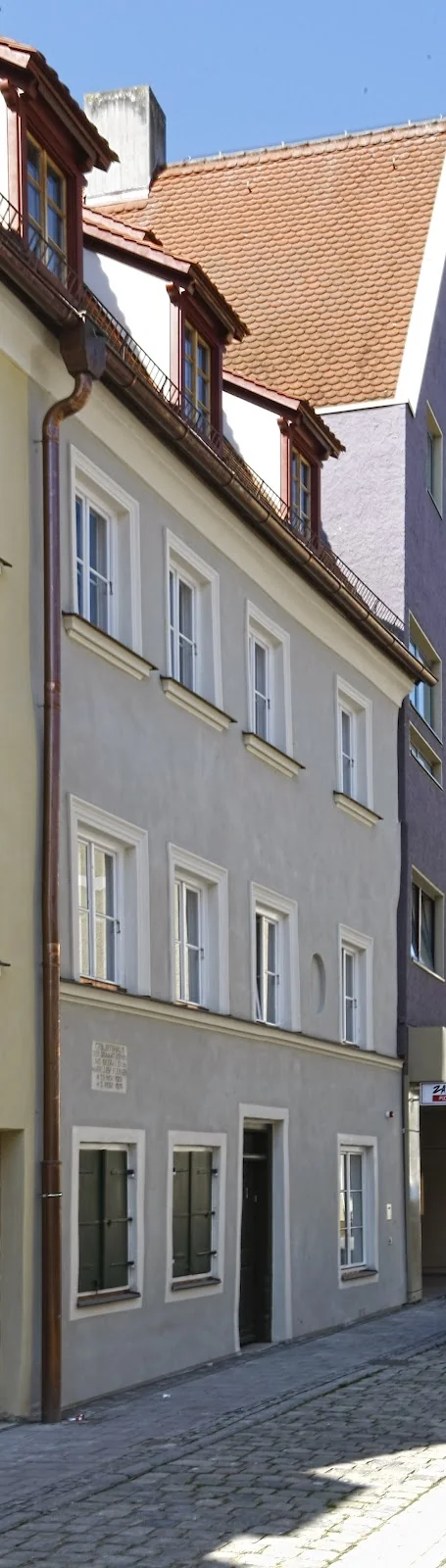
Kupferstraße 18, Ingolstadt-Altstadt Nordwest
Kupferstraße 18, 85049 Ingolstadt, Germany
Marieluise-Fleißer-Society Ingolstadt e.V. | House & Archive
The Marieluise-Fleißer-House in Ingolstadt is much more than an ordinary memorial museum. It connects the birthplace, literary history, city history, and a very concrete, location-based narrative. Anyone interested in Marieluise Fleißer will find a place here where biography and work come together closely: The author was born at Kupferstraße 18, spent most of her life in Ingolstadt, and significantly shaped the literary image of the city with her texts. The house was reopened after renovation on October 4, 2020, and has since presented itself as a modernly designed documentation site with seven thematic rooms, interactive elements, and a clear focus on language, atmosphere, and everyday culture. The Marieluise-Fleißer-Society also plays an important role on site, as it has been accompanying scientific and cultural mediation for years and contributes to ensuring that the place is not only preserved but also actively used. ([fleisser.net](https://fleisser.net/fleisserhaus/))
Birthplace, Exhibition, and the Seven Thematic Rooms
The charm of the house lies in the connection between a historical site and a clearly structured exhibition. The city of Ingolstadt and the Fleißer-Society describe the building as the birthplace of Marieluise Fleißer, which was initially established as a documentation site in November 2001 and reopened in a new form after the renovation in 2020. At the center is an exhibition concept by Sylvia R. Weber, which explores the life and work of the author in seven thematic rooms. These rooms have deliberately descriptive titles: THE TALENT, THE SUCCESS, THE ISOLATION, THE MEN, THE RECOGNITION, THE LANGUAGE, and THE IMPACT. This not only tells a biography but also builds a literary cosmos that connects Fleißer's development, her conflicts, and her history of impact. For visitors, this creates a tour that functions thematically rather than linearly, which fits very well with an author whose work is closely tied to language, milieu, and social observation. The house also informs about its own history, making it clear that the place itself is a historical document. ([fleisser.net](https://fleisser.net/fleisserhaus/))
Particularly striking is the strong emphasis on language. In the room THE LANGUAGE, five interactive modules have been developed that make the visit not only vivid but also participatory. These include a digital guestbook, a small audio play, a quiz on regionalisms and latent dialect, a section with voices on Fleißer's language, and a module titled About Sex, which deals with the power and powerlessness of language. This is where an important SEO and experience factor lies: Those searching for Marieluise Fleißer are often looking not only for a person but also for a tone, a literary style, and the cultural echo of a city. The house responds with an exhibition that connects listening, reading, and seeing. The design also refers to a special sensitivity for materials, images, and surfaces. The atmosphere of the house is therefore not museum-like and distant but close to the texts and the author's life world. This makes the place equally attractive for literature enthusiasts, school groups, locals, and cultural travelers. ([fleisser.net](https://fleisser.net/fleisserhaus/))
Opening Hours, Admission, and Practical Visitor Information
Anyone wishing to visit the Marieluise-Fleißer-House should be aware of the current times. The official city website states regular opening hours as Tuesday to Friday from 09:00 to 12:00 and Saturday and Sunday from 10:00 to 16:00. Additionally, the house is closed on several holidays, including November 1, Christmas Eve, and the first Christmas day, December 31, January 1, Shrove Tuesday, and Good Friday. This information is important because queries like opening hours, open today, or when open are very common and central to planning a visit. The museum platform also notes that there is a museum shop in the house. The address is Kupferstraße 18 in 85049 Ingolstadt. For general inquiries, the city provides the phone number 0841 305-1885, while the contact page of the City History Center also lists the cash desk of the Fleißer-House at 0841 305-1832. This clarifies the most important practical questions for travel and visit. ([zentrumstadtgeschichte.ingolstadt.de](https://zentrumstadtgeschichte.ingolstadt.de/index.php?FID=3625.424.1&ModID=7&object=tx%7C3625.424.1&utm_source=openai))
It is also worth taking a closer look at the city’s admission information. The city of Ingolstadt states that admission is free for children and young people up to 18 years as well as for persons up to 22 years if they are in school, vocational, or higher education. This is a relevant service note that particularly appeals to families, schools, and students. A complete price list for all other visitors is not explicitly mentioned in the sources evaluated here, so for planning, it is best to refer to the current museum page or the cash desk. Those additionally interested in special openings can find supplementary information on the action day Restoration Day or during the Night of Museums, as the house is also involved there. In the Night of Museums presentation, the house is also described as accessible. This facilitates short-term planning, as it allows for consideration of both regular times and special formats and additional reasons for visits. For SEO coverage, these topics are important: opening hours, admission, address, cash desk, and special dates are among the strongest local search intentions. ([zentrumstadtgeschichte.ingolstadt.de](https://zentrumstadtgeschichte.ingolstadt.de/Marieluise-Flei%C3%9Fer-Haus/?utm_source=openai))
Marieluise Fleißer, Her Works, and Ingolstadt
Marieluise Fleißer cannot be understood without Ingolstadt. The official biography of the City History Center states that she was born on November 22, 1901, at Kupferstraße 18, the daughter of a blacksmith and hardware dealer. She stood out early on due to her talent and imagination, later moving to Munich, where she met Lion Feuchtwanger and Bertolt Brecht, among others. Crucial for the SEO and content logic is not only the sequence of biographical stations but also the close bond between the city and her work. The city states that Fleißer spent over sixty of her 72 years in Ingolstadt and that her most famous plays, her novel, and several stories take place here. This close connection explains why the birthplace is in such high demand today. Those searching for Marie Luise Fleißer or Marieluise Fleißer Ingolstadt are usually looking for a literary trace in the city itself. The house makes this trace visible by not isolating the person but viewing her as part of a social, linguistic, and spatial structure. ([zentrumstadtgeschichte.ingolstadt.de](https://zentrumstadtgeschichte.ingolstadt.de/Marieluise-Flei%C3%9Fer-Haus/Biographie/?utm_source=openai))
Ingolstadt itself plays a dual role in Fleißer's work: as a hometown and as a literary resonance space. The city's sources emphasize that the province, the petty-bourgeois world, and the everyday lives of craftsmen, soldiers, students, and maids are important themes and breeding grounds for her writing. This is precisely why the Marieluise-Fleißer-House does not appear as an abstract literary monument but as a place where life world and text mutually explain each other. Particularly the historical view of the birthplace reinforces this impression. According to the society, the house itself is older than initially assumed; during the restoration, traces of the past, hidden inscriptions, and old layers of paint came to light. The research and memorial work thus combines several levels: the family house, the childhood city, the writer as a figure of modernity, and the present museum as a place of mediation. It is precisely in this mix that the uniqueness lies, attracting many visitors and being equally relevant for search engines and people. ([ingolstadt.de](https://www.ingolstadt.de/stadtmuseum/scheuerer/personen/flei-ing.htm?utm_source=openai))
That Marieluise Fleißer remains present not only as an author but also as a cultural figure is reflected in the focuses of the house. The city and the society refer to her language, her socially critical observations, and the impact of her work in the 20th century. For an SEO strategy, this is important because many users may not know the exact historical context but ask very concrete questions: Who was Marieluise Fleißer? What is her birthplace? Why is Ingolstadt so important to her? The answer is always similar yet differentiated: She was an Ingolstadt writer and playwright who has shaped the place literarily, and whose work is still read beyond her hometown. The house at Kupferstraße bundles this perspective and makes it tangible in a modern exhibition. Thus, the place remains not only a memorial space but also a starting point for literary mediation, city exploration, and historical learning. ([zentrumstadtgeschichte.ingolstadt.de](https://zentrumstadtgeschichte.ingolstadt.de/Marieluise-Flei%C3%9Fer-Haus/Biographie/?utm_source=openai))
Marieluise-Fleißer-Society and Fleißer Archive
The Marieluise-Fleißer-Society Ingolstadt e.V. is a central partner of the house. The society was founded on November 23, 1996, on the 95th birthday of the poet, and according to its statutes, aims to promote her work, scientific documentation, and the ideological and financial support of the reception. It also advocates for exhibitions, lectures, theater references, and ultimately for a memorial site in Ingolstadt. These goals are reflected in the current interplay of house, archive, and mediation work. The society is based at the house and is thus organizationally and content-wise closely linked to the place. For queries about the Marieluise-Fleißer-Society Ingolstadt e.V., not only are club information important, but also the question of what cultural infrastructure has emerged from it. The answer is: a network of exhibitions, archives, publications, events, and educational materials. This network keeps the topic current and ensures that Fleißer remains visible not only as a historical author but as a living part of Ingolstadt's culture. ([fleisser.net](https://fleisser.net/marieluise-fleisser-gesellschaft/?utm_source=openai))
A special role is played by the Marieluise-Fleißer-Archive. According to the society, the city archive of Ingolstadt has owned the literary estate since 1978, which is continuously supplemented by documents, newspaper articles, theater programs, books, modern media, photos, and posters. The archive is open to anyone who works scientifically or artistically with Fleißer, but prior registration is requested. This information is valuable for researchers, students, teachers, and theater people alike. In the context of local search intentions, the archive plays an important secondary role, as many people searching for the house also want to know where original materials, sources, and further information are located. The official city website adds that the estate was secured in 1978 through the transfer by the nephew Klaus Gültig and the purchase by the city. Thus, the archive is not only a storage place but a core component of the city's culture of remembrance. By visiting the house, one better understands that here not only is there an exhibition but also research, collection, and further thought. ([fleisser.net](https://fleisser.net/fleisserarchiv/))
Guided Tours, Education, and Special Formats in the House
The Marieluise-Fleißer-House is not a static exhibition site but an active learning and event space. The official pages of the City History Center repeatedly point to public tours, special exhibitions, and museum educational offerings. For example, there have been public tours in the house, and the city’s website regularly features information on children's programs, training sessions, and thematic mediation formats. The design is thus significantly broader than a mere exhibition: it is aimed at school classes, families, literature enthusiasts, and groups seeking access through language, history, and urban space. Particularly interesting is that the mediation is often linked to specific places in Ingolstadt. A concept developed by cultural mediator Annette Schweigart connects historical sites in the city with texts by Fleißer, which are recited there or read on a display. This turns the museum visit into a literary city tour. This is particularly relevant for users who are looking for programs, tours, or experiences rather than a purely museum-like frontal presentation. ([zentrumstadtgeschichte.ingolstadt.de](https://zentrumstadtgeschichte.ingolstadt.de/Marieluise-Fleißer-Haus/?utm_source=openai))
The content offerings also remain lively. The city of Ingolstadt repeatedly mentions new special exhibitions in the Fleißer-House in its announcements, and the society accompanies readings, film projects, school materials, and literary events. Thus, the house is interesting for both cultural audiences and the educational sector. The connection between archive, society, and museum is a strong unique selling point: those who come here can see traces from the author's everyday life, trace scientific foundations, and simultaneously discover contemporary approaches. For search engine optimization, this spectrum is very valuable as it covers several search intentions simultaneously: exhibition, tour, teaching, literary history, family program, city history, and author location. The Marieluise-Fleißer-Society supports this not only organizationally but also content-wise by providing materials, publications, and digital access. This transforms the location at Kupferstraße 18 into a hub for literary remembrance and cultural mediation in Ingolstadt. ([fleisser.net](https://fleisser.net/schule/?utm_source=openai))
Accessibility, Orientation, and Visitor Tips
For a good visit, not only the content but also accessibility plays a role. On the page for the Night of Museums, the Marieluise-Fleißer-House is described as barrier-free accessible, including the restrooms. This is an important signal for visitors with mobility impairments. At the same time, the house is compact and clearly structured, which facilitates orientation. The seven thematic rooms give the tour a clear internal logic, allowing visitors to grasp the visit well even in a relatively short time. Those with less time can focus on individual highlights, such as language, biography, or the history of the house. Those who have more time benefit from the interactive modules and the opportunity to discover the literary and historical layers step by step. This mix is ideal for families, school classes, and literary-minded travelers, as it does not overwhelm but invites. ([ndm.ingolstadt.de](https://ndm.ingolstadt.de/veranstaltungsorte/marieluise-fleisser-haus/?utm_source=openai))
Another practical note concerns the combination of museums, city history, and visit planning. The address Kupferstraße 18 is located in the old town of Ingolstadt, an area that can be easily combined with other cultural destinations. Those planning a whole day in Ingolstadt can incorporate the house into a larger tour through the city’s history. The city’s notes are also useful: opening hours, holiday regulations, phone numbers, and the option for free admission for certain groups make planning easier. For digital visibility, the search terms related to house, exhibition, opening hours, archive, and society are crucial, as they answer exactly those questions that are most frequently asked in practice. The Marieluise-Fleißer-House thus impresses not only with its content but also with its clear visitor logic. It is a place where literature, history, and modern mediation come together, and where Ingolstadt shows its own author in a very concrete and accessible way. Those who want to understand the city literarily will find one of the most important entry points here. ([zentrumstadtgeschichte.ingolstadt.de](https://zentrumstadtgeschichte.ingolstadt.de/index.php?FID=3625.424.1&ModID=7&object=tx%7C3625.424.1&utm_source=openai))
Sources:
- Marieluise-Fleißer-Society Ingolstadt e.V. – Fleißerhouse
- City History Center Ingolstadt – Marieluise-Fleißer-House
- City History Center Ingolstadt – Contact and Opening Hours
- City of Ingolstadt – Knowledge Storage Ingolstadt: Marieluise Fleißer
- Marieluise-Fleißer-Society Ingolstadt e.V. – Fleißer Archive
Show moreShow less
Marieluise-Fleißer-Society Ingolstadt e.V. | House & Archive
The Marieluise-Fleißer-House in Ingolstadt is much more than an ordinary memorial museum. It connects the birthplace, literary history, city history, and a very concrete, location-based narrative. Anyone interested in Marieluise Fleißer will find a place here where biography and work come together closely: The author was born at Kupferstraße 18, spent most of her life in Ingolstadt, and significantly shaped the literary image of the city with her texts. The house was reopened after renovation on October 4, 2020, and has since presented itself as a modernly designed documentation site with seven thematic rooms, interactive elements, and a clear focus on language, atmosphere, and everyday culture. The Marieluise-Fleißer-Society also plays an important role on site, as it has been accompanying scientific and cultural mediation for years and contributes to ensuring that the place is not only preserved but also actively used. ([fleisser.net](https://fleisser.net/fleisserhaus/))
Birthplace, Exhibition, and the Seven Thematic Rooms
The charm of the house lies in the connection between a historical site and a clearly structured exhibition. The city of Ingolstadt and the Fleißer-Society describe the building as the birthplace of Marieluise Fleißer, which was initially established as a documentation site in November 2001 and reopened in a new form after the renovation in 2020. At the center is an exhibition concept by Sylvia R. Weber, which explores the life and work of the author in seven thematic rooms. These rooms have deliberately descriptive titles: THE TALENT, THE SUCCESS, THE ISOLATION, THE MEN, THE RECOGNITION, THE LANGUAGE, and THE IMPACT. This not only tells a biography but also builds a literary cosmos that connects Fleißer's development, her conflicts, and her history of impact. For visitors, this creates a tour that functions thematically rather than linearly, which fits very well with an author whose work is closely tied to language, milieu, and social observation. The house also informs about its own history, making it clear that the place itself is a historical document. ([fleisser.net](https://fleisser.net/fleisserhaus/))
Particularly striking is the strong emphasis on language. In the room THE LANGUAGE, five interactive modules have been developed that make the visit not only vivid but also participatory. These include a digital guestbook, a small audio play, a quiz on regionalisms and latent dialect, a section with voices on Fleißer's language, and a module titled About Sex, which deals with the power and powerlessness of language. This is where an important SEO and experience factor lies: Those searching for Marieluise Fleißer are often looking not only for a person but also for a tone, a literary style, and the cultural echo of a city. The house responds with an exhibition that connects listening, reading, and seeing. The design also refers to a special sensitivity for materials, images, and surfaces. The atmosphere of the house is therefore not museum-like and distant but close to the texts and the author's life world. This makes the place equally attractive for literature enthusiasts, school groups, locals, and cultural travelers. ([fleisser.net](https://fleisser.net/fleisserhaus/))
Opening Hours, Admission, and Practical Visitor Information
Anyone wishing to visit the Marieluise-Fleißer-House should be aware of the current times. The official city website states regular opening hours as Tuesday to Friday from 09:00 to 12:00 and Saturday and Sunday from 10:00 to 16:00. Additionally, the house is closed on several holidays, including November 1, Christmas Eve, and the first Christmas day, December 31, January 1, Shrove Tuesday, and Good Friday. This information is important because queries like opening hours, open today, or when open are very common and central to planning a visit. The museum platform also notes that there is a museum shop in the house. The address is Kupferstraße 18 in 85049 Ingolstadt. For general inquiries, the city provides the phone number 0841 305-1885, while the contact page of the City History Center also lists the cash desk of the Fleißer-House at 0841 305-1832. This clarifies the most important practical questions for travel and visit. ([zentrumstadtgeschichte.ingolstadt.de](https://zentrumstadtgeschichte.ingolstadt.de/index.php?FID=3625.424.1&ModID=7&object=tx%7C3625.424.1&utm_source=openai))
It is also worth taking a closer look at the city’s admission information. The city of Ingolstadt states that admission is free for children and young people up to 18 years as well as for persons up to 22 years if they are in school, vocational, or higher education. This is a relevant service note that particularly appeals to families, schools, and students. A complete price list for all other visitors is not explicitly mentioned in the sources evaluated here, so for planning, it is best to refer to the current museum page or the cash desk. Those additionally interested in special openings can find supplementary information on the action day Restoration Day or during the Night of Museums, as the house is also involved there. In the Night of Museums presentation, the house is also described as accessible. This facilitates short-term planning, as it allows for consideration of both regular times and special formats and additional reasons for visits. For SEO coverage, these topics are important: opening hours, admission, address, cash desk, and special dates are among the strongest local search intentions. ([zentrumstadtgeschichte.ingolstadt.de](https://zentrumstadtgeschichte.ingolstadt.de/Marieluise-Flei%C3%9Fer-Haus/?utm_source=openai))
Marieluise Fleißer, Her Works, and Ingolstadt
Marieluise Fleißer cannot be understood without Ingolstadt. The official biography of the City History Center states that she was born on November 22, 1901, at Kupferstraße 18, the daughter of a blacksmith and hardware dealer. She stood out early on due to her talent and imagination, later moving to Munich, where she met Lion Feuchtwanger and Bertolt Brecht, among others. Crucial for the SEO and content logic is not only the sequence of biographical stations but also the close bond between the city and her work. The city states that Fleißer spent over sixty of her 72 years in Ingolstadt and that her most famous plays, her novel, and several stories take place here. This close connection explains why the birthplace is in such high demand today. Those searching for Marie Luise Fleißer or Marieluise Fleißer Ingolstadt are usually looking for a literary trace in the city itself. The house makes this trace visible by not isolating the person but viewing her as part of a social, linguistic, and spatial structure. ([zentrumstadtgeschichte.ingolstadt.de](https://zentrumstadtgeschichte.ingolstadt.de/Marieluise-Flei%C3%9Fer-Haus/Biographie/?utm_source=openai))
Ingolstadt itself plays a dual role in Fleißer's work: as a hometown and as a literary resonance space. The city's sources emphasize that the province, the petty-bourgeois world, and the everyday lives of craftsmen, soldiers, students, and maids are important themes and breeding grounds for her writing. This is precisely why the Marieluise-Fleißer-House does not appear as an abstract literary monument but as a place where life world and text mutually explain each other. Particularly the historical view of the birthplace reinforces this impression. According to the society, the house itself is older than initially assumed; during the restoration, traces of the past, hidden inscriptions, and old layers of paint came to light. The research and memorial work thus combines several levels: the family house, the childhood city, the writer as a figure of modernity, and the present museum as a place of mediation. It is precisely in this mix that the uniqueness lies, attracting many visitors and being equally relevant for search engines and people. ([ingolstadt.de](https://www.ingolstadt.de/stadtmuseum/scheuerer/personen/flei-ing.htm?utm_source=openai))
That Marieluise Fleißer remains present not only as an author but also as a cultural figure is reflected in the focuses of the house. The city and the society refer to her language, her socially critical observations, and the impact of her work in the 20th century. For an SEO strategy, this is important because many users may not know the exact historical context but ask very concrete questions: Who was Marieluise Fleißer? What is her birthplace? Why is Ingolstadt so important to her? The answer is always similar yet differentiated: She was an Ingolstadt writer and playwright who has shaped the place literarily, and whose work is still read beyond her hometown. The house at Kupferstraße bundles this perspective and makes it tangible in a modern exhibition. Thus, the place remains not only a memorial space but also a starting point for literary mediation, city exploration, and historical learning. ([zentrumstadtgeschichte.ingolstadt.de](https://zentrumstadtgeschichte.ingolstadt.de/Marieluise-Flei%C3%9Fer-Haus/Biographie/?utm_source=openai))
Marieluise-Fleißer-Society and Fleißer Archive
The Marieluise-Fleißer-Society Ingolstadt e.V. is a central partner of the house. The society was founded on November 23, 1996, on the 95th birthday of the poet, and according to its statutes, aims to promote her work, scientific documentation, and the ideological and financial support of the reception. It also advocates for exhibitions, lectures, theater references, and ultimately for a memorial site in Ingolstadt. These goals are reflected in the current interplay of house, archive, and mediation work. The society is based at the house and is thus organizationally and content-wise closely linked to the place. For queries about the Marieluise-Fleißer-Society Ingolstadt e.V., not only are club information important, but also the question of what cultural infrastructure has emerged from it. The answer is: a network of exhibitions, archives, publications, events, and educational materials. This network keeps the topic current and ensures that Fleißer remains visible not only as a historical author but as a living part of Ingolstadt's culture. ([fleisser.net](https://fleisser.net/marieluise-fleisser-gesellschaft/?utm_source=openai))
A special role is played by the Marieluise-Fleißer-Archive. According to the society, the city archive of Ingolstadt has owned the literary estate since 1978, which is continuously supplemented by documents, newspaper articles, theater programs, books, modern media, photos, and posters. The archive is open to anyone who works scientifically or artistically with Fleißer, but prior registration is requested. This information is valuable for researchers, students, teachers, and theater people alike. In the context of local search intentions, the archive plays an important secondary role, as many people searching for the house also want to know where original materials, sources, and further information are located. The official city website adds that the estate was secured in 1978 through the transfer by the nephew Klaus Gültig and the purchase by the city. Thus, the archive is not only a storage place but a core component of the city's culture of remembrance. By visiting the house, one better understands that here not only is there an exhibition but also research, collection, and further thought. ([fleisser.net](https://fleisser.net/fleisserarchiv/))
Guided Tours, Education, and Special Formats in the House
The Marieluise-Fleißer-House is not a static exhibition site but an active learning and event space. The official pages of the City History Center repeatedly point to public tours, special exhibitions, and museum educational offerings. For example, there have been public tours in the house, and the city’s website regularly features information on children's programs, training sessions, and thematic mediation formats. The design is thus significantly broader than a mere exhibition: it is aimed at school classes, families, literature enthusiasts, and groups seeking access through language, history, and urban space. Particularly interesting is that the mediation is often linked to specific places in Ingolstadt. A concept developed by cultural mediator Annette Schweigart connects historical sites in the city with texts by Fleißer, which are recited there or read on a display. This turns the museum visit into a literary city tour. This is particularly relevant for users who are looking for programs, tours, or experiences rather than a purely museum-like frontal presentation. ([zentrumstadtgeschichte.ingolstadt.de](https://zentrumstadtgeschichte.ingolstadt.de/Marieluise-Fleißer-Haus/?utm_source=openai))
The content offerings also remain lively. The city of Ingolstadt repeatedly mentions new special exhibitions in the Fleißer-House in its announcements, and the society accompanies readings, film projects, school materials, and literary events. Thus, the house is interesting for both cultural audiences and the educational sector. The connection between archive, society, and museum is a strong unique selling point: those who come here can see traces from the author's everyday life, trace scientific foundations, and simultaneously discover contemporary approaches. For search engine optimization, this spectrum is very valuable as it covers several search intentions simultaneously: exhibition, tour, teaching, literary history, family program, city history, and author location. The Marieluise-Fleißer-Society supports this not only organizationally but also content-wise by providing materials, publications, and digital access. This transforms the location at Kupferstraße 18 into a hub for literary remembrance and cultural mediation in Ingolstadt. ([fleisser.net](https://fleisser.net/schule/?utm_source=openai))
Accessibility, Orientation, and Visitor Tips
For a good visit, not only the content but also accessibility plays a role. On the page for the Night of Museums, the Marieluise-Fleißer-House is described as barrier-free accessible, including the restrooms. This is an important signal for visitors with mobility impairments. At the same time, the house is compact and clearly structured, which facilitates orientation. The seven thematic rooms give the tour a clear internal logic, allowing visitors to grasp the visit well even in a relatively short time. Those with less time can focus on individual highlights, such as language, biography, or the history of the house. Those who have more time benefit from the interactive modules and the opportunity to discover the literary and historical layers step by step. This mix is ideal for families, school classes, and literary-minded travelers, as it does not overwhelm but invites. ([ndm.ingolstadt.de](https://ndm.ingolstadt.de/veranstaltungsorte/marieluise-fleisser-haus/?utm_source=openai))
Another practical note concerns the combination of museums, city history, and visit planning. The address Kupferstraße 18 is located in the old town of Ingolstadt, an area that can be easily combined with other cultural destinations. Those planning a whole day in Ingolstadt can incorporate the house into a larger tour through the city’s history. The city’s notes are also useful: opening hours, holiday regulations, phone numbers, and the option for free admission for certain groups make planning easier. For digital visibility, the search terms related to house, exhibition, opening hours, archive, and society are crucial, as they answer exactly those questions that are most frequently asked in practice. The Marieluise-Fleißer-House thus impresses not only with its content but also with its clear visitor logic. It is a place where literature, history, and modern mediation come together, and where Ingolstadt shows its own author in a very concrete and accessible way. Those who want to understand the city literarily will find one of the most important entry points here. ([zentrumstadtgeschichte.ingolstadt.de](https://zentrumstadtgeschichte.ingolstadt.de/index.php?FID=3625.424.1&ModID=7&object=tx%7C3625.424.1&utm_source=openai))
Sources:
- Marieluise-Fleißer-Society Ingolstadt e.V. – Fleißerhouse
- City History Center Ingolstadt – Marieluise-Fleißer-House
- City History Center Ingolstadt – Contact and Opening Hours
- City of Ingolstadt – Knowledge Storage Ingolstadt: Marieluise Fleißer
- Marieluise-Fleißer-Society Ingolstadt e.V. – Fleißer Archive
Marieluise-Fleißer-Society Ingolstadt e.V. | House & Archive
The Marieluise-Fleißer-House in Ingolstadt is much more than an ordinary memorial museum. It connects the birthplace, literary history, city history, and a very concrete, location-based narrative. Anyone interested in Marieluise Fleißer will find a place here where biography and work come together closely: The author was born at Kupferstraße 18, spent most of her life in Ingolstadt, and significantly shaped the literary image of the city with her texts. The house was reopened after renovation on October 4, 2020, and has since presented itself as a modernly designed documentation site with seven thematic rooms, interactive elements, and a clear focus on language, atmosphere, and everyday culture. The Marieluise-Fleißer-Society also plays an important role on site, as it has been accompanying scientific and cultural mediation for years and contributes to ensuring that the place is not only preserved but also actively used. ([fleisser.net](https://fleisser.net/fleisserhaus/))
Birthplace, Exhibition, and the Seven Thematic Rooms
The charm of the house lies in the connection between a historical site and a clearly structured exhibition. The city of Ingolstadt and the Fleißer-Society describe the building as the birthplace of Marieluise Fleißer, which was initially established as a documentation site in November 2001 and reopened in a new form after the renovation in 2020. At the center is an exhibition concept by Sylvia R. Weber, which explores the life and work of the author in seven thematic rooms. These rooms have deliberately descriptive titles: THE TALENT, THE SUCCESS, THE ISOLATION, THE MEN, THE RECOGNITION, THE LANGUAGE, and THE IMPACT. This not only tells a biography but also builds a literary cosmos that connects Fleißer's development, her conflicts, and her history of impact. For visitors, this creates a tour that functions thematically rather than linearly, which fits very well with an author whose work is closely tied to language, milieu, and social observation. The house also informs about its own history, making it clear that the place itself is a historical document. ([fleisser.net](https://fleisser.net/fleisserhaus/))
Particularly striking is the strong emphasis on language. In the room THE LANGUAGE, five interactive modules have been developed that make the visit not only vivid but also participatory. These include a digital guestbook, a small audio play, a quiz on regionalisms and latent dialect, a section with voices on Fleißer's language, and a module titled About Sex, which deals with the power and powerlessness of language. This is where an important SEO and experience factor lies: Those searching for Marieluise Fleißer are often looking not only for a person but also for a tone, a literary style, and the cultural echo of a city. The house responds with an exhibition that connects listening, reading, and seeing. The design also refers to a special sensitivity for materials, images, and surfaces. The atmosphere of the house is therefore not museum-like and distant but close to the texts and the author's life world. This makes the place equally attractive for literature enthusiasts, school groups, locals, and cultural travelers. ([fleisser.net](https://fleisser.net/fleisserhaus/))
Opening Hours, Admission, and Practical Visitor Information
Anyone wishing to visit the Marieluise-Fleißer-House should be aware of the current times. The official city website states regular opening hours as Tuesday to Friday from 09:00 to 12:00 and Saturday and Sunday from 10:00 to 16:00. Additionally, the house is closed on several holidays, including November 1, Christmas Eve, and the first Christmas day, December 31, January 1, Shrove Tuesday, and Good Friday. This information is important because queries like opening hours, open today, or when open are very common and central to planning a visit. The museum platform also notes that there is a museum shop in the house. The address is Kupferstraße 18 in 85049 Ingolstadt. For general inquiries, the city provides the phone number 0841 305-1885, while the contact page of the City History Center also lists the cash desk of the Fleißer-House at 0841 305-1832. This clarifies the most important practical questions for travel and visit. ([zentrumstadtgeschichte.ingolstadt.de](https://zentrumstadtgeschichte.ingolstadt.de/index.php?FID=3625.424.1&ModID=7&object=tx%7C3625.424.1&utm_source=openai))
It is also worth taking a closer look at the city’s admission information. The city of Ingolstadt states that admission is free for children and young people up to 18 years as well as for persons up to 22 years if they are in school, vocational, or higher education. This is a relevant service note that particularly appeals to families, schools, and students. A complete price list for all other visitors is not explicitly mentioned in the sources evaluated here, so for planning, it is best to refer to the current museum page or the cash desk. Those additionally interested in special openings can find supplementary information on the action day Restoration Day or during the Night of Museums, as the house is also involved there. In the Night of Museums presentation, the house is also described as accessible. This facilitates short-term planning, as it allows for consideration of both regular times and special formats and additional reasons for visits. For SEO coverage, these topics are important: opening hours, admission, address, cash desk, and special dates are among the strongest local search intentions. ([zentrumstadtgeschichte.ingolstadt.de](https://zentrumstadtgeschichte.ingolstadt.de/Marieluise-Flei%C3%9Fer-Haus/?utm_source=openai))
Marieluise Fleißer, Her Works, and Ingolstadt
Marieluise Fleißer cannot be understood without Ingolstadt. The official biography of the City History Center states that she was born on November 22, 1901, at Kupferstraße 18, the daughter of a blacksmith and hardware dealer. She stood out early on due to her talent and imagination, later moving to Munich, where she met Lion Feuchtwanger and Bertolt Brecht, among others. Crucial for the SEO and content logic is not only the sequence of biographical stations but also the close bond between the city and her work. The city states that Fleißer spent over sixty of her 72 years in Ingolstadt and that her most famous plays, her novel, and several stories take place here. This close connection explains why the birthplace is in such high demand today. Those searching for Marie Luise Fleißer or Marieluise Fleißer Ingolstadt are usually looking for a literary trace in the city itself. The house makes this trace visible by not isolating the person but viewing her as part of a social, linguistic, and spatial structure. ([zentrumstadtgeschichte.ingolstadt.de](https://zentrumstadtgeschichte.ingolstadt.de/Marieluise-Flei%C3%9Fer-Haus/Biographie/?utm_source=openai))
Ingolstadt itself plays a dual role in Fleißer's work: as a hometown and as a literary resonance space. The city's sources emphasize that the province, the petty-bourgeois world, and the everyday lives of craftsmen, soldiers, students, and maids are important themes and breeding grounds for her writing. This is precisely why the Marieluise-Fleißer-House does not appear as an abstract literary monument but as a place where life world and text mutually explain each other. Particularly the historical view of the birthplace reinforces this impression. According to the society, the house itself is older than initially assumed; during the restoration, traces of the past, hidden inscriptions, and old layers of paint came to light. The research and memorial work thus combines several levels: the family house, the childhood city, the writer as a figure of modernity, and the present museum as a place of mediation. It is precisely in this mix that the uniqueness lies, attracting many visitors and being equally relevant for search engines and people. ([ingolstadt.de](https://www.ingolstadt.de/stadtmuseum/scheuerer/personen/flei-ing.htm?utm_source=openai))
That Marieluise Fleißer remains present not only as an author but also as a cultural figure is reflected in the focuses of the house. The city and the society refer to her language, her socially critical observations, and the impact of her work in the 20th century. For an SEO strategy, this is important because many users may not know the exact historical context but ask very concrete questions: Who was Marieluise Fleißer? What is her birthplace? Why is Ingolstadt so important to her? The answer is always similar yet differentiated: She was an Ingolstadt writer and playwright who has shaped the place literarily, and whose work is still read beyond her hometown. The house at Kupferstraße bundles this perspective and makes it tangible in a modern exhibition. Thus, the place remains not only a memorial space but also a starting point for literary mediation, city exploration, and historical learning. ([zentrumstadtgeschichte.ingolstadt.de](https://zentrumstadtgeschichte.ingolstadt.de/Marieluise-Flei%C3%9Fer-Haus/Biographie/?utm_source=openai))
Marieluise-Fleißer-Society and Fleißer Archive
The Marieluise-Fleißer-Society Ingolstadt e.V. is a central partner of the house. The society was founded on November 23, 1996, on the 95th birthday of the poet, and according to its statutes, aims to promote her work, scientific documentation, and the ideological and financial support of the reception. It also advocates for exhibitions, lectures, theater references, and ultimately for a memorial site in Ingolstadt. These goals are reflected in the current interplay of house, archive, and mediation work. The society is based at the house and is thus organizationally and content-wise closely linked to the place. For queries about the Marieluise-Fleißer-Society Ingolstadt e.V., not only are club information important, but also the question of what cultural infrastructure has emerged from it. The answer is: a network of exhibitions, archives, publications, events, and educational materials. This network keeps the topic current and ensures that Fleißer remains visible not only as a historical author but as a living part of Ingolstadt's culture. ([fleisser.net](https://fleisser.net/marieluise-fleisser-gesellschaft/?utm_source=openai))
A special role is played by the Marieluise-Fleißer-Archive. According to the society, the city archive of Ingolstadt has owned the literary estate since 1978, which is continuously supplemented by documents, newspaper articles, theater programs, books, modern media, photos, and posters. The archive is open to anyone who works scientifically or artistically with Fleißer, but prior registration is requested. This information is valuable for researchers, students, teachers, and theater people alike. In the context of local search intentions, the archive plays an important secondary role, as many people searching for the house also want to know where original materials, sources, and further information are located. The official city website adds that the estate was secured in 1978 through the transfer by the nephew Klaus Gültig and the purchase by the city. Thus, the archive is not only a storage place but a core component of the city's culture of remembrance. By visiting the house, one better understands that here not only is there an exhibition but also research, collection, and further thought. ([fleisser.net](https://fleisser.net/fleisserarchiv/))
Guided Tours, Education, and Special Formats in the House
The Marieluise-Fleißer-House is not a static exhibition site but an active learning and event space. The official pages of the City History Center repeatedly point to public tours, special exhibitions, and museum educational offerings. For example, there have been public tours in the house, and the city’s website regularly features information on children's programs, training sessions, and thematic mediation formats. The design is thus significantly broader than a mere exhibition: it is aimed at school classes, families, literature enthusiasts, and groups seeking access through language, history, and urban space. Particularly interesting is that the mediation is often linked to specific places in Ingolstadt. A concept developed by cultural mediator Annette Schweigart connects historical sites in the city with texts by Fleißer, which are recited there or read on a display. This turns the museum visit into a literary city tour. This is particularly relevant for users who are looking for programs, tours, or experiences rather than a purely museum-like frontal presentation. ([zentrumstadtgeschichte.ingolstadt.de](https://zentrumstadtgeschichte.ingolstadt.de/Marieluise-Fleißer-Haus/?utm_source=openai))
The content offerings also remain lively. The city of Ingolstadt repeatedly mentions new special exhibitions in the Fleißer-House in its announcements, and the society accompanies readings, film projects, school materials, and literary events. Thus, the house is interesting for both cultural audiences and the educational sector. The connection between archive, society, and museum is a strong unique selling point: those who come here can see traces from the author's everyday life, trace scientific foundations, and simultaneously discover contemporary approaches. For search engine optimization, this spectrum is very valuable as it covers several search intentions simultaneously: exhibition, tour, teaching, literary history, family program, city history, and author location. The Marieluise-Fleißer-Society supports this not only organizationally but also content-wise by providing materials, publications, and digital access. This transforms the location at Kupferstraße 18 into a hub for literary remembrance and cultural mediation in Ingolstadt. ([fleisser.net](https://fleisser.net/schule/?utm_source=openai))
Accessibility, Orientation, and Visitor Tips
For a good visit, not only the content but also accessibility plays a role. On the page for the Night of Museums, the Marieluise-Fleißer-House is described as barrier-free accessible, including the restrooms. This is an important signal for visitors with mobility impairments. At the same time, the house is compact and clearly structured, which facilitates orientation. The seven thematic rooms give the tour a clear internal logic, allowing visitors to grasp the visit well even in a relatively short time. Those with less time can focus on individual highlights, such as language, biography, or the history of the house. Those who have more time benefit from the interactive modules and the opportunity to discover the literary and historical layers step by step. This mix is ideal for families, school classes, and literary-minded travelers, as it does not overwhelm but invites. ([ndm.ingolstadt.de](https://ndm.ingolstadt.de/veranstaltungsorte/marieluise-fleisser-haus/?utm_source=openai))
Another practical note concerns the combination of museums, city history, and visit planning. The address Kupferstraße 18 is located in the old town of Ingolstadt, an area that can be easily combined with other cultural destinations. Those planning a whole day in Ingolstadt can incorporate the house into a larger tour through the city’s history. The city’s notes are also useful: opening hours, holiday regulations, phone numbers, and the option for free admission for certain groups make planning easier. For digital visibility, the search terms related to house, exhibition, opening hours, archive, and society are crucial, as they answer exactly those questions that are most frequently asked in practice. The Marieluise-Fleißer-House thus impresses not only with its content but also with its clear visitor logic. It is a place where literature, history, and modern mediation come together, and where Ingolstadt shows its own author in a very concrete and accessible way. Those who want to understand the city literarily will find one of the most important entry points here. ([zentrumstadtgeschichte.ingolstadt.de](https://zentrumstadtgeschichte.ingolstadt.de/index.php?FID=3625.424.1&ModID=7&object=tx%7C3625.424.1&utm_source=openai))
Sources:
- Marieluise-Fleißer-Society Ingolstadt e.V. – Fleißerhouse
- City History Center Ingolstadt – Marieluise-Fleißer-House
- City History Center Ingolstadt – Contact and Opening Hours
- City of Ingolstadt – Knowledge Storage Ingolstadt: Marieluise Fleißer
- Marieluise-Fleißer-Society Ingolstadt e.V. – Fleißer Archive
Upcoming Events
No events found
Frequently Asked Questions
Reviews
Hans Possehn
15. November 2022
A good insight into the life and work of Marieluise Fleißer. Well presented in a historic building and updated with modern technology.
Justine Pixel
20. February 2023
The exhibition in the playwright's birthplace is very informative and presented in a varied way. Definitely a new discovery for us.
Hans Eisenrieder
23. July 2018
A writer from Ingolstadt, born in 1901, died in 1974.
christa
26. September 2024
Lots of information presented in a particularly impressive way.
Johanna Kensbock
29. September 2022
Impressive portrayal of the female diver.