
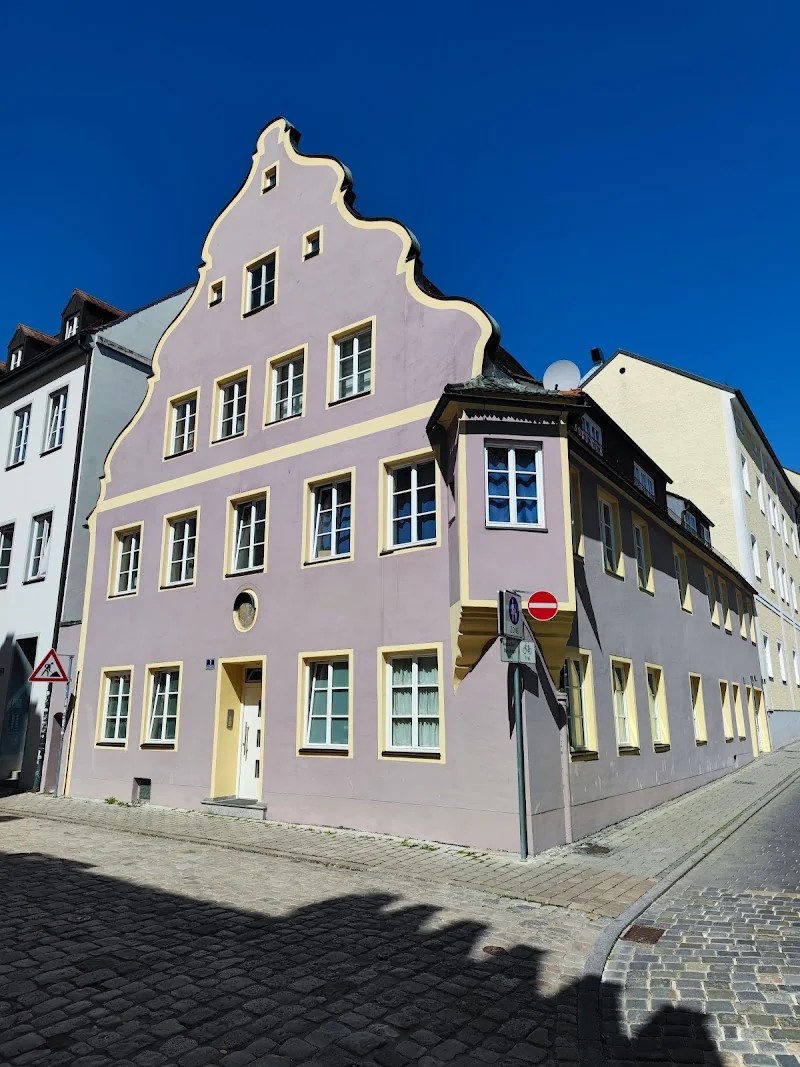
Goldknopfgasse 7, Ingolstadt-Altstadt Südwest
Goldknopfgasse 7, 85049 Ingolstadt, Germany
Hohe Schule Ingolstadt | History & Tours
The Hohe Schule in Ingolstadt is much more than a historical building in the old town. Today, anyone walking through Goldknopfgasse stands at a place where city history, science, monument preservation, and current university use meet in close proximity. The building is closely linked to the first Bavarian university, which was established here in 1472, and it continues to shape the ensemble around Georgianum, Hohe-Schul-Straße, and Goldknopfgasse to this day. For visitors, the Hohe Schule is therefore a place where the past can not only be told but also experienced spatially. At the same time, it is a vibrant part of the current campus of the Catholic University of Eichstätt-Ingolstadt, where research, teaching, and future projects are anchored. ([ku.de](https://www.ku.de/adventskalender))
The search queries surrounding the Hohe Schule clearly show what interested parties want to know: history, tours, directions, parking, opening hours, museum, Frankenstein, and the neighboring Georgianum. These topics are addressed in the following sections. The Hohe Schule is thus a typical example of a location where the actual use today has a university and event-related character, while the public appeal primarily arises from the historical depth, architecture, and cultural experience. Those looking for a fixed visiting program will find more special dates, tours, and event formats here than traditional museum opening hours. ([ku.de](https://www.ku.de/news/das-mids-zieht-in-die-hohe-schule))
History of the Hohe Schule in Ingolstadt
The history of the Hohe Schule does not begin with the university, but even earlier as a representatively planned benefice house. The city of Ingolstadt describes the building as having been constructed from 1434 at the instigation of Duke Ludwig the Bearded. Originally, 15 poor people were to live there, praying and singing for the salvation of the founder in the Liebfrauenmünster. After the duke's death, the foundation was not completed, but the place remained significant for urban development. Under Duke Ludwig the Rich, the house became the seat of the newly founded first Bavarian state university in 1472. Thus, a social foundation building transformed into a scientific center of supra-regional importance. ([ingolstadt.de](https://www.ingolstadt.de/stadtmuseum/scheuerer/ing/denkmal1.htm?utm_source=openai))
Until 1800, the Hohe Schule remained the university's focal point in Ingolstadt. After that, the institution first moved to Landshut and later to Munich, where it continues to exist today as Ludwig Maximilian University. For Ingolstadt, the Hohe Schule is therefore a key location in the history of science, commemorating 550 years of university development. In the historical representations of the city, names such as Celtis, Reuchlin, the two Apiane, Dr. Eck, and Canisius are associated with this place. They symbolically represent the intellectual stature of the house, which was not only a place of teaching and learning but also shaped debates on religion, humanism, and science for centuries. This historical depth makes the Hohe Schule so important for city tours, anniversary formats, and cultural-historical walks. ([ingolstadt.de](https://www.ingolstadt.de/stadtmuseum/scheuerer/ing/denkmal1.htm?utm_source=openai))
Architecture, Frescoes, and the Historical Roof Structure
Architecturally, the Hohe Schule is also one of the most striking buildings in Ingolstadt's old town. The city description highlights the impressive, multi-story building with a high gable roof; the high architectural demands are still clearly perceptible in the pilastered gables and frescoes. Additionally, there is a particularly valuable roof structure that, according to historical investigations, has remained intact to this day despite deformations. For monument conservators, this connection of late medieval substance, later revisions, and modern renovation is of particular interest. The city also points out that the rooms were renovated and modernized in the 1990s with special consideration for monument protection, followed by a more recent renovation of the roof structure. ([ingolstadt.de](https://www.ingolstadt.de/stadtmuseum/scheuerer/ing/denkmal1.htm?utm_source=openai))
Another central detail is the mural in the stairwell. The Catholic University describes a fresco from 1936 by Oskar Martin Amorbach titled The Entrance of Peter Canisius into the University of Ingolstadt. The image recalls the early scientific history of the house and connects architecture with a concrete historical narrative. This is important for visitors because the Hohe Schule does not only act as a shell but as a space where history is visibly staged. Especially in connection with the historical staircase, the powerful roof, and the design of the ensemble, the building conveys an impression of how strongly the university was once anchored in the cityscape. It is precisely this combination of architectural dignity and historical symbolism that makes the Hohe Schule a special destination for culture enthusiasts to this day. ([ku.de](https://www.ku.de/adventskalender))
Hohe Schule Today: KU, MIDS, and Future Campus
Today, the Hohe Schule is not only a monument but also a workplace and study location. The Catholic University of Eichstätt-Ingolstadt lists the building as a location on its site plan and names various institutions and chairs there. In the current KU pages, among other things, the professorship for civil law, civil procedure law, and insolvency law, as well as other units of the academic operation, are located at this site. Additionally, the faculty and campus communication shows that the Mathematical Institute for Machine Learning and Data Science, short MIDS, has moved into the historic rooms of the Hohe Schule. Thus, the location consciously connects tradition and future: a building with a university past now houses research and teaching structures that are clearly oriented towards modern questions. ([ku.de](https://www.ku.de/en/unileben/campus-und-umfeld/lageplan-ingolstadt/hohe-schule))
Especially exciting is that the KU places the Hohe Schule in the context of the Future Campus in Ingolstadt. A new university location is to be created around the historic buildings of the Hohe Schule and Georgianum, bringing together science, education, and urban development. The KU describes this area as a Future Campus in the middle of the old town, and the travel information clearly explains the spatial proximity of the buildings. This means for visitors: The Hohe Schule is not an isolated individual monument but part of a larger urban and scientific development concept. Thus, those visiting the site see not only a historic building but also the current transformation of an entire quarter. This is precisely why the Hohe Schule is so well suited for content about the university, city history, research, and cultural future locations. ([ku.de](https://www.ku.de/en/campus-life/campus?utm_source=openai))
Tours, Frankenstein Tour, and Events at the Hohe Schule
For many interested parties, the Hohe Schule becomes particularly tangible through tours. The official tour and event landscape in Ingolstadt repeatedly uses the location as a meeting point, starting point, or thematic backdrop. The Frankenstein Tour is particularly well-known, which, according to Ingolstadt erleben, begins in the courtyard of the Hohe Schule at the back of the building. Practical information about parking options and access via the old town is also available there. The choice of this location for the tour is no coincidence: the historical context enhances the theme of science, experiment, and Ingolstadt's city history in an atmospheric way. Additionally, the Schanzer Beer Tour starts at the corner of Hohe-Schul-Straße and Goldknopfgasse, right at the forecourt of the Hohe Schule. This shows that the location plays a real role in tourism and cultural mediation. ([ingolstadt-erleben.de](https://www.ingolstadt-erleben.de/frankenstein/treffpunkt/))
Beyond the classic tours, the Hohe Schule is also part of special dates and historical visits. On the Day of Open Monuments, the building and its rooms were already opened to the public, including the roof structure, Illuminati Hall, and the Aesculapius fresco. This shows that the location is not only viewed from the outside depending on the occasion but is also partially accessible from the inside. For today's use, it is also important that the KU and the institutions located there often schedule appointments by arrangement. Therefore, those looking for opening hours should understand the Hohe Schule less like a museum with a daily ticket office but as a historical university site that is experienced through events, tours, and appointment arrangements. This form of accessibility fits a building that is simultaneously a monument, university address, and event location. ([ingolstadt.de](https://www.ingolstadt.de/stadtmuseum/scheuerer/ing/denkmal1.htm?utm_source=openai))
Directions, Parking, and Location in the Old Town
The location of the Hohe Schule is one of its great advantages. It is located at Goldknopfgasse 7 in 85049 Ingolstadt, right in the historical center near the Georgianum. For events, the KU specifies a very concrete walking logic: From the parking lot Hallenbad on Jahnstraße, one can reach the Hohe Schule via the Taschenturmtor, Taschenturmstraße, and Goldknopfgasse. The train and bus connections are also well described. From the main train station, you can take bus lines 11 or 10 into the city, and line 44 stops directly at the Taschenturm. This makes the location easily accessible for both locals and visitors from outside. ([ku.de](https://www.ku.de/die-ku/fakultaeten/sts/aktuelles/termine/zukuenfte-entwerfen/anreise))
For parking, the underground garage Am Münster and the parking lot Hallenbad are particularly relevant. This is especially helpful because the Hohe Schule is located in a densely built-up area of the old town, where spontaneous parking searches often waste unnecessary time. Those wanting to facilitate orientation can follow the walking route from Hallenbad via the Taschenturmtor or adopt the route from the official directions when visiting events. The old town location has a cultural advantage: Surrounding the Hohe Schule are other historical stations, making a visit easily combinable with a walk through the center. The distance between arrival, culture, and city experience remains pleasantly short, making the location particularly attractive for tours and excursions. ([ingolstadt-erleben.de](https://www.ingolstadt-erleben.de/frankenstein/treffpunkt/))
Quartier Hohe Schule, Pedellhaus, and Other Attractions
The Hohe Schule does not stand alone but as part of a historical quarter. The city description for the Day of Open Monuments already makes clear that the Hohe Schule, Georgianum, Kamerariat, and Pedellhaus can be read together as an ensemble. This spatial density is extraordinary for Ingolstadt because here the history of science, church, and city overlap very closely. Therefore, when visiting the site, one is not only presented with a single building but a whole historical structure that refers to the time of the university and its ancillary buildings. This is precisely why the quarter is so valuable for city tours and historical walks. ([ingolstadt.de](https://www.ingolstadt.de/stadtmuseum/scheuerer/ing/denkmal1.htm?utm_source=openai))
A particularly tangible example is the Pedellhaus, which today houses the Heimatmuseum Niemes and Prachatitz. The city of Ingolstadt describes six restored rooms in the former Pedellhaus of the Hohe Schule and provides specific visitor information: Open on the first Sunday of the month from 1:00 PM to 4:00 PM and by telephone appointment, admission and guided tours are free. This makes the place interesting for cultural-historical double visits, as a tour through the Hohe-Schule quarter can be combined with a museum visit. Therefore, those wanting to understand the Hohe Schule not just as a photo opportunity but as part of a lively city and memory site will find in the Pedellhaus an ideal counterpart. Thus, the historical name Hohe Schule becomes a whole building block of the city that connects the past, present, and public mediation. ([ingolstadt.de](https://www.ingolstadt.de/Museum-Niemes-Prachatitz?utm_source=openai))
Sources:
- Catholic University of Eichstätt-Ingolstadt – Hohe Schule
- KU – The MIDS Moves to the Hohe Schule
- KU – Directions to the Future Campus Ingolstadt
- Ingolstadt erleben – Frankenstein Tour Meeting Point
- Ingolstadt erleben – Schanzer Beer Tour Dates
- City of Ingolstadt – Heimatmuseum Niemes and Prachatitz
- City of Ingolstadt – Day of Open Monuments 2002
Show moreShow less
Hohe Schule Ingolstadt | History & Tours
The Hohe Schule in Ingolstadt is much more than a historical building in the old town. Today, anyone walking through Goldknopfgasse stands at a place where city history, science, monument preservation, and current university use meet in close proximity. The building is closely linked to the first Bavarian university, which was established here in 1472, and it continues to shape the ensemble around Georgianum, Hohe-Schul-Straße, and Goldknopfgasse to this day. For visitors, the Hohe Schule is therefore a place where the past can not only be told but also experienced spatially. At the same time, it is a vibrant part of the current campus of the Catholic University of Eichstätt-Ingolstadt, where research, teaching, and future projects are anchored. ([ku.de](https://www.ku.de/adventskalender))
The search queries surrounding the Hohe Schule clearly show what interested parties want to know: history, tours, directions, parking, opening hours, museum, Frankenstein, and the neighboring Georgianum. These topics are addressed in the following sections. The Hohe Schule is thus a typical example of a location where the actual use today has a university and event-related character, while the public appeal primarily arises from the historical depth, architecture, and cultural experience. Those looking for a fixed visiting program will find more special dates, tours, and event formats here than traditional museum opening hours. ([ku.de](https://www.ku.de/news/das-mids-zieht-in-die-hohe-schule))
History of the Hohe Schule in Ingolstadt
The history of the Hohe Schule does not begin with the university, but even earlier as a representatively planned benefice house. The city of Ingolstadt describes the building as having been constructed from 1434 at the instigation of Duke Ludwig the Bearded. Originally, 15 poor people were to live there, praying and singing for the salvation of the founder in the Liebfrauenmünster. After the duke's death, the foundation was not completed, but the place remained significant for urban development. Under Duke Ludwig the Rich, the house became the seat of the newly founded first Bavarian state university in 1472. Thus, a social foundation building transformed into a scientific center of supra-regional importance. ([ingolstadt.de](https://www.ingolstadt.de/stadtmuseum/scheuerer/ing/denkmal1.htm?utm_source=openai))
Until 1800, the Hohe Schule remained the university's focal point in Ingolstadt. After that, the institution first moved to Landshut and later to Munich, where it continues to exist today as Ludwig Maximilian University. For Ingolstadt, the Hohe Schule is therefore a key location in the history of science, commemorating 550 years of university development. In the historical representations of the city, names such as Celtis, Reuchlin, the two Apiane, Dr. Eck, and Canisius are associated with this place. They symbolically represent the intellectual stature of the house, which was not only a place of teaching and learning but also shaped debates on religion, humanism, and science for centuries. This historical depth makes the Hohe Schule so important for city tours, anniversary formats, and cultural-historical walks. ([ingolstadt.de](https://www.ingolstadt.de/stadtmuseum/scheuerer/ing/denkmal1.htm?utm_source=openai))
Architecture, Frescoes, and the Historical Roof Structure
Architecturally, the Hohe Schule is also one of the most striking buildings in Ingolstadt's old town. The city description highlights the impressive, multi-story building with a high gable roof; the high architectural demands are still clearly perceptible in the pilastered gables and frescoes. Additionally, there is a particularly valuable roof structure that, according to historical investigations, has remained intact to this day despite deformations. For monument conservators, this connection of late medieval substance, later revisions, and modern renovation is of particular interest. The city also points out that the rooms were renovated and modernized in the 1990s with special consideration for monument protection, followed by a more recent renovation of the roof structure. ([ingolstadt.de](https://www.ingolstadt.de/stadtmuseum/scheuerer/ing/denkmal1.htm?utm_source=openai))
Another central detail is the mural in the stairwell. The Catholic University describes a fresco from 1936 by Oskar Martin Amorbach titled The Entrance of Peter Canisius into the University of Ingolstadt. The image recalls the early scientific history of the house and connects architecture with a concrete historical narrative. This is important for visitors because the Hohe Schule does not only act as a shell but as a space where history is visibly staged. Especially in connection with the historical staircase, the powerful roof, and the design of the ensemble, the building conveys an impression of how strongly the university was once anchored in the cityscape. It is precisely this combination of architectural dignity and historical symbolism that makes the Hohe Schule a special destination for culture enthusiasts to this day. ([ku.de](https://www.ku.de/adventskalender))
Hohe Schule Today: KU, MIDS, and Future Campus
Today, the Hohe Schule is not only a monument but also a workplace and study location. The Catholic University of Eichstätt-Ingolstadt lists the building as a location on its site plan and names various institutions and chairs there. In the current KU pages, among other things, the professorship for civil law, civil procedure law, and insolvency law, as well as other units of the academic operation, are located at this site. Additionally, the faculty and campus communication shows that the Mathematical Institute for Machine Learning and Data Science, short MIDS, has moved into the historic rooms of the Hohe Schule. Thus, the location consciously connects tradition and future: a building with a university past now houses research and teaching structures that are clearly oriented towards modern questions. ([ku.de](https://www.ku.de/en/unileben/campus-und-umfeld/lageplan-ingolstadt/hohe-schule))
Especially exciting is that the KU places the Hohe Schule in the context of the Future Campus in Ingolstadt. A new university location is to be created around the historic buildings of the Hohe Schule and Georgianum, bringing together science, education, and urban development. The KU describes this area as a Future Campus in the middle of the old town, and the travel information clearly explains the spatial proximity of the buildings. This means for visitors: The Hohe Schule is not an isolated individual monument but part of a larger urban and scientific development concept. Thus, those visiting the site see not only a historic building but also the current transformation of an entire quarter. This is precisely why the Hohe Schule is so well suited for content about the university, city history, research, and cultural future locations. ([ku.de](https://www.ku.de/en/campus-life/campus?utm_source=openai))
Tours, Frankenstein Tour, and Events at the Hohe Schule
For many interested parties, the Hohe Schule becomes particularly tangible through tours. The official tour and event landscape in Ingolstadt repeatedly uses the location as a meeting point, starting point, or thematic backdrop. The Frankenstein Tour is particularly well-known, which, according to Ingolstadt erleben, begins in the courtyard of the Hohe Schule at the back of the building. Practical information about parking options and access via the old town is also available there. The choice of this location for the tour is no coincidence: the historical context enhances the theme of science, experiment, and Ingolstadt's city history in an atmospheric way. Additionally, the Schanzer Beer Tour starts at the corner of Hohe-Schul-Straße and Goldknopfgasse, right at the forecourt of the Hohe Schule. This shows that the location plays a real role in tourism and cultural mediation. ([ingolstadt-erleben.de](https://www.ingolstadt-erleben.de/frankenstein/treffpunkt/))
Beyond the classic tours, the Hohe Schule is also part of special dates and historical visits. On the Day of Open Monuments, the building and its rooms were already opened to the public, including the roof structure, Illuminati Hall, and the Aesculapius fresco. This shows that the location is not only viewed from the outside depending on the occasion but is also partially accessible from the inside. For today's use, it is also important that the KU and the institutions located there often schedule appointments by arrangement. Therefore, those looking for opening hours should understand the Hohe Schule less like a museum with a daily ticket office but as a historical university site that is experienced through events, tours, and appointment arrangements. This form of accessibility fits a building that is simultaneously a monument, university address, and event location. ([ingolstadt.de](https://www.ingolstadt.de/stadtmuseum/scheuerer/ing/denkmal1.htm?utm_source=openai))
Directions, Parking, and Location in the Old Town
The location of the Hohe Schule is one of its great advantages. It is located at Goldknopfgasse 7 in 85049 Ingolstadt, right in the historical center near the Georgianum. For events, the KU specifies a very concrete walking logic: From the parking lot Hallenbad on Jahnstraße, one can reach the Hohe Schule via the Taschenturmtor, Taschenturmstraße, and Goldknopfgasse. The train and bus connections are also well described. From the main train station, you can take bus lines 11 or 10 into the city, and line 44 stops directly at the Taschenturm. This makes the location easily accessible for both locals and visitors from outside. ([ku.de](https://www.ku.de/die-ku/fakultaeten/sts/aktuelles/termine/zukuenfte-entwerfen/anreise))
For parking, the underground garage Am Münster and the parking lot Hallenbad are particularly relevant. This is especially helpful because the Hohe Schule is located in a densely built-up area of the old town, where spontaneous parking searches often waste unnecessary time. Those wanting to facilitate orientation can follow the walking route from Hallenbad via the Taschenturmtor or adopt the route from the official directions when visiting events. The old town location has a cultural advantage: Surrounding the Hohe Schule are other historical stations, making a visit easily combinable with a walk through the center. The distance between arrival, culture, and city experience remains pleasantly short, making the location particularly attractive for tours and excursions. ([ingolstadt-erleben.de](https://www.ingolstadt-erleben.de/frankenstein/treffpunkt/))
Quartier Hohe Schule, Pedellhaus, and Other Attractions
The Hohe Schule does not stand alone but as part of a historical quarter. The city description for the Day of Open Monuments already makes clear that the Hohe Schule, Georgianum, Kamerariat, and Pedellhaus can be read together as an ensemble. This spatial density is extraordinary for Ingolstadt because here the history of science, church, and city overlap very closely. Therefore, when visiting the site, one is not only presented with a single building but a whole historical structure that refers to the time of the university and its ancillary buildings. This is precisely why the quarter is so valuable for city tours and historical walks. ([ingolstadt.de](https://www.ingolstadt.de/stadtmuseum/scheuerer/ing/denkmal1.htm?utm_source=openai))
A particularly tangible example is the Pedellhaus, which today houses the Heimatmuseum Niemes and Prachatitz. The city of Ingolstadt describes six restored rooms in the former Pedellhaus of the Hohe Schule and provides specific visitor information: Open on the first Sunday of the month from 1:00 PM to 4:00 PM and by telephone appointment, admission and guided tours are free. This makes the place interesting for cultural-historical double visits, as a tour through the Hohe-Schule quarter can be combined with a museum visit. Therefore, those wanting to understand the Hohe Schule not just as a photo opportunity but as part of a lively city and memory site will find in the Pedellhaus an ideal counterpart. Thus, the historical name Hohe Schule becomes a whole building block of the city that connects the past, present, and public mediation. ([ingolstadt.de](https://www.ingolstadt.de/Museum-Niemes-Prachatitz?utm_source=openai))
Sources:
- Catholic University of Eichstätt-Ingolstadt – Hohe Schule
- KU – The MIDS Moves to the Hohe Schule
- KU – Directions to the Future Campus Ingolstadt
- Ingolstadt erleben – Frankenstein Tour Meeting Point
- Ingolstadt erleben – Schanzer Beer Tour Dates
- City of Ingolstadt – Heimatmuseum Niemes and Prachatitz
- City of Ingolstadt – Day of Open Monuments 2002
Hohe Schule Ingolstadt | History & Tours
The Hohe Schule in Ingolstadt is much more than a historical building in the old town. Today, anyone walking through Goldknopfgasse stands at a place where city history, science, monument preservation, and current university use meet in close proximity. The building is closely linked to the first Bavarian university, which was established here in 1472, and it continues to shape the ensemble around Georgianum, Hohe-Schul-Straße, and Goldknopfgasse to this day. For visitors, the Hohe Schule is therefore a place where the past can not only be told but also experienced spatially. At the same time, it is a vibrant part of the current campus of the Catholic University of Eichstätt-Ingolstadt, where research, teaching, and future projects are anchored. ([ku.de](https://www.ku.de/adventskalender))
The search queries surrounding the Hohe Schule clearly show what interested parties want to know: history, tours, directions, parking, opening hours, museum, Frankenstein, and the neighboring Georgianum. These topics are addressed in the following sections. The Hohe Schule is thus a typical example of a location where the actual use today has a university and event-related character, while the public appeal primarily arises from the historical depth, architecture, and cultural experience. Those looking for a fixed visiting program will find more special dates, tours, and event formats here than traditional museum opening hours. ([ku.de](https://www.ku.de/news/das-mids-zieht-in-die-hohe-schule))
History of the Hohe Schule in Ingolstadt
The history of the Hohe Schule does not begin with the university, but even earlier as a representatively planned benefice house. The city of Ingolstadt describes the building as having been constructed from 1434 at the instigation of Duke Ludwig the Bearded. Originally, 15 poor people were to live there, praying and singing for the salvation of the founder in the Liebfrauenmünster. After the duke's death, the foundation was not completed, but the place remained significant for urban development. Under Duke Ludwig the Rich, the house became the seat of the newly founded first Bavarian state university in 1472. Thus, a social foundation building transformed into a scientific center of supra-regional importance. ([ingolstadt.de](https://www.ingolstadt.de/stadtmuseum/scheuerer/ing/denkmal1.htm?utm_source=openai))
Until 1800, the Hohe Schule remained the university's focal point in Ingolstadt. After that, the institution first moved to Landshut and later to Munich, where it continues to exist today as Ludwig Maximilian University. For Ingolstadt, the Hohe Schule is therefore a key location in the history of science, commemorating 550 years of university development. In the historical representations of the city, names such as Celtis, Reuchlin, the two Apiane, Dr. Eck, and Canisius are associated with this place. They symbolically represent the intellectual stature of the house, which was not only a place of teaching and learning but also shaped debates on religion, humanism, and science for centuries. This historical depth makes the Hohe Schule so important for city tours, anniversary formats, and cultural-historical walks. ([ingolstadt.de](https://www.ingolstadt.de/stadtmuseum/scheuerer/ing/denkmal1.htm?utm_source=openai))
Architecture, Frescoes, and the Historical Roof Structure
Architecturally, the Hohe Schule is also one of the most striking buildings in Ingolstadt's old town. The city description highlights the impressive, multi-story building with a high gable roof; the high architectural demands are still clearly perceptible in the pilastered gables and frescoes. Additionally, there is a particularly valuable roof structure that, according to historical investigations, has remained intact to this day despite deformations. For monument conservators, this connection of late medieval substance, later revisions, and modern renovation is of particular interest. The city also points out that the rooms were renovated and modernized in the 1990s with special consideration for monument protection, followed by a more recent renovation of the roof structure. ([ingolstadt.de](https://www.ingolstadt.de/stadtmuseum/scheuerer/ing/denkmal1.htm?utm_source=openai))
Another central detail is the mural in the stairwell. The Catholic University describes a fresco from 1936 by Oskar Martin Amorbach titled The Entrance of Peter Canisius into the University of Ingolstadt. The image recalls the early scientific history of the house and connects architecture with a concrete historical narrative. This is important for visitors because the Hohe Schule does not only act as a shell but as a space where history is visibly staged. Especially in connection with the historical staircase, the powerful roof, and the design of the ensemble, the building conveys an impression of how strongly the university was once anchored in the cityscape. It is precisely this combination of architectural dignity and historical symbolism that makes the Hohe Schule a special destination for culture enthusiasts to this day. ([ku.de](https://www.ku.de/adventskalender))
Hohe Schule Today: KU, MIDS, and Future Campus
Today, the Hohe Schule is not only a monument but also a workplace and study location. The Catholic University of Eichstätt-Ingolstadt lists the building as a location on its site plan and names various institutions and chairs there. In the current KU pages, among other things, the professorship for civil law, civil procedure law, and insolvency law, as well as other units of the academic operation, are located at this site. Additionally, the faculty and campus communication shows that the Mathematical Institute for Machine Learning and Data Science, short MIDS, has moved into the historic rooms of the Hohe Schule. Thus, the location consciously connects tradition and future: a building with a university past now houses research and teaching structures that are clearly oriented towards modern questions. ([ku.de](https://www.ku.de/en/unileben/campus-und-umfeld/lageplan-ingolstadt/hohe-schule))
Especially exciting is that the KU places the Hohe Schule in the context of the Future Campus in Ingolstadt. A new university location is to be created around the historic buildings of the Hohe Schule and Georgianum, bringing together science, education, and urban development. The KU describes this area as a Future Campus in the middle of the old town, and the travel information clearly explains the spatial proximity of the buildings. This means for visitors: The Hohe Schule is not an isolated individual monument but part of a larger urban and scientific development concept. Thus, those visiting the site see not only a historic building but also the current transformation of an entire quarter. This is precisely why the Hohe Schule is so well suited for content about the university, city history, research, and cultural future locations. ([ku.de](https://www.ku.de/en/campus-life/campus?utm_source=openai))
Tours, Frankenstein Tour, and Events at the Hohe Schule
For many interested parties, the Hohe Schule becomes particularly tangible through tours. The official tour and event landscape in Ingolstadt repeatedly uses the location as a meeting point, starting point, or thematic backdrop. The Frankenstein Tour is particularly well-known, which, according to Ingolstadt erleben, begins in the courtyard of the Hohe Schule at the back of the building. Practical information about parking options and access via the old town is also available there. The choice of this location for the tour is no coincidence: the historical context enhances the theme of science, experiment, and Ingolstadt's city history in an atmospheric way. Additionally, the Schanzer Beer Tour starts at the corner of Hohe-Schul-Straße and Goldknopfgasse, right at the forecourt of the Hohe Schule. This shows that the location plays a real role in tourism and cultural mediation. ([ingolstadt-erleben.de](https://www.ingolstadt-erleben.de/frankenstein/treffpunkt/))
Beyond the classic tours, the Hohe Schule is also part of special dates and historical visits. On the Day of Open Monuments, the building and its rooms were already opened to the public, including the roof structure, Illuminati Hall, and the Aesculapius fresco. This shows that the location is not only viewed from the outside depending on the occasion but is also partially accessible from the inside. For today's use, it is also important that the KU and the institutions located there often schedule appointments by arrangement. Therefore, those looking for opening hours should understand the Hohe Schule less like a museum with a daily ticket office but as a historical university site that is experienced through events, tours, and appointment arrangements. This form of accessibility fits a building that is simultaneously a monument, university address, and event location. ([ingolstadt.de](https://www.ingolstadt.de/stadtmuseum/scheuerer/ing/denkmal1.htm?utm_source=openai))
Directions, Parking, and Location in the Old Town
The location of the Hohe Schule is one of its great advantages. It is located at Goldknopfgasse 7 in 85049 Ingolstadt, right in the historical center near the Georgianum. For events, the KU specifies a very concrete walking logic: From the parking lot Hallenbad on Jahnstraße, one can reach the Hohe Schule via the Taschenturmtor, Taschenturmstraße, and Goldknopfgasse. The train and bus connections are also well described. From the main train station, you can take bus lines 11 or 10 into the city, and line 44 stops directly at the Taschenturm. This makes the location easily accessible for both locals and visitors from outside. ([ku.de](https://www.ku.de/die-ku/fakultaeten/sts/aktuelles/termine/zukuenfte-entwerfen/anreise))
For parking, the underground garage Am Münster and the parking lot Hallenbad are particularly relevant. This is especially helpful because the Hohe Schule is located in a densely built-up area of the old town, where spontaneous parking searches often waste unnecessary time. Those wanting to facilitate orientation can follow the walking route from Hallenbad via the Taschenturmtor or adopt the route from the official directions when visiting events. The old town location has a cultural advantage: Surrounding the Hohe Schule are other historical stations, making a visit easily combinable with a walk through the center. The distance between arrival, culture, and city experience remains pleasantly short, making the location particularly attractive for tours and excursions. ([ingolstadt-erleben.de](https://www.ingolstadt-erleben.de/frankenstein/treffpunkt/))
Quartier Hohe Schule, Pedellhaus, and Other Attractions
The Hohe Schule does not stand alone but as part of a historical quarter. The city description for the Day of Open Monuments already makes clear that the Hohe Schule, Georgianum, Kamerariat, and Pedellhaus can be read together as an ensemble. This spatial density is extraordinary for Ingolstadt because here the history of science, church, and city overlap very closely. Therefore, when visiting the site, one is not only presented with a single building but a whole historical structure that refers to the time of the university and its ancillary buildings. This is precisely why the quarter is so valuable for city tours and historical walks. ([ingolstadt.de](https://www.ingolstadt.de/stadtmuseum/scheuerer/ing/denkmal1.htm?utm_source=openai))
A particularly tangible example is the Pedellhaus, which today houses the Heimatmuseum Niemes and Prachatitz. The city of Ingolstadt describes six restored rooms in the former Pedellhaus of the Hohe Schule and provides specific visitor information: Open on the first Sunday of the month from 1:00 PM to 4:00 PM and by telephone appointment, admission and guided tours are free. This makes the place interesting for cultural-historical double visits, as a tour through the Hohe-Schule quarter can be combined with a museum visit. Therefore, those wanting to understand the Hohe Schule not just as a photo opportunity but as part of a lively city and memory site will find in the Pedellhaus an ideal counterpart. Thus, the historical name Hohe Schule becomes a whole building block of the city that connects the past, present, and public mediation. ([ingolstadt.de](https://www.ingolstadt.de/Museum-Niemes-Prachatitz?utm_source=openai))
Sources:
- Catholic University of Eichstätt-Ingolstadt – Hohe Schule
- KU – The MIDS Moves to the Hohe Schule
- KU – Directions to the Future Campus Ingolstadt
- Ingolstadt erleben – Frankenstein Tour Meeting Point
- Ingolstadt erleben – Schanzer Beer Tour Dates
- City of Ingolstadt – Heimatmuseum Niemes and Prachatitz
- City of Ingolstadt – Day of Open Monuments 2002
Upcoming Events
No events found
Frequently Asked Questions
Reviews
Ilona Brunner
10. September 2023
The Frankenstein tour was amazing! I've been talking about it for 20 years, and now it's finally happened. The courtyard of the university is a bit creepy at night. The actors kept switching between different roles. And the information about Frankenstein and Ingolstadt was very interesting. The tour is a combination of scares and laughs. I deliberately didn't take any photos because everyone should definitely experience it for themselves. I absolutely loved the tour. I especially didn't know where the old cemetery in Ingolstadt was. A huge compliment to the actors... bravo!
Helmut P.
23. October 2022
The current exhibition – a lament for Bavaria's oldest university district – is not entirely successful. The holographic images used appear rather blurry; one apparently needs to be a certain height for the effect to be fully appreciated. Overall, the exhibition focuses more on urban planning than on education and university life.
Bernd Sandner
2. July 2022
The construction fence is particularly noteworthy. I have rarely seen such a great construction fence.
Was auch Immer
27. April 2021
It belongs to the FOS. There is no need to say more. 🤮
Werner Knöppler
1. July 2020
Sunshine, nice people, a beer garden at the university. What could be better?