
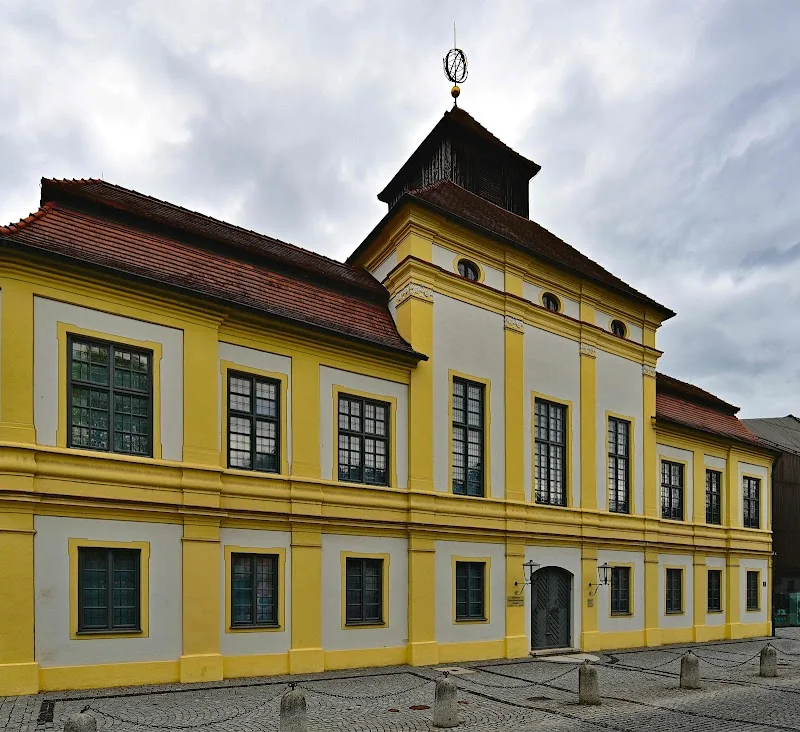
Ingolstadt
Anatomiestraße 18-20, 85049 Ingolstadt, Deutschland
German Museum of Medical History Ingolstadt | Tickets & Directions
The German Museum of Medical History Ingolstadt (DMMI) combines historical authenticity with a contemporary museum experience. In the baroque 'Old Anatomy' – the former anatomy building of the university – you look into the world of healing from the 18th century to the present. The permanent exhibition, opened in 2020, presents authentically staged rooms, extraordinary objects, and critically curated thematic spaces. The experience is complemented by the medical technology department, which provides an overview of 2,000 years of urinary stone therapy, a large medicinal plant garden with scent and touch garden, as well as the seasonally operated museum café. Thanks to the extension completed in 2016, you can access the exhibitions barrier-free, start the tour in the new foyer, and enjoy the view of the Ingolstadt Cathedral. Address: Anatomiestraße 18–20, 85049 Ingolstadt – located in the middle of the old town yet quiet by the historic garden. Whether individual visit, family outing, or group tour: here you will encounter well-founded knowledge, vivid communication, and a special atmosphere that makes the museum visit a sustainable experience.
Tickets, Opening Hours, and Booking: How to Plan Your Visit
For admission to the DMMI, a clearly structured, visitor-friendly system applies. The regular ticket price is 6 euros, reduced 4 euros. Discounts are available for students, trainees over 22 years, severely disabled persons (GdB 50–90), holders of the Bavarian Volunteer Card, federal volunteers, retirees, and unemployed persons as well as social assistance recipients. Free admission is granted to children and adolescents up to and including 18 years, as well as students and trainees up to and including 21 years. Also enjoying free access are individuals with a GdB of 100 or with certain disability markers (including registered companions), media representatives, donors, and lenders, as well as members of the support association, the German Museum Association (DMB), and ICOM. Generally, no ticket is required for the medicinal plant garden with museum shop – both can be visited freely.
Opening hours: The museum is usually open from Tuesday to Sunday between 10:00 and 17:00. There are fixed closing days, including January 1, November 1, December 24 and 25, and December 31. Additionally, the museum is closed on Shrove Tuesday and Good Friday. It is open on several public holidays, such as January 6 (Epiphany), May 1, August 15, October 3, as well as on Easter and Whit Monday, Ascension Day, and Corpus Christi. Since occasionally deviating opening hours are possible (e.g., internal events or team building), it is advisable to check the current notices on the museum's website before your visit.
You can conveniently book tickets online in the museum's shop or purchase them directly at the ticket counter. For groups, the DMMI offers themed tours for adults, families, and children – with prior registration via the booking form. Practical tip: If you only want to enjoy the garden, you can combine a city walk with a break in the green, explore the scent and touch garden, and then – depending on the season – stop by the café 'hortus medicus'. Photography is allowed without flash; however, the museum encourages a 'slow look', meaning to consciously observe individual objects instead of quickly clicking through countless images.
International Museum Day on May 18: Participation, Free Admission, and Program
The International Museum Day is declared annually by the International Council of Museums (ICOM) and is significantly coordinated in Germany by the German Museum Association. It traditionally takes place on May 18 and aims to make the diversity, relevance, and offerings of museums visible. Many museums across the country participate on this day with free admission, special tours, hands-on programs, or behind-the-scenes looks. For visitors, it is an excellent opportunity to discover new institutions or rediscover favorites – often without an admission fee.
Ingolstadt also offers a look into the event calendar around May 18. Whether the German Museum of Medical History participates in a specific year with free admission or special formats will be announced in advance on the museum's website under 'Current'. This may include thematic short tours, family offers, discussion rounds on medical history, or special stations in the garden – the exact program is determined by the museum itself and communicated in a timely manner. Therefore, if you want to specifically plan your visit for Museum Day, you should check the DMMI's notices shortly before the date and, if necessary, reserve free time tickets or guided tour spots.
Regardless of Museum Day, medical history can be experienced here all year round. The permanent exhibition of the Old Anatomy focuses on 18th-century medicine, complemented by critical perspectives on practices, objects, and knowledge orders. The DMMI places value on presenting historical concepts in an understandable yet scientifically sound manner – ideal for anyone wanting to delve deeper into the history of healing. Those who are curious can explore the museum's YouTube channel or browse the online shop. On the action day itself, comfortable shoes, some time buffer for tours, and – depending on the offer – early planning are recommended.
Directions & Parking: The Best Ways to Anatomiestraße 18–20
The location of the museum is easily accessible for both public transport users and drivers. From Ingolstadt Central Station, bus lines 10 and 11 run in a staggered 15-minute interval to Rathausplatz. From there, a short walk of about five minutes leads you via Sauerstraße, Kanalstraße, and Taschenturmstraße towards Taschenturm/Hallenbad; then turn right into Anatomiestraße, where the museum is located. If you prefer to walk, you can reach the museum in about 30 minutes from the station, straight along Münchener Straße into the city center and further to Rathausplatz – from there as described.
By car, the journey via the A9 motorway (exit Ingolstadt Süd) is recommended. There, follow the brown museum signage or the signs towards the city center/Hallenbad. There is a paid parking lot directly at the Hallenbad; from this parking lot, it is about a two-minute walk via Jahnstraße to the parallel-running Anatomiestraße. This short, well-signposted connection makes access comfortable even for families with strollers or visitors with mobility restrictions, especially since access to the museum is barrier-free through the new building.
From Munich Airport, the INVG Airport Express X109 is recommended, which connects directly to Ingolstadt. Depending on the time of day and day of the week, the frequency and stops may vary – checking the current timetable is advisable. The old town is well-connected for cyclists; bike racks are located on the surrounding streets. If you combine your museum visit with a city stroll, you can easily explore the paths between the Danube, Cathedral, and Old Anatomy on foot. Tip: Since the medicinal plant garden and the shop are freely accessible, a short stop in the green can be wonderfully integrated into your arrival or departure.
Exhibitions & Program: Permanent Exhibition, Annual Exhibition, and Tours
The tour begins today in the extension building (2016) and leads into the Old Anatomy. On the upper floor, you will encounter 18th-century medicine: teaching and learning practices, the role of anatomy in education, drug manufacturing, botany, and the self-positioning of medicine in the scholarly canon of that time. On the ground floor, '21 Strong Things' come into the spotlight – striking objects that tell the history of medicine pointedly and also raise critical questions about the past and present. The medical technology department, in a converted barn at the northern end of the garden, focuses on urinary stone therapy over two millennia through selected exhibits and makes progress as well as pains and risks of historical procedures tangible.
Temporary exhibitions set targeted accents. The annual exhibition 'Viewpoint. Human Preparations in the Museum' runs until January 11, 2026. It addresses the handling of preparations, their scientific, historical, and ethical dimensions, and opens up space for reflection for visitors. In addition, the DMMI regularly offers tours and programs – one example is the event 'Victor Frankenstein and Anatomy', a tour on Sunday, December 28, 2025, that connects literary motifs with historical anatomy. The current program with dates and booking options is continuously maintained online; for popular formats, early reservation is recommended.
For groups – whether universities, schools, or companies – themed tours can be specifically tailored to interests and prior knowledge. Families benefit from child-friendly access and the open garden area, which offers a short movement break between exhibition sections. If you want to know whether photography is allowed: Yes, but without flash. The museum encourages conscious seeing – so rather take a detailed look at one object and discover connections instead of taking many pictures while passing by. This approach fits the curatorial attitude of the museum, to tell connections understandably and to stimulate debates about the medicine of yesterday and today.
History of the Old Anatomy: From Theatrum Anatomicum to Modern Museum
The Old Anatomy was built between 1723 and 1736 for the Medical Faculty of the then University of Ingolstadt. The architect is considered to be the Hofbau director Gabriel de Gabrieli; under anatomy professor Johann Adam Morasch, the site between the High School and the city wall was acquired and built. At the center was a large lecture hall, the Theatrum Anatomicum, where dissection exercises and demonstrations took place – a typical component of medical education at that time. The baroque building with a mansard roof and a tower-like elevated central pavilion shaped the quarter; inside, a ceiling fresco still adorns the former anatomy hall today. This fresco, created around 1730 by the Ingolstadt painter Melchior Buchner and restored in 1970/72, visualizes the self-understanding of contemporary medicine in allegorical figures.
After the university moved to Landshut in 1800, the building experienced various uses – at times it even served as a farm – before it was opened in 1973 as the German Museum of Medical History after restoration. In 1992, the medicinal plant garden was newly designed as a living part of the museum on the occasion of the Bavarian State Garden Show. In 2008, the medical technology department was added in a converted barn at the northern end of the garden. A significant milestone is marked by the extension building by Staab Architekten (completion 2016): The new building reorganizes the foyer, special exhibition spaces, seminar room, depot, and administration, ensures barrier-free access, and cleverly integrates the garden. Today, visitors enter the museum through the new building and transition from there to the old building; a wide window opens up an impressive view axis towards the Ingolstadt Cathedral.
The comprehensive renovation of the Old Anatomy culminated in the reopening of the permanent exhibition in 2020. It reflects Ingolstadt's special role as a medical center of the 18th century and creates space to view healing arts in a societal context. That the building is still considered the 'most beautiful exhibit' is more than a cliché: architecture, garden, and collection noticeably intertwine. Upon entering the former anatomy hall, one perceives the aura of a place that makes the history of science immediately tangible – an ideal stage to vividly convey historical objects, questions, and debates.
Medicinal Plant Garden & Café 'hortus medicus': Learn, Relax, Enjoy
The 'Hortus medicus' was already part of the original planning of the anatomy building in the 18th century to teach botanical knowledge and pharmacology. Today, the medicinal plant garden forms a centerpiece of the museum – freely accessible and consciously designed as a learning and relaxation space. The current layout dates back to the redesign for the Bavarian State Garden Show in 1992. The planting concept groups medicinal plants by active ingredient groups (including essential oils, alkaloids, saponins, mucilages, oils, bitter substances, tannins, glycosides) and arranges them by families; a special section shows species with different ingredients that are often used in folk medicine and homeopathy. The municipal gardening office is responsible for maintenance.
Particular attention should be paid to the scent and touch garden: Raised beds, tactile signage with Braille, and a selection of characteristic plants – from rosemary and mint to eucalyptus and horsetail to marshmallow or thorn apple – enable an immediate, inclusive plant experience, especially for people with visual or mobility impairments. Throughout the year, changes in the plant world can be tracked; the museum offers digital insights with monthly garden videos from a pharmacist explaining typical medicinal plants and their characteristics. The garden is ideal for lightening up the museum visit, discovering with children, or simply taking a break in the green.
Directly at the garden is the museum café 'hortus medicus'. It operates seasonally: In November, the café is open daily except Mondays from 1 to 5 PM; it remains closed in the winter months. In mild weather, the café expands its operation in summer under the arcades and into the garden – a charming setting to let impressions from the exhibitions resonate. For reservations, the café team provides a contact option. Those who do not plan a museum visit can use the garden and shop independently of the ticket and aim for the café – depending on the season – as a destination for a city stroll.
Sources:
- German Museum of Medical History Ingolstadt – Official Website
- DMMI – Important Information for Your Visit (Opening Hours, Admission, Accessibility)
- DMMI – Directions, Public Transport, Parking at Hallenbad
- DMMI – Museum History, Permanent Exhibition, Extension Building
- DMMI – Café 'hortus medicus' (Season, Contact)
- Old Anatomy Ingolstadt – Construction History and Architect (Wikipedia)
- Staab Architekten – Extension DMMI (Completion 2016)
- German Museum Association – International Museum Day (Info & May 18)
Show moreShow less
German Museum of Medical History Ingolstadt | Tickets & Directions
The German Museum of Medical History Ingolstadt (DMMI) combines historical authenticity with a contemporary museum experience. In the baroque 'Old Anatomy' – the former anatomy building of the university – you look into the world of healing from the 18th century to the present. The permanent exhibition, opened in 2020, presents authentically staged rooms, extraordinary objects, and critically curated thematic spaces. The experience is complemented by the medical technology department, which provides an overview of 2,000 years of urinary stone therapy, a large medicinal plant garden with scent and touch garden, as well as the seasonally operated museum café. Thanks to the extension completed in 2016, you can access the exhibitions barrier-free, start the tour in the new foyer, and enjoy the view of the Ingolstadt Cathedral. Address: Anatomiestraße 18–20, 85049 Ingolstadt – located in the middle of the old town yet quiet by the historic garden. Whether individual visit, family outing, or group tour: here you will encounter well-founded knowledge, vivid communication, and a special atmosphere that makes the museum visit a sustainable experience.
Tickets, Opening Hours, and Booking: How to Plan Your Visit
For admission to the DMMI, a clearly structured, visitor-friendly system applies. The regular ticket price is 6 euros, reduced 4 euros. Discounts are available for students, trainees over 22 years, severely disabled persons (GdB 50–90), holders of the Bavarian Volunteer Card, federal volunteers, retirees, and unemployed persons as well as social assistance recipients. Free admission is granted to children and adolescents up to and including 18 years, as well as students and trainees up to and including 21 years. Also enjoying free access are individuals with a GdB of 100 or with certain disability markers (including registered companions), media representatives, donors, and lenders, as well as members of the support association, the German Museum Association (DMB), and ICOM. Generally, no ticket is required for the medicinal plant garden with museum shop – both can be visited freely.
Opening hours: The museum is usually open from Tuesday to Sunday between 10:00 and 17:00. There are fixed closing days, including January 1, November 1, December 24 and 25, and December 31. Additionally, the museum is closed on Shrove Tuesday and Good Friday. It is open on several public holidays, such as January 6 (Epiphany), May 1, August 15, October 3, as well as on Easter and Whit Monday, Ascension Day, and Corpus Christi. Since occasionally deviating opening hours are possible (e.g., internal events or team building), it is advisable to check the current notices on the museum's website before your visit.
You can conveniently book tickets online in the museum's shop or purchase them directly at the ticket counter. For groups, the DMMI offers themed tours for adults, families, and children – with prior registration via the booking form. Practical tip: If you only want to enjoy the garden, you can combine a city walk with a break in the green, explore the scent and touch garden, and then – depending on the season – stop by the café 'hortus medicus'. Photography is allowed without flash; however, the museum encourages a 'slow look', meaning to consciously observe individual objects instead of quickly clicking through countless images.
International Museum Day on May 18: Participation, Free Admission, and Program
The International Museum Day is declared annually by the International Council of Museums (ICOM) and is significantly coordinated in Germany by the German Museum Association. It traditionally takes place on May 18 and aims to make the diversity, relevance, and offerings of museums visible. Many museums across the country participate on this day with free admission, special tours, hands-on programs, or behind-the-scenes looks. For visitors, it is an excellent opportunity to discover new institutions or rediscover favorites – often without an admission fee.
Ingolstadt also offers a look into the event calendar around May 18. Whether the German Museum of Medical History participates in a specific year with free admission or special formats will be announced in advance on the museum's website under 'Current'. This may include thematic short tours, family offers, discussion rounds on medical history, or special stations in the garden – the exact program is determined by the museum itself and communicated in a timely manner. Therefore, if you want to specifically plan your visit for Museum Day, you should check the DMMI's notices shortly before the date and, if necessary, reserve free time tickets or guided tour spots.
Regardless of Museum Day, medical history can be experienced here all year round. The permanent exhibition of the Old Anatomy focuses on 18th-century medicine, complemented by critical perspectives on practices, objects, and knowledge orders. The DMMI places value on presenting historical concepts in an understandable yet scientifically sound manner – ideal for anyone wanting to delve deeper into the history of healing. Those who are curious can explore the museum's YouTube channel or browse the online shop. On the action day itself, comfortable shoes, some time buffer for tours, and – depending on the offer – early planning are recommended.
Directions & Parking: The Best Ways to Anatomiestraße 18–20
The location of the museum is easily accessible for both public transport users and drivers. From Ingolstadt Central Station, bus lines 10 and 11 run in a staggered 15-minute interval to Rathausplatz. From there, a short walk of about five minutes leads you via Sauerstraße, Kanalstraße, and Taschenturmstraße towards Taschenturm/Hallenbad; then turn right into Anatomiestraße, where the museum is located. If you prefer to walk, you can reach the museum in about 30 minutes from the station, straight along Münchener Straße into the city center and further to Rathausplatz – from there as described.
By car, the journey via the A9 motorway (exit Ingolstadt Süd) is recommended. There, follow the brown museum signage or the signs towards the city center/Hallenbad. There is a paid parking lot directly at the Hallenbad; from this parking lot, it is about a two-minute walk via Jahnstraße to the parallel-running Anatomiestraße. This short, well-signposted connection makes access comfortable even for families with strollers or visitors with mobility restrictions, especially since access to the museum is barrier-free through the new building.
From Munich Airport, the INVG Airport Express X109 is recommended, which connects directly to Ingolstadt. Depending on the time of day and day of the week, the frequency and stops may vary – checking the current timetable is advisable. The old town is well-connected for cyclists; bike racks are located on the surrounding streets. If you combine your museum visit with a city stroll, you can easily explore the paths between the Danube, Cathedral, and Old Anatomy on foot. Tip: Since the medicinal plant garden and the shop are freely accessible, a short stop in the green can be wonderfully integrated into your arrival or departure.
Exhibitions & Program: Permanent Exhibition, Annual Exhibition, and Tours
The tour begins today in the extension building (2016) and leads into the Old Anatomy. On the upper floor, you will encounter 18th-century medicine: teaching and learning practices, the role of anatomy in education, drug manufacturing, botany, and the self-positioning of medicine in the scholarly canon of that time. On the ground floor, '21 Strong Things' come into the spotlight – striking objects that tell the history of medicine pointedly and also raise critical questions about the past and present. The medical technology department, in a converted barn at the northern end of the garden, focuses on urinary stone therapy over two millennia through selected exhibits and makes progress as well as pains and risks of historical procedures tangible.
Temporary exhibitions set targeted accents. The annual exhibition 'Viewpoint. Human Preparations in the Museum' runs until January 11, 2026. It addresses the handling of preparations, their scientific, historical, and ethical dimensions, and opens up space for reflection for visitors. In addition, the DMMI regularly offers tours and programs – one example is the event 'Victor Frankenstein and Anatomy', a tour on Sunday, December 28, 2025, that connects literary motifs with historical anatomy. The current program with dates and booking options is continuously maintained online; for popular formats, early reservation is recommended.
For groups – whether universities, schools, or companies – themed tours can be specifically tailored to interests and prior knowledge. Families benefit from child-friendly access and the open garden area, which offers a short movement break between exhibition sections. If you want to know whether photography is allowed: Yes, but without flash. The museum encourages conscious seeing – so rather take a detailed look at one object and discover connections instead of taking many pictures while passing by. This approach fits the curatorial attitude of the museum, to tell connections understandably and to stimulate debates about the medicine of yesterday and today.
History of the Old Anatomy: From Theatrum Anatomicum to Modern Museum
The Old Anatomy was built between 1723 and 1736 for the Medical Faculty of the then University of Ingolstadt. The architect is considered to be the Hofbau director Gabriel de Gabrieli; under anatomy professor Johann Adam Morasch, the site between the High School and the city wall was acquired and built. At the center was a large lecture hall, the Theatrum Anatomicum, where dissection exercises and demonstrations took place – a typical component of medical education at that time. The baroque building with a mansard roof and a tower-like elevated central pavilion shaped the quarter; inside, a ceiling fresco still adorns the former anatomy hall today. This fresco, created around 1730 by the Ingolstadt painter Melchior Buchner and restored in 1970/72, visualizes the self-understanding of contemporary medicine in allegorical figures.
After the university moved to Landshut in 1800, the building experienced various uses – at times it even served as a farm – before it was opened in 1973 as the German Museum of Medical History after restoration. In 1992, the medicinal plant garden was newly designed as a living part of the museum on the occasion of the Bavarian State Garden Show. In 2008, the medical technology department was added in a converted barn at the northern end of the garden. A significant milestone is marked by the extension building by Staab Architekten (completion 2016): The new building reorganizes the foyer, special exhibition spaces, seminar room, depot, and administration, ensures barrier-free access, and cleverly integrates the garden. Today, visitors enter the museum through the new building and transition from there to the old building; a wide window opens up an impressive view axis towards the Ingolstadt Cathedral.
The comprehensive renovation of the Old Anatomy culminated in the reopening of the permanent exhibition in 2020. It reflects Ingolstadt's special role as a medical center of the 18th century and creates space to view healing arts in a societal context. That the building is still considered the 'most beautiful exhibit' is more than a cliché: architecture, garden, and collection noticeably intertwine. Upon entering the former anatomy hall, one perceives the aura of a place that makes the history of science immediately tangible – an ideal stage to vividly convey historical objects, questions, and debates.
Medicinal Plant Garden & Café 'hortus medicus': Learn, Relax, Enjoy
The 'Hortus medicus' was already part of the original planning of the anatomy building in the 18th century to teach botanical knowledge and pharmacology. Today, the medicinal plant garden forms a centerpiece of the museum – freely accessible and consciously designed as a learning and relaxation space. The current layout dates back to the redesign for the Bavarian State Garden Show in 1992. The planting concept groups medicinal plants by active ingredient groups (including essential oils, alkaloids, saponins, mucilages, oils, bitter substances, tannins, glycosides) and arranges them by families; a special section shows species with different ingredients that are often used in folk medicine and homeopathy. The municipal gardening office is responsible for maintenance.
Particular attention should be paid to the scent and touch garden: Raised beds, tactile signage with Braille, and a selection of characteristic plants – from rosemary and mint to eucalyptus and horsetail to marshmallow or thorn apple – enable an immediate, inclusive plant experience, especially for people with visual or mobility impairments. Throughout the year, changes in the plant world can be tracked; the museum offers digital insights with monthly garden videos from a pharmacist explaining typical medicinal plants and their characteristics. The garden is ideal for lightening up the museum visit, discovering with children, or simply taking a break in the green.
Directly at the garden is the museum café 'hortus medicus'. It operates seasonally: In November, the café is open daily except Mondays from 1 to 5 PM; it remains closed in the winter months. In mild weather, the café expands its operation in summer under the arcades and into the garden – a charming setting to let impressions from the exhibitions resonate. For reservations, the café team provides a contact option. Those who do not plan a museum visit can use the garden and shop independently of the ticket and aim for the café – depending on the season – as a destination for a city stroll.
Sources:
- German Museum of Medical History Ingolstadt – Official Website
- DMMI – Important Information for Your Visit (Opening Hours, Admission, Accessibility)
- DMMI – Directions, Public Transport, Parking at Hallenbad
- DMMI – Museum History, Permanent Exhibition, Extension Building
- DMMI – Café 'hortus medicus' (Season, Contact)
- Old Anatomy Ingolstadt – Construction History and Architect (Wikipedia)
- Staab Architekten – Extension DMMI (Completion 2016)
- German Museum Association – International Museum Day (Info & May 18)
German Museum of Medical History Ingolstadt | Tickets & Directions
The German Museum of Medical History Ingolstadt (DMMI) combines historical authenticity with a contemporary museum experience. In the baroque 'Old Anatomy' – the former anatomy building of the university – you look into the world of healing from the 18th century to the present. The permanent exhibition, opened in 2020, presents authentically staged rooms, extraordinary objects, and critically curated thematic spaces. The experience is complemented by the medical technology department, which provides an overview of 2,000 years of urinary stone therapy, a large medicinal plant garden with scent and touch garden, as well as the seasonally operated museum café. Thanks to the extension completed in 2016, you can access the exhibitions barrier-free, start the tour in the new foyer, and enjoy the view of the Ingolstadt Cathedral. Address: Anatomiestraße 18–20, 85049 Ingolstadt – located in the middle of the old town yet quiet by the historic garden. Whether individual visit, family outing, or group tour: here you will encounter well-founded knowledge, vivid communication, and a special atmosphere that makes the museum visit a sustainable experience.
Tickets, Opening Hours, and Booking: How to Plan Your Visit
For admission to the DMMI, a clearly structured, visitor-friendly system applies. The regular ticket price is 6 euros, reduced 4 euros. Discounts are available for students, trainees over 22 years, severely disabled persons (GdB 50–90), holders of the Bavarian Volunteer Card, federal volunteers, retirees, and unemployed persons as well as social assistance recipients. Free admission is granted to children and adolescents up to and including 18 years, as well as students and trainees up to and including 21 years. Also enjoying free access are individuals with a GdB of 100 or with certain disability markers (including registered companions), media representatives, donors, and lenders, as well as members of the support association, the German Museum Association (DMB), and ICOM. Generally, no ticket is required for the medicinal plant garden with museum shop – both can be visited freely.
Opening hours: The museum is usually open from Tuesday to Sunday between 10:00 and 17:00. There are fixed closing days, including January 1, November 1, December 24 and 25, and December 31. Additionally, the museum is closed on Shrove Tuesday and Good Friday. It is open on several public holidays, such as January 6 (Epiphany), May 1, August 15, October 3, as well as on Easter and Whit Monday, Ascension Day, and Corpus Christi. Since occasionally deviating opening hours are possible (e.g., internal events or team building), it is advisable to check the current notices on the museum's website before your visit.
You can conveniently book tickets online in the museum's shop or purchase them directly at the ticket counter. For groups, the DMMI offers themed tours for adults, families, and children – with prior registration via the booking form. Practical tip: If you only want to enjoy the garden, you can combine a city walk with a break in the green, explore the scent and touch garden, and then – depending on the season – stop by the café 'hortus medicus'. Photography is allowed without flash; however, the museum encourages a 'slow look', meaning to consciously observe individual objects instead of quickly clicking through countless images.
International Museum Day on May 18: Participation, Free Admission, and Program
The International Museum Day is declared annually by the International Council of Museums (ICOM) and is significantly coordinated in Germany by the German Museum Association. It traditionally takes place on May 18 and aims to make the diversity, relevance, and offerings of museums visible. Many museums across the country participate on this day with free admission, special tours, hands-on programs, or behind-the-scenes looks. For visitors, it is an excellent opportunity to discover new institutions or rediscover favorites – often without an admission fee.
Ingolstadt also offers a look into the event calendar around May 18. Whether the German Museum of Medical History participates in a specific year with free admission or special formats will be announced in advance on the museum's website under 'Current'. This may include thematic short tours, family offers, discussion rounds on medical history, or special stations in the garden – the exact program is determined by the museum itself and communicated in a timely manner. Therefore, if you want to specifically plan your visit for Museum Day, you should check the DMMI's notices shortly before the date and, if necessary, reserve free time tickets or guided tour spots.
Regardless of Museum Day, medical history can be experienced here all year round. The permanent exhibition of the Old Anatomy focuses on 18th-century medicine, complemented by critical perspectives on practices, objects, and knowledge orders. The DMMI places value on presenting historical concepts in an understandable yet scientifically sound manner – ideal for anyone wanting to delve deeper into the history of healing. Those who are curious can explore the museum's YouTube channel or browse the online shop. On the action day itself, comfortable shoes, some time buffer for tours, and – depending on the offer – early planning are recommended.
Directions & Parking: The Best Ways to Anatomiestraße 18–20
The location of the museum is easily accessible for both public transport users and drivers. From Ingolstadt Central Station, bus lines 10 and 11 run in a staggered 15-minute interval to Rathausplatz. From there, a short walk of about five minutes leads you via Sauerstraße, Kanalstraße, and Taschenturmstraße towards Taschenturm/Hallenbad; then turn right into Anatomiestraße, where the museum is located. If you prefer to walk, you can reach the museum in about 30 minutes from the station, straight along Münchener Straße into the city center and further to Rathausplatz – from there as described.
By car, the journey via the A9 motorway (exit Ingolstadt Süd) is recommended. There, follow the brown museum signage or the signs towards the city center/Hallenbad. There is a paid parking lot directly at the Hallenbad; from this parking lot, it is about a two-minute walk via Jahnstraße to the parallel-running Anatomiestraße. This short, well-signposted connection makes access comfortable even for families with strollers or visitors with mobility restrictions, especially since access to the museum is barrier-free through the new building.
From Munich Airport, the INVG Airport Express X109 is recommended, which connects directly to Ingolstadt. Depending on the time of day and day of the week, the frequency and stops may vary – checking the current timetable is advisable. The old town is well-connected for cyclists; bike racks are located on the surrounding streets. If you combine your museum visit with a city stroll, you can easily explore the paths between the Danube, Cathedral, and Old Anatomy on foot. Tip: Since the medicinal plant garden and the shop are freely accessible, a short stop in the green can be wonderfully integrated into your arrival or departure.
Exhibitions & Program: Permanent Exhibition, Annual Exhibition, and Tours
The tour begins today in the extension building (2016) and leads into the Old Anatomy. On the upper floor, you will encounter 18th-century medicine: teaching and learning practices, the role of anatomy in education, drug manufacturing, botany, and the self-positioning of medicine in the scholarly canon of that time. On the ground floor, '21 Strong Things' come into the spotlight – striking objects that tell the history of medicine pointedly and also raise critical questions about the past and present. The medical technology department, in a converted barn at the northern end of the garden, focuses on urinary stone therapy over two millennia through selected exhibits and makes progress as well as pains and risks of historical procedures tangible.
Temporary exhibitions set targeted accents. The annual exhibition 'Viewpoint. Human Preparations in the Museum' runs until January 11, 2026. It addresses the handling of preparations, their scientific, historical, and ethical dimensions, and opens up space for reflection for visitors. In addition, the DMMI regularly offers tours and programs – one example is the event 'Victor Frankenstein and Anatomy', a tour on Sunday, December 28, 2025, that connects literary motifs with historical anatomy. The current program with dates and booking options is continuously maintained online; for popular formats, early reservation is recommended.
For groups – whether universities, schools, or companies – themed tours can be specifically tailored to interests and prior knowledge. Families benefit from child-friendly access and the open garden area, which offers a short movement break between exhibition sections. If you want to know whether photography is allowed: Yes, but without flash. The museum encourages conscious seeing – so rather take a detailed look at one object and discover connections instead of taking many pictures while passing by. This approach fits the curatorial attitude of the museum, to tell connections understandably and to stimulate debates about the medicine of yesterday and today.
History of the Old Anatomy: From Theatrum Anatomicum to Modern Museum
The Old Anatomy was built between 1723 and 1736 for the Medical Faculty of the then University of Ingolstadt. The architect is considered to be the Hofbau director Gabriel de Gabrieli; under anatomy professor Johann Adam Morasch, the site between the High School and the city wall was acquired and built. At the center was a large lecture hall, the Theatrum Anatomicum, where dissection exercises and demonstrations took place – a typical component of medical education at that time. The baroque building with a mansard roof and a tower-like elevated central pavilion shaped the quarter; inside, a ceiling fresco still adorns the former anatomy hall today. This fresco, created around 1730 by the Ingolstadt painter Melchior Buchner and restored in 1970/72, visualizes the self-understanding of contemporary medicine in allegorical figures.
After the university moved to Landshut in 1800, the building experienced various uses – at times it even served as a farm – before it was opened in 1973 as the German Museum of Medical History after restoration. In 1992, the medicinal plant garden was newly designed as a living part of the museum on the occasion of the Bavarian State Garden Show. In 2008, the medical technology department was added in a converted barn at the northern end of the garden. A significant milestone is marked by the extension building by Staab Architekten (completion 2016): The new building reorganizes the foyer, special exhibition spaces, seminar room, depot, and administration, ensures barrier-free access, and cleverly integrates the garden. Today, visitors enter the museum through the new building and transition from there to the old building; a wide window opens up an impressive view axis towards the Ingolstadt Cathedral.
The comprehensive renovation of the Old Anatomy culminated in the reopening of the permanent exhibition in 2020. It reflects Ingolstadt's special role as a medical center of the 18th century and creates space to view healing arts in a societal context. That the building is still considered the 'most beautiful exhibit' is more than a cliché: architecture, garden, and collection noticeably intertwine. Upon entering the former anatomy hall, one perceives the aura of a place that makes the history of science immediately tangible – an ideal stage to vividly convey historical objects, questions, and debates.
Medicinal Plant Garden & Café 'hortus medicus': Learn, Relax, Enjoy
The 'Hortus medicus' was already part of the original planning of the anatomy building in the 18th century to teach botanical knowledge and pharmacology. Today, the medicinal plant garden forms a centerpiece of the museum – freely accessible and consciously designed as a learning and relaxation space. The current layout dates back to the redesign for the Bavarian State Garden Show in 1992. The planting concept groups medicinal plants by active ingredient groups (including essential oils, alkaloids, saponins, mucilages, oils, bitter substances, tannins, glycosides) and arranges them by families; a special section shows species with different ingredients that are often used in folk medicine and homeopathy. The municipal gardening office is responsible for maintenance.
Particular attention should be paid to the scent and touch garden: Raised beds, tactile signage with Braille, and a selection of characteristic plants – from rosemary and mint to eucalyptus and horsetail to marshmallow or thorn apple – enable an immediate, inclusive plant experience, especially for people with visual or mobility impairments. Throughout the year, changes in the plant world can be tracked; the museum offers digital insights with monthly garden videos from a pharmacist explaining typical medicinal plants and their characteristics. The garden is ideal for lightening up the museum visit, discovering with children, or simply taking a break in the green.
Directly at the garden is the museum café 'hortus medicus'. It operates seasonally: In November, the café is open daily except Mondays from 1 to 5 PM; it remains closed in the winter months. In mild weather, the café expands its operation in summer under the arcades and into the garden – a charming setting to let impressions from the exhibitions resonate. For reservations, the café team provides a contact option. Those who do not plan a museum visit can use the garden and shop independently of the ticket and aim for the café – depending on the season – as a destination for a city stroll.
Sources:
- German Museum of Medical History Ingolstadt – Official Website
- DMMI – Important Information for Your Visit (Opening Hours, Admission, Accessibility)
- DMMI – Directions, Public Transport, Parking at Hallenbad
- DMMI – Museum History, Permanent Exhibition, Extension Building
- DMMI – Café 'hortus medicus' (Season, Contact)
- Old Anatomy Ingolstadt – Construction History and Architect (Wikipedia)
- Staab Architekten – Extension DMMI (Completion 2016)
- German Museum Association – International Museum Day (Info & May 18)
Upcoming Events
No events found
Frequently Asked Questions
Reviews
Lea Lia -
12. December 2025
Absolutely amazing museum! Really fantastic. Price is totally reasonable, very nice and friendly staff at the reception. 🌸 Also a very beautiful "castle garden". There are plenty of parking spaces available across the street in the large parking lot.
Sophie
7. October 2025
Very exciting! The woman at the cash register on Saturday around 3 PM was very sweet and super friendly! We were there as a couple. The prices are very reasonable and there’s free rental of audio devices.
Stefan Nekola
27. May 2025
Super interesting museum. If you want to read everything and listen to every audio guide, you should bring enough time (we spent about 4 hours there). The museum was only sparsely visited, so you could linger in peace. The exhibits and surrounding details were beautifully and clearly presented. The temporary exhibition was also super interesting with comments from Ingolstadt doctors and professors. The integrated café in the garden is also worth a visit.
Frank H.
24. July 2025
Impressive. If you read everything and use the audio guide, you should plan at least 3 hours, but very few will do that. The café and the herb garden are also very nice.
R W
7. September 2025
I had the idea to take another round through the Medical History Museum in Ingolstadt with my daughter after reading a small media report about the special exhibition "Point of View" that morning. Coincidentally, we were also able to book a 90-minute tour of the permanent exhibition and were very excited about so much fascinating information and explanations about the exhibits. After that, we visited the special exhibition and found impressive specimens and some exciting medical explanations. Our visit ended completely satisfied in the museum's café. We will gladly come back!