
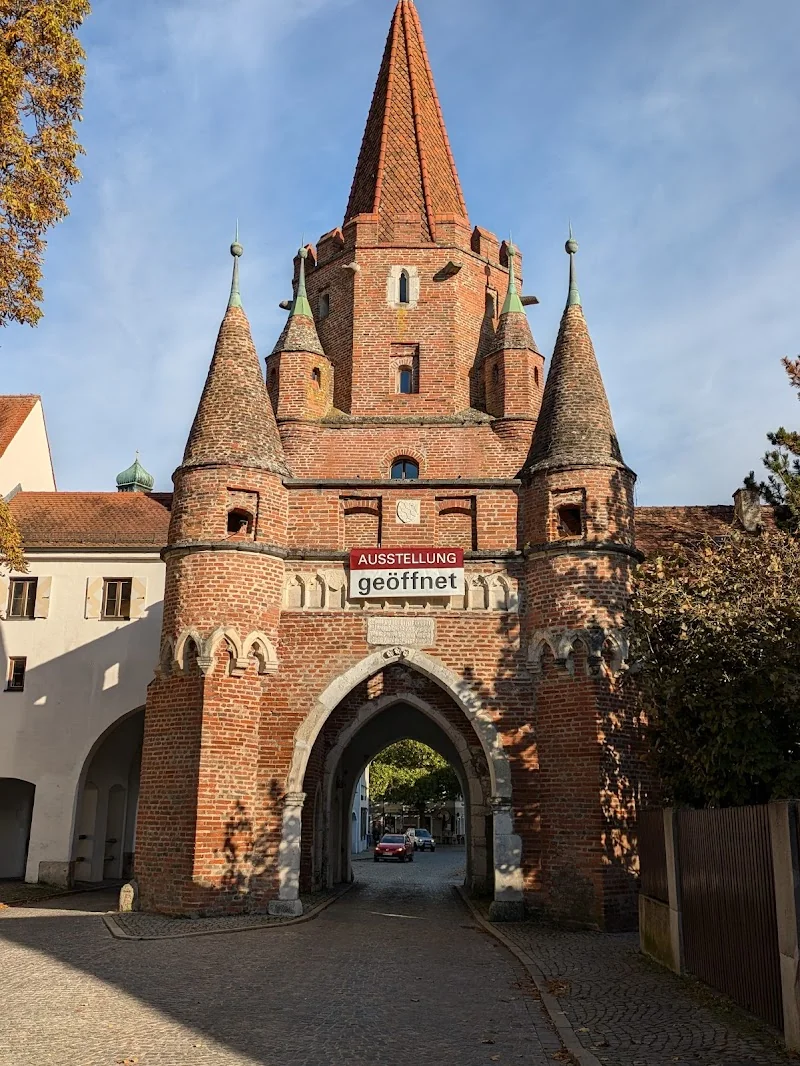
Kreuzstraße, Ingolstadt
Kreuzstraße, 85049 Ingolstadt, Germany
Kreuztor Ingolstadt | History & Access
The Kreuztor in Ingolstadt is much more than just an old city gate. It represents the transition between medieval urban history and today's life in the old town, for the view of a city that has visibly preserved its historical layers, and for a structure that has served as a landmark for centuries. Those who visit the Kreuztor do not experience a classic event location with a stage and hall, but a publicly accessible landmark that is excellent for city walks, photo shoots, and discovering the Ingolstadt old town. The gate was built as part of the second city fortification in the second half of the 14th century and is thus one of the most significant surviving testimonies of medieval urban development. ([stadtgeschichtslexikon.ingolstadt.de](https://stadtgeschichtslexikon.ingolstadt.de/wiki/Kreuztor))
Particularly interesting is the location: The Kreuztor is located on Kreuzstraße and marks the access to the old town from the west. In urban descriptions, it is highlighted as a landmark and perceived as an urban planning defining point because it connects the historical axis of the city center with modern urban life. For visitors, this is practical, as the Kreuztor can be easily integrated into a tour of the old town. At the same time, it is a place where history feels very immediate: no museum distance, but a structure that stands in the urban space and continues to shape the everyday life of the city to this day. ([stadtgeschichtslexikon.ingolstadt.de](https://stadtgeschichtslexikon.ingolstadt.de/wiki/Kreuztor))
History and Origin of the Kreuztor
The history of the Kreuztor begins with the expansion of Ingolstadt in the 14th century. According to the city history lexicon, the gate was created as part of the second city fortification when the city was expanded to the west and several large main gates were built as access points to the city. Alongside the Feldkirchnertor, the Hardertor, and the Donautor, the westward Kreuztor was one of these four main gates. This classification is important because it shows that the Kreuztor was not intended as a standalone structure but as part of a comprehensive fortification and order system that spatially and militarily structured the city. The inscription above the entrance names 1386 as the year of the foundation stone laying, thus precisely placing its origin in the late Gothic period. ([stadtgeschichtslexikon.ingolstadt.de](https://stadtgeschichtslexikon.ingolstadt.de/wiki/Kreuztor))
The name of the gate derives from the former leper house with the Church of the Holy Cross, which was located west of the city before it was replaced by a bastion in the 16th century. This origin of the name makes the Kreuztor culturally and historically interesting, as it points to a connection between urban space, care facilities, and military fortification. Over the course of history, the environment of the gate also changed: In front of the structure once lay a moat with a bridge, which was filled in during the second half of the 19th century. This significantly altered the original effect of the gate in the urban space. Nevertheless, it remained a prominent structure and continued to be read as an urban symbol over time. ([stadtgeschichtslexikon.ingolstadt.de](https://stadtgeschichtslexikon.ingolstadt.de/wiki/Kreuztor))
The further development of the Kreuztor also tells of changing epochs. In the 19th century, remnants of the old plaster were removed during a restoration to highlight the romanticized brick effect that appears so characteristic today. In the 20th century, two pedestrian paths were added, which were established in 1929/30 and 1952. This functionally adapted the gate to the urban space without completely losing its historical character. It is precisely this mixture of medieval core and later changes that makes the Kreuztor a particularly vivid monument of urban history. It is not a frozen object but a structure with visible layers that tells of the city's transformation. ([stadtgeschichtslexikon.ingolstadt.de](https://stadtgeschichtslexikon.ingolstadt.de/wiki/Kreuztor))
For SEO relevance, this topic is central because users expect such background information when searching for terms like historical city gate, city wall Ingolstadt, landmark Ingolstadt, or medieval city gate. The Kreuztor fulfills this search intent very well: It offers a clear historical classification, a strong architectural identity, and a concise reference to the development of the old town. Those interested in medieval city fortifications will find here an example that does not need to be explained abstractly but is visible on site. This is also the reason why the Kreuztor serves as a fixed reference point in many city tours and walks. ([stadtgeschichtslexikon.ingolstadt.de](https://stadtgeschichtslexikon.ingolstadt.de/wiki/Kreuztor))
Access, Parking, and Entry to the Old Town
Anyone wishing to visit the Kreuztor should view its location in the Ingolstadt city center as an advantage. The gate is located on Kreuzstraße in the old town area and is positioned at the edge of the pedestrian zone. This makes it easily accessible for both pedestrians and for a short drive into the city center. Particularly pleasant is that the gate can be easily integrated into a tour of the old town. Those arriving in Ingolstadt by train or bus can walk from the central stops and reach the Kreuztor without complicated routes. For walks, the location is ideal because the city gate forms a natural transition between the historic city center and the surrounding streets. ([stadtgeschichtslexikon.ingolstadt.de](https://stadtgeschichtslexikon.ingolstadt.de/wiki/Kreuztor))
When it comes to parking, the official city regulations are particularly important. The city of Ingolstadt points out that the short-term parking zones in the city center and the adjacent outer area are subject to fees. Parking is done via parking ticket machines, and payment via app is also possible. Additionally, the city mentions the so-called Semmeltaste for free short-term parking in the city center. Therefore, those driving to the Kreuztor should rather expect a short visit to the city center and plan the parking duration accordingly. For longer stays, the public parking garages and underground garages in the city center are the better choice, as they offer more flexibility than the short-term parking zones in the immediate old town area. ([ingolstadt.de](https://www.ingolstadt.de/Rathaus/Verkehr/Parken/Verkehrs-%C3%BCberwachungsdienst?utm_source=openai))
The pedestrian zone itself is also clearly regulated. The city explains that it is generally reserved for pedestrians, and driving is only allowed during a limited time window for delivery traffic. Cyclists must also walk in many areas starting at 10:30 AM. For visitors to the Kreuztor, this means: The area is designed for calm, safe strolling and not for permanent car traffic. This supports the effect of the gate as a monument in the urban space. It does not stand in a traffic corridor but at a historical threshold that should primarily be experienced on foot today. Those who plan their access and parking in advance can visit the Kreuztor without stress and begin their old town walk in a relaxed manner. ([ingolstadt.de](https://www.ingolstadt.de/Rathaus/Verkehr/Parken/Verkehrs-%C3%BCberwachungsdienst?utm_source=openai))
For practical planning, it is also helpful to see the Kreuztor as a starting point for further destinations in the city center. Those who park directly in the vicinity can continue walking through the pedestrian zone after the photo stop, explore further historical buildings, or take a short break in the old town. The city structure makes this easy: short distances, clear orientation, and a strong center where the Kreuztor serves as a fixed point. Thus, the topic of access is not just a technical question but part of the visitor experience. The gate is quickly reached, easily found, and well integrated into the daily schedule. ([stadtgeschichtslexikon.ingolstadt.de](https://stadtgeschichtslexikon.ingolstadt.de/wiki/Kreuztor))
Architecture, Design, and Historical Details
Architecturally, the Kreuztor is one of the most impressive structures of the Ingolstadt old town. The city history lexicon describes a square substructure framed by four corner towers. Above it sits an octagonal tower structure with a distinctive battlement and steep tower helmet. On the side facing away from the old town, there is a zwinger-like forebuilding with two flanking towers. This structure gives the gate a strong plasticity and an almost defensive monumentality. At the same time, the ornamental design is intentionally kept sparse, which particularly highlights the clear language of form of late medieval architecture. ([stadtgeschichtslexikon.ingolstadt.de](https://stadtgeschichtslexikon.ingolstadt.de/wiki/Kreuztor))
The details are also remarkable. The gate structure is adorned with a pointed arch frieze made of stone, and the Bavarian diamond coat of arms can be found on the enemy side, while the city coat of arms is on the inside. These symbols not only emphasize the representative function of the gate but also the political and symbolic significance of a city gate architecture that was more than mere defense. The Kreuztor was a visible sign of urban order and self-assertion. The fact that the architect is unknown makes the structure even more interesting, as it has developed an extraordinarily strong language of form despite the lack of personal attribution. ([stadtgeschichtslexikon.ingolstadt.de](https://stadtgeschichtslexikon.ingolstadt.de/wiki/Kreuztor))
The history of restoration explains why the Kreuztor appears as it does today. According to the city history lexicon, the gate originally had a plaster that was meant to protect the soft bricks and simultaneously conceal the inner building structure. In the 19th century, remnants of this plaster were removed because the monument aesthetics of the time preferred a romanticized brick view. This resulted in the visual clarity that visitors today associate with the Kreuztor: red brick masonry, clear verticals, defensive proportions, and a strong silhouette. The result is not a random photo object but the product of several historical layers that have consciously or unconsciously shaped its current appearance. ([stadtgeschichtslexikon.ingolstadt.de](https://stadtgeschichtslexikon.ingolstadt.de/wiki/Kreuztor))
For visitors, the Kreuztor is therefore an ideal place to experience medieval city architecture directly. One does not need to explain much to understand the effect: The gate structure stands upright, compact, and at the same time richly detailed in the urban landscape. Those who look at the facade recognize the combination of defensiveness and representation, of function and symbolism. This is exactly what makes the place so photogenic and suitable for content related to the sights of Ingolstadt, photo spots in Ingolstadt, or the city wall in Ingolstadt. The Kreuztor is not just a historical relic but a walkable part of the urban memory. ([stadtgeschichtslexikon.ingolstadt.de](https://stadtgeschichtslexikon.ingolstadt.de/wiki/Kreuztor))
In SEO terms, this section is important because search queries like historical city gate, medieval city gate, city fortification Ingolstadt, or landmark Ingolstadt specifically target such architectural features. Users want to know if a visit is worthwhile, what the structure looks like, and why it is considered important. The Kreuztor provides a convincing answer: it is one of the most visible and well-known testimonies of the old city fortification, historically relevant and aesthetically striking. This results in a clear added value for tourist sites, local guides, and city walks. ([stadtgeschichtslexikon.ingolstadt.de](https://stadtgeschichtslexikon.ingolstadt.de/wiki/Kreuztor))
Kreuztor as a Photo Spot, Landmark, and Urban Experience
The Kreuztor is an excellent photo spot because it possesses strong forms, clear proportions, and an instantly recognizable historical character. Compared to an interior or a classic event venue, it offers something different: an open, freely accessible structure in the urban space that presents itself differently at various times of the day. In the morning, the facade appears calm and structured; during the day, the light emphasizes the bricks and the architectural composition, and in the evening, a particularly atmospheric image often emerges. This transformability is an advantage for visitors who want to not only see landmarks but also capture them. The Kreuztor is thus a classic place for organic urban photography, without artificial staging. ([stadtgeschichtslexikon.ingolstadt.de](https://stadtgeschichtslexikon.ingolstadt.de/wiki/Kreuztor))
As a landmark, the gate is closely linked to the identity of the city. The city history lexicon explicitly emphasizes that it has become a landmark of Ingolstadt due to its striking appearance and historical significance. This importance is also reflected in urban planning: In the official city planning, the Kreuztor is described as an important reference point that shapes the urban space and is perceived as a prominent endpoint or access point. This is helpful for visitors because a landmark must not only look beautiful but also provide orientation and characterize a city. This function has been fulfilled by the Kreuztor for centuries. ([stadtgeschichtslexikon.ingolstadt.de](https://stadtgeschichtslexikon.ingolstadt.de/wiki/Kreuztor))
For the visit itself, a calm walk with time for details is recommended. Those standing at the Kreuztor should not only photograph it from the front but also include the side view, the relation to the street, and the effect of height on the view into the old town. This makes it understandable why the structure possesses such a strong presence despite its comparatively compact footprint. It does not convey monumental size in the modern sense but historical authority. This mixture of proximity and dignity makes the Kreuztor interesting for cultural travelers, urban explorers, and anyone wanting to experience medieval architecture in its original form. ([stadtgeschichtslexikon.ingolstadt.de](https://stadtgeschichtslexikon.ingolstadt.de/wiki/Kreuztor))
The Kreuztor can be particularly well integrated into themes such as Ingolstadt old town, sights in Ingolstadt, and western access to the old town. Those creating content for a travel or event site should present the gate as a fixed anchor point of the urban experience. It is not a place where one lingers for long, as there are no interior spaces in the classical sense, but its openness is precisely what makes it appealing. The Kreuztor is a place for the first impression, for a quick stop, for conscious observation, and for the transition into the rest of the old town. ([stadtgeschichtslexikon.ingolstadt.de](https://stadtgeschichtslexikon.ingolstadt.de/wiki/Kreuztor))
In terms of content, the Kreuztor is also relevant for search engines because it bundles many different user intents: history, access, parking, architecture, old town, and photo spot. This makes it an ideal topic for local SEO texts, where not only a fact is mentioned but a complete picture of the visit is created. Those who find the Kreuztor via Google are often not looking for a pure monument database but for a clear, user-oriented overview. The Kreuztor provides exactly this: a historically significant, visually striking, and easily accessible city gate with a clear role in the urban landscape. ([stadtgeschichtslexikon.ingolstadt.de](https://stadtgeschichtslexikon.ingolstadt.de/wiki/Kreuztor))
Kreuztor, Old Town, and City Walk
The Kreuztor unfolds its full effect in conjunction with the Ingolstadt old town. Those walking there do not experience the gate in isolation but as part of an urban ensemble of historical streets, pedestrian zones, and city history. For this reason, it is worthwhile to plan the visit not as a single stop but as the beginning or end of a stroll through the old town. The paths are short, orientation is easy, and the Kreuztor offers a natural anchor to discover further places in the city center. In the context of a city stroll, it is a particularly good entry point because it immediately sets a historical tone. ([stadtgeschichtslexikon.ingolstadt.de](https://stadtgeschichtslexikon.ingolstadt.de/wiki/Kreuztor))
The proximity to the pedestrian zone is a great advantage. The city describes the historic core as an area with clearly regulated traffic calming, so the old town is primarily to be experienced on foot. This fits perfectly with the character of the Kreuztor. Upon arrival, one quickly realizes that this place is not intended for through traffic but for perception, movement, and short stays. The historic gate is thus part of an urban experience where the route is almost as important as the destination. From an SEO perspective, terms like pedestrian zone Ingolstadt, old town Ingolstadt, and access to Kreuztor can be very well connected here. ([ingolstadt.de](https://www.ingolstadt.de/Rathaus/Verkehr/Parken/Verkehrs-%C3%BCberwachungsdienst?utm_source=openai))
For visitors interested in city history, the Kreuztor can also serve as a starting point for a thematic tour. The official city history refers to the old city fortifications and other main gates of historical urban development. This makes it clear that the Kreuztor should not be viewed as a standalone sight but as part of a larger system of historical fortification and urban expansion. Therefore, when observing the Kreuztor, one also sees a slice of the entire history of Ingolstadt: expansion, defense, representation, and later monument protection. This makes the place rich in content and particularly suitable for longer texts. ([stadtgeschichtslexikon.ingolstadt.de](https://stadtgeschichtslexikon.ingolstadt.de/wiki/Kreuztor))
For groups, families, or individual travelers, the Kreuztor is an uncomplicated stop. The place requires no entrance tickets, no long paths, and no prior registration. Nevertheless, a closer look is worthwhile because much can be told about the city through it. It is precisely this mixture of accessibility and historical weight that makes the gate attractive to visitors. Those who want to not only consume Ingolstadt but understand it find here an ideal starting point. The Kreuztor stands for what good urban culture is all about: visible, memorable, public, and deeply rooted in local identity. ([stadtgeschichtslexikon.ingolstadt.de](https://stadtgeschichtslexikon.ingolstadt.de/wiki/Kreuztor))
In a larger context, the Kreuztor is also a good example of how a city integrates its heritage into everyday life. The gate is not isolated but part of a vibrant city center. This makes the visit so pleasant: one can combine history with shopping, coffee breaks, or further city walks without losing the character of the place. For content that aims at both experience and information, this is a strong motive. Therefore, terms like sights Ingolstadt, landmark Ingolstadt, and historical city gate work here not only as keywords but as a genuine description of the visitor experience. ([stadtgeschichtslexikon.ingolstadt.de](https://stadtgeschichtslexikon.ingolstadt.de/wiki/Kreuztor))
Sources:
Show moreShow less
Kreuztor Ingolstadt | History & Access
The Kreuztor in Ingolstadt is much more than just an old city gate. It represents the transition between medieval urban history and today's life in the old town, for the view of a city that has visibly preserved its historical layers, and for a structure that has served as a landmark for centuries. Those who visit the Kreuztor do not experience a classic event location with a stage and hall, but a publicly accessible landmark that is excellent for city walks, photo shoots, and discovering the Ingolstadt old town. The gate was built as part of the second city fortification in the second half of the 14th century and is thus one of the most significant surviving testimonies of medieval urban development. ([stadtgeschichtslexikon.ingolstadt.de](https://stadtgeschichtslexikon.ingolstadt.de/wiki/Kreuztor))
Particularly interesting is the location: The Kreuztor is located on Kreuzstraße and marks the access to the old town from the west. In urban descriptions, it is highlighted as a landmark and perceived as an urban planning defining point because it connects the historical axis of the city center with modern urban life. For visitors, this is practical, as the Kreuztor can be easily integrated into a tour of the old town. At the same time, it is a place where history feels very immediate: no museum distance, but a structure that stands in the urban space and continues to shape the everyday life of the city to this day. ([stadtgeschichtslexikon.ingolstadt.de](https://stadtgeschichtslexikon.ingolstadt.de/wiki/Kreuztor))
History and Origin of the Kreuztor
The history of the Kreuztor begins with the expansion of Ingolstadt in the 14th century. According to the city history lexicon, the gate was created as part of the second city fortification when the city was expanded to the west and several large main gates were built as access points to the city. Alongside the Feldkirchnertor, the Hardertor, and the Donautor, the westward Kreuztor was one of these four main gates. This classification is important because it shows that the Kreuztor was not intended as a standalone structure but as part of a comprehensive fortification and order system that spatially and militarily structured the city. The inscription above the entrance names 1386 as the year of the foundation stone laying, thus precisely placing its origin in the late Gothic period. ([stadtgeschichtslexikon.ingolstadt.de](https://stadtgeschichtslexikon.ingolstadt.de/wiki/Kreuztor))
The name of the gate derives from the former leper house with the Church of the Holy Cross, which was located west of the city before it was replaced by a bastion in the 16th century. This origin of the name makes the Kreuztor culturally and historically interesting, as it points to a connection between urban space, care facilities, and military fortification. Over the course of history, the environment of the gate also changed: In front of the structure once lay a moat with a bridge, which was filled in during the second half of the 19th century. This significantly altered the original effect of the gate in the urban space. Nevertheless, it remained a prominent structure and continued to be read as an urban symbol over time. ([stadtgeschichtslexikon.ingolstadt.de](https://stadtgeschichtslexikon.ingolstadt.de/wiki/Kreuztor))
The further development of the Kreuztor also tells of changing epochs. In the 19th century, remnants of the old plaster were removed during a restoration to highlight the romanticized brick effect that appears so characteristic today. In the 20th century, two pedestrian paths were added, which were established in 1929/30 and 1952. This functionally adapted the gate to the urban space without completely losing its historical character. It is precisely this mixture of medieval core and later changes that makes the Kreuztor a particularly vivid monument of urban history. It is not a frozen object but a structure with visible layers that tells of the city's transformation. ([stadtgeschichtslexikon.ingolstadt.de](https://stadtgeschichtslexikon.ingolstadt.de/wiki/Kreuztor))
For SEO relevance, this topic is central because users expect such background information when searching for terms like historical city gate, city wall Ingolstadt, landmark Ingolstadt, or medieval city gate. The Kreuztor fulfills this search intent very well: It offers a clear historical classification, a strong architectural identity, and a concise reference to the development of the old town. Those interested in medieval city fortifications will find here an example that does not need to be explained abstractly but is visible on site. This is also the reason why the Kreuztor serves as a fixed reference point in many city tours and walks. ([stadtgeschichtslexikon.ingolstadt.de](https://stadtgeschichtslexikon.ingolstadt.de/wiki/Kreuztor))
Access, Parking, and Entry to the Old Town
Anyone wishing to visit the Kreuztor should view its location in the Ingolstadt city center as an advantage. The gate is located on Kreuzstraße in the old town area and is positioned at the edge of the pedestrian zone. This makes it easily accessible for both pedestrians and for a short drive into the city center. Particularly pleasant is that the gate can be easily integrated into a tour of the old town. Those arriving in Ingolstadt by train or bus can walk from the central stops and reach the Kreuztor without complicated routes. For walks, the location is ideal because the city gate forms a natural transition between the historic city center and the surrounding streets. ([stadtgeschichtslexikon.ingolstadt.de](https://stadtgeschichtslexikon.ingolstadt.de/wiki/Kreuztor))
When it comes to parking, the official city regulations are particularly important. The city of Ingolstadt points out that the short-term parking zones in the city center and the adjacent outer area are subject to fees. Parking is done via parking ticket machines, and payment via app is also possible. Additionally, the city mentions the so-called Semmeltaste for free short-term parking in the city center. Therefore, those driving to the Kreuztor should rather expect a short visit to the city center and plan the parking duration accordingly. For longer stays, the public parking garages and underground garages in the city center are the better choice, as they offer more flexibility than the short-term parking zones in the immediate old town area. ([ingolstadt.de](https://www.ingolstadt.de/Rathaus/Verkehr/Parken/Verkehrs-%C3%BCberwachungsdienst?utm_source=openai))
The pedestrian zone itself is also clearly regulated. The city explains that it is generally reserved for pedestrians, and driving is only allowed during a limited time window for delivery traffic. Cyclists must also walk in many areas starting at 10:30 AM. For visitors to the Kreuztor, this means: The area is designed for calm, safe strolling and not for permanent car traffic. This supports the effect of the gate as a monument in the urban space. It does not stand in a traffic corridor but at a historical threshold that should primarily be experienced on foot today. Those who plan their access and parking in advance can visit the Kreuztor without stress and begin their old town walk in a relaxed manner. ([ingolstadt.de](https://www.ingolstadt.de/Rathaus/Verkehr/Parken/Verkehrs-%C3%BCberwachungsdienst?utm_source=openai))
For practical planning, it is also helpful to see the Kreuztor as a starting point for further destinations in the city center. Those who park directly in the vicinity can continue walking through the pedestrian zone after the photo stop, explore further historical buildings, or take a short break in the old town. The city structure makes this easy: short distances, clear orientation, and a strong center where the Kreuztor serves as a fixed point. Thus, the topic of access is not just a technical question but part of the visitor experience. The gate is quickly reached, easily found, and well integrated into the daily schedule. ([stadtgeschichtslexikon.ingolstadt.de](https://stadtgeschichtslexikon.ingolstadt.de/wiki/Kreuztor))
Architecture, Design, and Historical Details
Architecturally, the Kreuztor is one of the most impressive structures of the Ingolstadt old town. The city history lexicon describes a square substructure framed by four corner towers. Above it sits an octagonal tower structure with a distinctive battlement and steep tower helmet. On the side facing away from the old town, there is a zwinger-like forebuilding with two flanking towers. This structure gives the gate a strong plasticity and an almost defensive monumentality. At the same time, the ornamental design is intentionally kept sparse, which particularly highlights the clear language of form of late medieval architecture. ([stadtgeschichtslexikon.ingolstadt.de](https://stadtgeschichtslexikon.ingolstadt.de/wiki/Kreuztor))
The details are also remarkable. The gate structure is adorned with a pointed arch frieze made of stone, and the Bavarian diamond coat of arms can be found on the enemy side, while the city coat of arms is on the inside. These symbols not only emphasize the representative function of the gate but also the political and symbolic significance of a city gate architecture that was more than mere defense. The Kreuztor was a visible sign of urban order and self-assertion. The fact that the architect is unknown makes the structure even more interesting, as it has developed an extraordinarily strong language of form despite the lack of personal attribution. ([stadtgeschichtslexikon.ingolstadt.de](https://stadtgeschichtslexikon.ingolstadt.de/wiki/Kreuztor))
The history of restoration explains why the Kreuztor appears as it does today. According to the city history lexicon, the gate originally had a plaster that was meant to protect the soft bricks and simultaneously conceal the inner building structure. In the 19th century, remnants of this plaster were removed because the monument aesthetics of the time preferred a romanticized brick view. This resulted in the visual clarity that visitors today associate with the Kreuztor: red brick masonry, clear verticals, defensive proportions, and a strong silhouette. The result is not a random photo object but the product of several historical layers that have consciously or unconsciously shaped its current appearance. ([stadtgeschichtslexikon.ingolstadt.de](https://stadtgeschichtslexikon.ingolstadt.de/wiki/Kreuztor))
For visitors, the Kreuztor is therefore an ideal place to experience medieval city architecture directly. One does not need to explain much to understand the effect: The gate structure stands upright, compact, and at the same time richly detailed in the urban landscape. Those who look at the facade recognize the combination of defensiveness and representation, of function and symbolism. This is exactly what makes the place so photogenic and suitable for content related to the sights of Ingolstadt, photo spots in Ingolstadt, or the city wall in Ingolstadt. The Kreuztor is not just a historical relic but a walkable part of the urban memory. ([stadtgeschichtslexikon.ingolstadt.de](https://stadtgeschichtslexikon.ingolstadt.de/wiki/Kreuztor))
In SEO terms, this section is important because search queries like historical city gate, medieval city gate, city fortification Ingolstadt, or landmark Ingolstadt specifically target such architectural features. Users want to know if a visit is worthwhile, what the structure looks like, and why it is considered important. The Kreuztor provides a convincing answer: it is one of the most visible and well-known testimonies of the old city fortification, historically relevant and aesthetically striking. This results in a clear added value for tourist sites, local guides, and city walks. ([stadtgeschichtslexikon.ingolstadt.de](https://stadtgeschichtslexikon.ingolstadt.de/wiki/Kreuztor))
Kreuztor as a Photo Spot, Landmark, and Urban Experience
The Kreuztor is an excellent photo spot because it possesses strong forms, clear proportions, and an instantly recognizable historical character. Compared to an interior or a classic event venue, it offers something different: an open, freely accessible structure in the urban space that presents itself differently at various times of the day. In the morning, the facade appears calm and structured; during the day, the light emphasizes the bricks and the architectural composition, and in the evening, a particularly atmospheric image often emerges. This transformability is an advantage for visitors who want to not only see landmarks but also capture them. The Kreuztor is thus a classic place for organic urban photography, without artificial staging. ([stadtgeschichtslexikon.ingolstadt.de](https://stadtgeschichtslexikon.ingolstadt.de/wiki/Kreuztor))
As a landmark, the gate is closely linked to the identity of the city. The city history lexicon explicitly emphasizes that it has become a landmark of Ingolstadt due to its striking appearance and historical significance. This importance is also reflected in urban planning: In the official city planning, the Kreuztor is described as an important reference point that shapes the urban space and is perceived as a prominent endpoint or access point. This is helpful for visitors because a landmark must not only look beautiful but also provide orientation and characterize a city. This function has been fulfilled by the Kreuztor for centuries. ([stadtgeschichtslexikon.ingolstadt.de](https://stadtgeschichtslexikon.ingolstadt.de/wiki/Kreuztor))
For the visit itself, a calm walk with time for details is recommended. Those standing at the Kreuztor should not only photograph it from the front but also include the side view, the relation to the street, and the effect of height on the view into the old town. This makes it understandable why the structure possesses such a strong presence despite its comparatively compact footprint. It does not convey monumental size in the modern sense but historical authority. This mixture of proximity and dignity makes the Kreuztor interesting for cultural travelers, urban explorers, and anyone wanting to experience medieval architecture in its original form. ([stadtgeschichtslexikon.ingolstadt.de](https://stadtgeschichtslexikon.ingolstadt.de/wiki/Kreuztor))
The Kreuztor can be particularly well integrated into themes such as Ingolstadt old town, sights in Ingolstadt, and western access to the old town. Those creating content for a travel or event site should present the gate as a fixed anchor point of the urban experience. It is not a place where one lingers for long, as there are no interior spaces in the classical sense, but its openness is precisely what makes it appealing. The Kreuztor is a place for the first impression, for a quick stop, for conscious observation, and for the transition into the rest of the old town. ([stadtgeschichtslexikon.ingolstadt.de](https://stadtgeschichtslexikon.ingolstadt.de/wiki/Kreuztor))
In terms of content, the Kreuztor is also relevant for search engines because it bundles many different user intents: history, access, parking, architecture, old town, and photo spot. This makes it an ideal topic for local SEO texts, where not only a fact is mentioned but a complete picture of the visit is created. Those who find the Kreuztor via Google are often not looking for a pure monument database but for a clear, user-oriented overview. The Kreuztor provides exactly this: a historically significant, visually striking, and easily accessible city gate with a clear role in the urban landscape. ([stadtgeschichtslexikon.ingolstadt.de](https://stadtgeschichtslexikon.ingolstadt.de/wiki/Kreuztor))
Kreuztor, Old Town, and City Walk
The Kreuztor unfolds its full effect in conjunction with the Ingolstadt old town. Those walking there do not experience the gate in isolation but as part of an urban ensemble of historical streets, pedestrian zones, and city history. For this reason, it is worthwhile to plan the visit not as a single stop but as the beginning or end of a stroll through the old town. The paths are short, orientation is easy, and the Kreuztor offers a natural anchor to discover further places in the city center. In the context of a city stroll, it is a particularly good entry point because it immediately sets a historical tone. ([stadtgeschichtslexikon.ingolstadt.de](https://stadtgeschichtslexikon.ingolstadt.de/wiki/Kreuztor))
The proximity to the pedestrian zone is a great advantage. The city describes the historic core as an area with clearly regulated traffic calming, so the old town is primarily to be experienced on foot. This fits perfectly with the character of the Kreuztor. Upon arrival, one quickly realizes that this place is not intended for through traffic but for perception, movement, and short stays. The historic gate is thus part of an urban experience where the route is almost as important as the destination. From an SEO perspective, terms like pedestrian zone Ingolstadt, old town Ingolstadt, and access to Kreuztor can be very well connected here. ([ingolstadt.de](https://www.ingolstadt.de/Rathaus/Verkehr/Parken/Verkehrs-%C3%BCberwachungsdienst?utm_source=openai))
For visitors interested in city history, the Kreuztor can also serve as a starting point for a thematic tour. The official city history refers to the old city fortifications and other main gates of historical urban development. This makes it clear that the Kreuztor should not be viewed as a standalone sight but as part of a larger system of historical fortification and urban expansion. Therefore, when observing the Kreuztor, one also sees a slice of the entire history of Ingolstadt: expansion, defense, representation, and later monument protection. This makes the place rich in content and particularly suitable for longer texts. ([stadtgeschichtslexikon.ingolstadt.de](https://stadtgeschichtslexikon.ingolstadt.de/wiki/Kreuztor))
For groups, families, or individual travelers, the Kreuztor is an uncomplicated stop. The place requires no entrance tickets, no long paths, and no prior registration. Nevertheless, a closer look is worthwhile because much can be told about the city through it. It is precisely this mixture of accessibility and historical weight that makes the gate attractive to visitors. Those who want to not only consume Ingolstadt but understand it find here an ideal starting point. The Kreuztor stands for what good urban culture is all about: visible, memorable, public, and deeply rooted in local identity. ([stadtgeschichtslexikon.ingolstadt.de](https://stadtgeschichtslexikon.ingolstadt.de/wiki/Kreuztor))
In a larger context, the Kreuztor is also a good example of how a city integrates its heritage into everyday life. The gate is not isolated but part of a vibrant city center. This makes the visit so pleasant: one can combine history with shopping, coffee breaks, or further city walks without losing the character of the place. For content that aims at both experience and information, this is a strong motive. Therefore, terms like sights Ingolstadt, landmark Ingolstadt, and historical city gate work here not only as keywords but as a genuine description of the visitor experience. ([stadtgeschichtslexikon.ingolstadt.de](https://stadtgeschichtslexikon.ingolstadt.de/wiki/Kreuztor))
Sources:
Kreuztor Ingolstadt | History & Access
The Kreuztor in Ingolstadt is much more than just an old city gate. It represents the transition between medieval urban history and today's life in the old town, for the view of a city that has visibly preserved its historical layers, and for a structure that has served as a landmark for centuries. Those who visit the Kreuztor do not experience a classic event location with a stage and hall, but a publicly accessible landmark that is excellent for city walks, photo shoots, and discovering the Ingolstadt old town. The gate was built as part of the second city fortification in the second half of the 14th century and is thus one of the most significant surviving testimonies of medieval urban development. ([stadtgeschichtslexikon.ingolstadt.de](https://stadtgeschichtslexikon.ingolstadt.de/wiki/Kreuztor))
Particularly interesting is the location: The Kreuztor is located on Kreuzstraße and marks the access to the old town from the west. In urban descriptions, it is highlighted as a landmark and perceived as an urban planning defining point because it connects the historical axis of the city center with modern urban life. For visitors, this is practical, as the Kreuztor can be easily integrated into a tour of the old town. At the same time, it is a place where history feels very immediate: no museum distance, but a structure that stands in the urban space and continues to shape the everyday life of the city to this day. ([stadtgeschichtslexikon.ingolstadt.de](https://stadtgeschichtslexikon.ingolstadt.de/wiki/Kreuztor))
History and Origin of the Kreuztor
The history of the Kreuztor begins with the expansion of Ingolstadt in the 14th century. According to the city history lexicon, the gate was created as part of the second city fortification when the city was expanded to the west and several large main gates were built as access points to the city. Alongside the Feldkirchnertor, the Hardertor, and the Donautor, the westward Kreuztor was one of these four main gates. This classification is important because it shows that the Kreuztor was not intended as a standalone structure but as part of a comprehensive fortification and order system that spatially and militarily structured the city. The inscription above the entrance names 1386 as the year of the foundation stone laying, thus precisely placing its origin in the late Gothic period. ([stadtgeschichtslexikon.ingolstadt.de](https://stadtgeschichtslexikon.ingolstadt.de/wiki/Kreuztor))
The name of the gate derives from the former leper house with the Church of the Holy Cross, which was located west of the city before it was replaced by a bastion in the 16th century. This origin of the name makes the Kreuztor culturally and historically interesting, as it points to a connection between urban space, care facilities, and military fortification. Over the course of history, the environment of the gate also changed: In front of the structure once lay a moat with a bridge, which was filled in during the second half of the 19th century. This significantly altered the original effect of the gate in the urban space. Nevertheless, it remained a prominent structure and continued to be read as an urban symbol over time. ([stadtgeschichtslexikon.ingolstadt.de](https://stadtgeschichtslexikon.ingolstadt.de/wiki/Kreuztor))
The further development of the Kreuztor also tells of changing epochs. In the 19th century, remnants of the old plaster were removed during a restoration to highlight the romanticized brick effect that appears so characteristic today. In the 20th century, two pedestrian paths were added, which were established in 1929/30 and 1952. This functionally adapted the gate to the urban space without completely losing its historical character. It is precisely this mixture of medieval core and later changes that makes the Kreuztor a particularly vivid monument of urban history. It is not a frozen object but a structure with visible layers that tells of the city's transformation. ([stadtgeschichtslexikon.ingolstadt.de](https://stadtgeschichtslexikon.ingolstadt.de/wiki/Kreuztor))
For SEO relevance, this topic is central because users expect such background information when searching for terms like historical city gate, city wall Ingolstadt, landmark Ingolstadt, or medieval city gate. The Kreuztor fulfills this search intent very well: It offers a clear historical classification, a strong architectural identity, and a concise reference to the development of the old town. Those interested in medieval city fortifications will find here an example that does not need to be explained abstractly but is visible on site. This is also the reason why the Kreuztor serves as a fixed reference point in many city tours and walks. ([stadtgeschichtslexikon.ingolstadt.de](https://stadtgeschichtslexikon.ingolstadt.de/wiki/Kreuztor))
Access, Parking, and Entry to the Old Town
Anyone wishing to visit the Kreuztor should view its location in the Ingolstadt city center as an advantage. The gate is located on Kreuzstraße in the old town area and is positioned at the edge of the pedestrian zone. This makes it easily accessible for both pedestrians and for a short drive into the city center. Particularly pleasant is that the gate can be easily integrated into a tour of the old town. Those arriving in Ingolstadt by train or bus can walk from the central stops and reach the Kreuztor without complicated routes. For walks, the location is ideal because the city gate forms a natural transition between the historic city center and the surrounding streets. ([stadtgeschichtslexikon.ingolstadt.de](https://stadtgeschichtslexikon.ingolstadt.de/wiki/Kreuztor))
When it comes to parking, the official city regulations are particularly important. The city of Ingolstadt points out that the short-term parking zones in the city center and the adjacent outer area are subject to fees. Parking is done via parking ticket machines, and payment via app is also possible. Additionally, the city mentions the so-called Semmeltaste for free short-term parking in the city center. Therefore, those driving to the Kreuztor should rather expect a short visit to the city center and plan the parking duration accordingly. For longer stays, the public parking garages and underground garages in the city center are the better choice, as they offer more flexibility than the short-term parking zones in the immediate old town area. ([ingolstadt.de](https://www.ingolstadt.de/Rathaus/Verkehr/Parken/Verkehrs-%C3%BCberwachungsdienst?utm_source=openai))
The pedestrian zone itself is also clearly regulated. The city explains that it is generally reserved for pedestrians, and driving is only allowed during a limited time window for delivery traffic. Cyclists must also walk in many areas starting at 10:30 AM. For visitors to the Kreuztor, this means: The area is designed for calm, safe strolling and not for permanent car traffic. This supports the effect of the gate as a monument in the urban space. It does not stand in a traffic corridor but at a historical threshold that should primarily be experienced on foot today. Those who plan their access and parking in advance can visit the Kreuztor without stress and begin their old town walk in a relaxed manner. ([ingolstadt.de](https://www.ingolstadt.de/Rathaus/Verkehr/Parken/Verkehrs-%C3%BCberwachungsdienst?utm_source=openai))
For practical planning, it is also helpful to see the Kreuztor as a starting point for further destinations in the city center. Those who park directly in the vicinity can continue walking through the pedestrian zone after the photo stop, explore further historical buildings, or take a short break in the old town. The city structure makes this easy: short distances, clear orientation, and a strong center where the Kreuztor serves as a fixed point. Thus, the topic of access is not just a technical question but part of the visitor experience. The gate is quickly reached, easily found, and well integrated into the daily schedule. ([stadtgeschichtslexikon.ingolstadt.de](https://stadtgeschichtslexikon.ingolstadt.de/wiki/Kreuztor))
Architecture, Design, and Historical Details
Architecturally, the Kreuztor is one of the most impressive structures of the Ingolstadt old town. The city history lexicon describes a square substructure framed by four corner towers. Above it sits an octagonal tower structure with a distinctive battlement and steep tower helmet. On the side facing away from the old town, there is a zwinger-like forebuilding with two flanking towers. This structure gives the gate a strong plasticity and an almost defensive monumentality. At the same time, the ornamental design is intentionally kept sparse, which particularly highlights the clear language of form of late medieval architecture. ([stadtgeschichtslexikon.ingolstadt.de](https://stadtgeschichtslexikon.ingolstadt.de/wiki/Kreuztor))
The details are also remarkable. The gate structure is adorned with a pointed arch frieze made of stone, and the Bavarian diamond coat of arms can be found on the enemy side, while the city coat of arms is on the inside. These symbols not only emphasize the representative function of the gate but also the political and symbolic significance of a city gate architecture that was more than mere defense. The Kreuztor was a visible sign of urban order and self-assertion. The fact that the architect is unknown makes the structure even more interesting, as it has developed an extraordinarily strong language of form despite the lack of personal attribution. ([stadtgeschichtslexikon.ingolstadt.de](https://stadtgeschichtslexikon.ingolstadt.de/wiki/Kreuztor))
The history of restoration explains why the Kreuztor appears as it does today. According to the city history lexicon, the gate originally had a plaster that was meant to protect the soft bricks and simultaneously conceal the inner building structure. In the 19th century, remnants of this plaster were removed because the monument aesthetics of the time preferred a romanticized brick view. This resulted in the visual clarity that visitors today associate with the Kreuztor: red brick masonry, clear verticals, defensive proportions, and a strong silhouette. The result is not a random photo object but the product of several historical layers that have consciously or unconsciously shaped its current appearance. ([stadtgeschichtslexikon.ingolstadt.de](https://stadtgeschichtslexikon.ingolstadt.de/wiki/Kreuztor))
For visitors, the Kreuztor is therefore an ideal place to experience medieval city architecture directly. One does not need to explain much to understand the effect: The gate structure stands upright, compact, and at the same time richly detailed in the urban landscape. Those who look at the facade recognize the combination of defensiveness and representation, of function and symbolism. This is exactly what makes the place so photogenic and suitable for content related to the sights of Ingolstadt, photo spots in Ingolstadt, or the city wall in Ingolstadt. The Kreuztor is not just a historical relic but a walkable part of the urban memory. ([stadtgeschichtslexikon.ingolstadt.de](https://stadtgeschichtslexikon.ingolstadt.de/wiki/Kreuztor))
In SEO terms, this section is important because search queries like historical city gate, medieval city gate, city fortification Ingolstadt, or landmark Ingolstadt specifically target such architectural features. Users want to know if a visit is worthwhile, what the structure looks like, and why it is considered important. The Kreuztor provides a convincing answer: it is one of the most visible and well-known testimonies of the old city fortification, historically relevant and aesthetically striking. This results in a clear added value for tourist sites, local guides, and city walks. ([stadtgeschichtslexikon.ingolstadt.de](https://stadtgeschichtslexikon.ingolstadt.de/wiki/Kreuztor))
Kreuztor as a Photo Spot, Landmark, and Urban Experience
The Kreuztor is an excellent photo spot because it possesses strong forms, clear proportions, and an instantly recognizable historical character. Compared to an interior or a classic event venue, it offers something different: an open, freely accessible structure in the urban space that presents itself differently at various times of the day. In the morning, the facade appears calm and structured; during the day, the light emphasizes the bricks and the architectural composition, and in the evening, a particularly atmospheric image often emerges. This transformability is an advantage for visitors who want to not only see landmarks but also capture them. The Kreuztor is thus a classic place for organic urban photography, without artificial staging. ([stadtgeschichtslexikon.ingolstadt.de](https://stadtgeschichtslexikon.ingolstadt.de/wiki/Kreuztor))
As a landmark, the gate is closely linked to the identity of the city. The city history lexicon explicitly emphasizes that it has become a landmark of Ingolstadt due to its striking appearance and historical significance. This importance is also reflected in urban planning: In the official city planning, the Kreuztor is described as an important reference point that shapes the urban space and is perceived as a prominent endpoint or access point. This is helpful for visitors because a landmark must not only look beautiful but also provide orientation and characterize a city. This function has been fulfilled by the Kreuztor for centuries. ([stadtgeschichtslexikon.ingolstadt.de](https://stadtgeschichtslexikon.ingolstadt.de/wiki/Kreuztor))
For the visit itself, a calm walk with time for details is recommended. Those standing at the Kreuztor should not only photograph it from the front but also include the side view, the relation to the street, and the effect of height on the view into the old town. This makes it understandable why the structure possesses such a strong presence despite its comparatively compact footprint. It does not convey monumental size in the modern sense but historical authority. This mixture of proximity and dignity makes the Kreuztor interesting for cultural travelers, urban explorers, and anyone wanting to experience medieval architecture in its original form. ([stadtgeschichtslexikon.ingolstadt.de](https://stadtgeschichtslexikon.ingolstadt.de/wiki/Kreuztor))
The Kreuztor can be particularly well integrated into themes such as Ingolstadt old town, sights in Ingolstadt, and western access to the old town. Those creating content for a travel or event site should present the gate as a fixed anchor point of the urban experience. It is not a place where one lingers for long, as there are no interior spaces in the classical sense, but its openness is precisely what makes it appealing. The Kreuztor is a place for the first impression, for a quick stop, for conscious observation, and for the transition into the rest of the old town. ([stadtgeschichtslexikon.ingolstadt.de](https://stadtgeschichtslexikon.ingolstadt.de/wiki/Kreuztor))
In terms of content, the Kreuztor is also relevant for search engines because it bundles many different user intents: history, access, parking, architecture, old town, and photo spot. This makes it an ideal topic for local SEO texts, where not only a fact is mentioned but a complete picture of the visit is created. Those who find the Kreuztor via Google are often not looking for a pure monument database but for a clear, user-oriented overview. The Kreuztor provides exactly this: a historically significant, visually striking, and easily accessible city gate with a clear role in the urban landscape. ([stadtgeschichtslexikon.ingolstadt.de](https://stadtgeschichtslexikon.ingolstadt.de/wiki/Kreuztor))
Kreuztor, Old Town, and City Walk
The Kreuztor unfolds its full effect in conjunction with the Ingolstadt old town. Those walking there do not experience the gate in isolation but as part of an urban ensemble of historical streets, pedestrian zones, and city history. For this reason, it is worthwhile to plan the visit not as a single stop but as the beginning or end of a stroll through the old town. The paths are short, orientation is easy, and the Kreuztor offers a natural anchor to discover further places in the city center. In the context of a city stroll, it is a particularly good entry point because it immediately sets a historical tone. ([stadtgeschichtslexikon.ingolstadt.de](https://stadtgeschichtslexikon.ingolstadt.de/wiki/Kreuztor))
The proximity to the pedestrian zone is a great advantage. The city describes the historic core as an area with clearly regulated traffic calming, so the old town is primarily to be experienced on foot. This fits perfectly with the character of the Kreuztor. Upon arrival, one quickly realizes that this place is not intended for through traffic but for perception, movement, and short stays. The historic gate is thus part of an urban experience where the route is almost as important as the destination. From an SEO perspective, terms like pedestrian zone Ingolstadt, old town Ingolstadt, and access to Kreuztor can be very well connected here. ([ingolstadt.de](https://www.ingolstadt.de/Rathaus/Verkehr/Parken/Verkehrs-%C3%BCberwachungsdienst?utm_source=openai))
For visitors interested in city history, the Kreuztor can also serve as a starting point for a thematic tour. The official city history refers to the old city fortifications and other main gates of historical urban development. This makes it clear that the Kreuztor should not be viewed as a standalone sight but as part of a larger system of historical fortification and urban expansion. Therefore, when observing the Kreuztor, one also sees a slice of the entire history of Ingolstadt: expansion, defense, representation, and later monument protection. This makes the place rich in content and particularly suitable for longer texts. ([stadtgeschichtslexikon.ingolstadt.de](https://stadtgeschichtslexikon.ingolstadt.de/wiki/Kreuztor))
For groups, families, or individual travelers, the Kreuztor is an uncomplicated stop. The place requires no entrance tickets, no long paths, and no prior registration. Nevertheless, a closer look is worthwhile because much can be told about the city through it. It is precisely this mixture of accessibility and historical weight that makes the gate attractive to visitors. Those who want to not only consume Ingolstadt but understand it find here an ideal starting point. The Kreuztor stands for what good urban culture is all about: visible, memorable, public, and deeply rooted in local identity. ([stadtgeschichtslexikon.ingolstadt.de](https://stadtgeschichtslexikon.ingolstadt.de/wiki/Kreuztor))
In a larger context, the Kreuztor is also a good example of how a city integrates its heritage into everyday life. The gate is not isolated but part of a vibrant city center. This makes the visit so pleasant: one can combine history with shopping, coffee breaks, or further city walks without losing the character of the place. For content that aims at both experience and information, this is a strong motive. Therefore, terms like sights Ingolstadt, landmark Ingolstadt, and historical city gate work here not only as keywords but as a genuine description of the visitor experience. ([stadtgeschichtslexikon.ingolstadt.de](https://stadtgeschichtslexikon.ingolstadt.de/wiki/Kreuztor))
Sources:
Upcoming Events
No events found
Frequently Asked Questions
Reviews
Bill Lin
12. November 2025
The Kreuztor, built in 1385, is the western gateway to the medieval city center of Ingolstadt. The tower's name is derived from the leper house belonging to the Church of the Holy Cross, which stood to the west of the city walls until its destruction in the Schmalkaldic War in 1546. Driving your car passing through the Cross Gate, both during day and night time, will give you the feeling of medieval period.
Paweł W
14. October 2025
Kreuztor is one of the most iconic landmarks in Ingolstadt and definitely worth a visit if you’re exploring the city. This medieval gate, built in the 14th century, is beautifully preserved and serves as a reminder of the city’s rich history. The red brick architecture and the distinctive towers make it a perfect spot for photos – especially at sunset when the light brings out the warm tones of the walls. The area around Kreuztor is lively, with many cafés, restaurants, and small shops nearby. It’s a great place to take a walk, grab a coffee, and soak up the atmosphere of the old town. The structure itself is not large, but it’s incredibly picturesque and full of charm. It’s also interesting to see how the old and modern parts of the city blend here – the gate stands proudly at the entrance to the pedestrian zone, symbolizing Ingolstadt’s heritage. A small historical plaque provides some background information, which helps appreciate the site even more. While the gate itself doesn’t take long to visit, it’s the overall surroundings that make the experience memorable. If you’re in Ingolstadt, don’t miss a quick stop here – it’s a great spot to start or end your city walk.
TheKaKaNow YouTube
5. January 2026
Big gate
david antoun
10. June 2023
The seven-tower Kreuztor is part of the second Ingolstadt city wall built in 1363. It is the only one of the original four main gates Feldkirchnertor, Hardertor, Kreuztor and Donautor that has been preserved. The name of the gate is derived from the former leper house to the west of the city, the Holy Cross.
Yosi Raz
5. August 2022
Nice place for a short 2 hour trip.