
Neubaustraße 11/2, Ingolstadt
Neubaustraße 11/2, 85049 Ingolstadt, Germany
Asamkirche Maria de Victoria | Opening Hours & Photos
The Asamkirche Maria de Victoria is one of the most impressive cultural sites in Ingolstadt and is exactly the place where a rather inconspicuous first impression can turn into amazement in just a few seconds. Hidden in the old town, without prominently visible towers and with a deliberately restrained facade design, a space opens up behind the entrance that counts among the great baroque and rococo experiences of the city. The church was built from 1732 to 1736 as a prayer hall for the Marian Congregation; the architect is named as Egid Quirin Asam, with execution by Michael Anton Prunthaler. The rectangular, approximately ten-meter-high hall is architecturally designed to be deliberately simple, yet this very contrast is what makes the building attractive. Inside, a finely tuned interplay of painting, stucco, light, and perspective unfolds, captivating visitors to this day. Particularly famous is the large ceiling painting by Cosmas Damian Asam, which depicts Mary as the Queen of Heaven and Mediatrix of divine grace. Additionally, there is the famous Lepanto monstrance in the sacristy, which further underscores the sacred significance of the place. The Asamkirche is thus not only a sight but a living piece of Ingolstadt's cultural history with a strong appeal for art lovers, city explorers, photography fans, and anyone who wants to experience the contrast between external restraint and internal splendor. ([ingolstadt.de](https://www.ingolstadt.de/Kultur/Museen/weitere-/Asamkirche-Maria-de-Victoria/?utm_source=openai))
Opening Hours, Admission, and Visits
Those wishing to visit the Asamkirche Maria de Victoria should keep an eye on the seasonal opening hours, as access is clearly regulated and not identical throughout the year. From March to October, the church is open Tuesday to Sunday from 09:00 to 12:00 and from 12:30 to 17:00. In the months of May to September, Monday openings are also added. From November to February, shortened winter hours apply: then the church is accessible Tuesday to Sunday from 13:00 to 16:00. The Asamkirche is closed on Shrove Tuesday, Good Friday, January 1, November 1, and December 24, 25, and 31. These details are important for planning because the church can be visited as a sight, but it is not a permanently open church space. Those coming specifically for the interior, the ceiling painting, or the Lepanto monstrance should therefore pay attention to the current times in advance. According to the city's fee schedule, admission is 3.50 euros for adults and 2.00 euros reduced; thus, the visit remains very moderate compared to the cultural value of the experience. Additionally, from the end of April to the end of September, there is the organ matinee at twelve, a traditional concert series of the city's cultural office, which takes place on Sundays at 12 o'clock and is freely accessible. Thus, the Asamkirche combines sightseeing, music, and sacred atmosphere in a particularly low-threshold way. For visitors, this is pleasant because the stay is suitable not only as a short photo stop but also as a quiet cultural break in the old town. ([ingolstadt.de](https://www.ingolstadt.de/Rathaus/Aktuelles/Meldungs-Archiv/%C3%96ffnungszeiten-Asamkirche-Maria-de-Victoria.php?FID=3052.289.1&La=1&ModID=7&NavID=2789.737&object=tx%2C2789.5.1&utm_source=openai))
History and Origin of the Asamkirche
The history of the Asamkirche Maria de Victoria is closely linked to the religious and urban development of Ingolstadt. As early as the early 17th century, a strong Marian piety emerged in the city, from which the Bürgerkongregation Maria de Victoria arose. The later-built church is thus not an isolated building but an expression of a long tradition that is deeply rooted in Ingolstadt. From 1732 to 1736, the current house of worship was built as a prayer hall for this congregation; the new building connected to older forms of Marian veneration and stands in the baroque heyday of the city. The place is described in the sources as a conscious counterpoint: externally restrained, almost inconspicuous, yet composed for maximum effect internally. This staging makes the Asamkirche a key work of southern German baroque and rococo art. The Asam brothers, especially Egid Quirin Asam as architect and Cosmas Damian Asam as painter, are among the defining artists of this era. In Ingolstadt, they set a late highlight of their work with Maria de Victoria. The building is also a hint at the close connection between Jesuits, the university, and the urban society, as the Marian congregations were closely integrated into the spiritual and religious life of the city. From a historical perspective, the church thus shows not only piety but also education, representation, and urban pride. Especially for visitors looking for more than just beautiful photos, the Asamkirche offers a tangible bridge between art history, religion, and local identity. ([ingolstadt.de](https://www.ingolstadt.de/stadtmuseum/scheuerer/ausstell/sj-burko.htm?utm_source=openai))
The Ceiling Painting and Rococo Interior
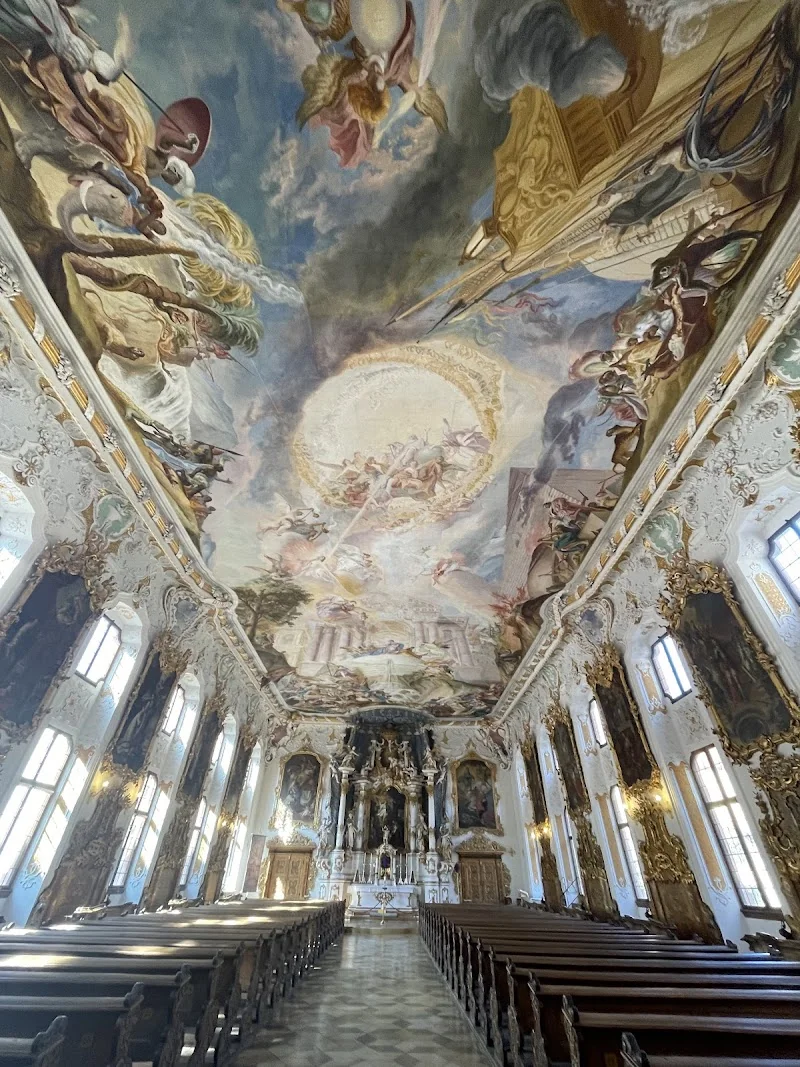
The greatest visual magnet of the Asamkirche Maria de Victoria is the monumental ceiling painting by Cosmas Damian Asam. It extends over the entire ceiling and depicts Mary as the Queen of Heaven and Mediatrix of divine grace. The image is not merely decorative but intended as a spatial staging: those walking through the central aisle experience how the perspective changes and the fresco seemingly moves with them. This is precisely where the special power of the interior lies. The architecture is rectangular in floor plan and designed as a hall, but the inner appearance seems much larger than the exterior view suggests. The space is only about ten meters high, yet it unfolds an astonishingly rich interplay of color, movement, and image dramaturgy. For the visitor, an experience arises that aims for amazement from the very first step: the walls almost seem like a stage, the ceiling painting draws the gaze upward, and the overall spatial effect combines sacredness with artistic virtuosity. For this reason, the church is ideal for people interested in architecture, rococo painting, or photographic motifs. The contrast between the simple facade and the opulent inner world is highlighted in many visitor observations and has almost become part of the brand core of the place. The Asamkirche is therefore not just beautiful but deliberately composed to evoke emotions. In the old town of Ingolstadt, it is one of the most significant places when it comes to baroque spatial art and the connection between architecture and illusion. ([ingolstadt.de](https://www.ingolstadt.de/Kultur/Museen/weitere-/Asamkirche-Maria-de-Victoria/?utm_source=openai))
Lepanto Monstrance and Sacred Particularities
A second unique feature of the Asamkirche Maria de Victoria is the Lepanto monstrance. It was made in 1708 by the Augsburg goldsmith Johann Zeckel for the Bürgerkongregation and is now located in the sacristy of the church. The piece is among the most famous works of baroque goldsmithing in Ingolstadt and is closely linked to Marian veneration and the historical memory of the city. The monstrance refers to the naval battle of Lepanto on October 7, 1571, which was interpreted as a victory of the Holy League over the Ottoman fleet. In the city history lexicon, it is described as one of the most prominent and unique works of this kind. For the church visit, this is important because here not only an aesthetic highlight is hidden but also an object of high symbolic density. The monstrance thus serves as a strong link between faith history, propaganda, craftsmanship, and urban memory. Even those who are usually not interested in liturgical objects often find themselves captivated by it because it conveys an extraordinarily clear impression of baroque staging. In combination with the ceiling fresco, a complete picture emerges that elevates Maria de Victoria far beyond the rank of a normal parish church. The place tells of the self-understanding of a community that made its piety visible in precious art. That is why it is worthwhile to not just quickly walk through during the tour but also to focus on the smaller, yet historically important details. ([stadtgeschichtslexikon.ingolstadt.de](https://stadtgeschichtslexikon.ingolstadt.de/wiki/Lepanto-Monstranz))
Access, Parking, and Location in the Old Town
The Asamkirche is located in the Ingolstadt old town on Neubaustraße and is therefore very well integrated into a city stroll. Especially because it does not have a prominent tower and fits into the row of houses, it is often only discovered when one is already right in front of it. This makes the place even more attractive. Those arriving by car will find several practical parking options in the nearby city center. The underground garage Münster is located directly opposite the Liebfrauenmünster at Bergbräustraße 5 and offers 377 parking spaces; it is therefore a convenient option for a visit in the old town area. Also easily usable is the parking lot Festplatz in Dreizehnerstraße in the north of the old town with 1,437 parking spaces. For longer visits or a combined old town tour, this is comfortable because one can combine the church visit with other sights. Additionally, the IFG refers to a park-and-ride option via the underground garage Reduit Tilly, from which one can travel to the city center for free with the parking ticket. This is particularly practical if one does not want to park directly in the old town center. For visitors who discover Ingolstadt on foot, the location is anyway an advantage: the Asamkirche is situated in a historical environment where churches, squares, museums, and shopping streets can be connected without long distances. The combination of urban accessibility and hidden character makes it an ideal destination for a half city walk or a focused cultural stop. ([ingolstadt-ifg.de](https://www.ingolstadt-ifg.de/parkin/parkeinrichtungen-der-ifg/tiefgarage-muenster))
Organ Matinee, Cultural Program, and Special Impressions
The Asamkirche Maria de Victoria is not only a sight for quiet visits but also a vibrant cultural place. This becomes particularly visible at the organ matinee at twelve, a concert series of the cultural office of the city of Ingolstadt, which takes place from the end of April to the end of September on Sundays at 12 o'clock in the church. The series has been a fixed part of Ingolstadt's cultural life for decades and attracts music lovers from the region. Admission is free, making it attractive for spontaneous guests as well. For many visitors, this creates an additional reason to experience the church not only within the framework of a classic city tour but also as an acoustic space. The combination of musical performance and baroque interior architecture gives the place a special intensity. Standing once in the nave and perceiving the interplay of sound, light, and fresco, one quickly understands why this church is still considered a jewel today. This impression is also reflected in visitor reviews: the facade appears simple, yet inside unfolds an overwhelming splendor that many describe as surprising and worthwhile. Therefore, the Asamkirche is equally interesting for photos, culture, and quiet impressions. It is suitable for art-historically oriented guests as well as for people who simply want to experience an extraordinary place in Ingolstadt. Those planning a visit should check the opening hours, take some time for the interior, and ideally also plan for a small moment of quiet before the ceiling painting. Only then does a sight become a lasting impression. ([ingolstadt.de](https://www.ingolstadt.de/Kultur_Freizeit/Konzerte_Musik/Orgelmusik/?utm_source=openai))
Sources:
- City of Ingolstadt - Asamkirche Maria de Victoria
- Liebfrauenmünster and St. Moritz Ingolstadt - Maria de Victoria
- City of Ingolstadt City History Lexicon - Lepanto Monstrance
- IFG Ingolstadt - Underground Garage Münster
- IFG Ingolstadt - Parking Lot Festplatz
- City of Ingolstadt - Opening Hours Asamkirche Maria de Victoria
Show moreShow less
Asamkirche Maria de Victoria | Opening Hours & Photos
The Asamkirche Maria de Victoria is one of the most impressive cultural sites in Ingolstadt and is exactly the place where a rather inconspicuous first impression can turn into amazement in just a few seconds. Hidden in the old town, without prominently visible towers and with a deliberately restrained facade design, a space opens up behind the entrance that counts among the great baroque and rococo experiences of the city. The church was built from 1732 to 1736 as a prayer hall for the Marian Congregation; the architect is named as Egid Quirin Asam, with execution by Michael Anton Prunthaler. The rectangular, approximately ten-meter-high hall is architecturally designed to be deliberately simple, yet this very contrast is what makes the building attractive. Inside, a finely tuned interplay of painting, stucco, light, and perspective unfolds, captivating visitors to this day. Particularly famous is the large ceiling painting by Cosmas Damian Asam, which depicts Mary as the Queen of Heaven and Mediatrix of divine grace. Additionally, there is the famous Lepanto monstrance in the sacristy, which further underscores the sacred significance of the place. The Asamkirche is thus not only a sight but a living piece of Ingolstadt's cultural history with a strong appeal for art lovers, city explorers, photography fans, and anyone who wants to experience the contrast between external restraint and internal splendor. ([ingolstadt.de](https://www.ingolstadt.de/Kultur/Museen/weitere-/Asamkirche-Maria-de-Victoria/?utm_source=openai))
Opening Hours, Admission, and Visits
Those wishing to visit the Asamkirche Maria de Victoria should keep an eye on the seasonal opening hours, as access is clearly regulated and not identical throughout the year. From March to October, the church is open Tuesday to Sunday from 09:00 to 12:00 and from 12:30 to 17:00. In the months of May to September, Monday openings are also added. From November to February, shortened winter hours apply: then the church is accessible Tuesday to Sunday from 13:00 to 16:00. The Asamkirche is closed on Shrove Tuesday, Good Friday, January 1, November 1, and December 24, 25, and 31. These details are important for planning because the church can be visited as a sight, but it is not a permanently open church space. Those coming specifically for the interior, the ceiling painting, or the Lepanto monstrance should therefore pay attention to the current times in advance. According to the city's fee schedule, admission is 3.50 euros for adults and 2.00 euros reduced; thus, the visit remains very moderate compared to the cultural value of the experience. Additionally, from the end of April to the end of September, there is the organ matinee at twelve, a traditional concert series of the city's cultural office, which takes place on Sundays at 12 o'clock and is freely accessible. Thus, the Asamkirche combines sightseeing, music, and sacred atmosphere in a particularly low-threshold way. For visitors, this is pleasant because the stay is suitable not only as a short photo stop but also as a quiet cultural break in the old town. ([ingolstadt.de](https://www.ingolstadt.de/Rathaus/Aktuelles/Meldungs-Archiv/%C3%96ffnungszeiten-Asamkirche-Maria-de-Victoria.php?FID=3052.289.1&La=1&ModID=7&NavID=2789.737&object=tx%2C2789.5.1&utm_source=openai))
History and Origin of the Asamkirche
The history of the Asamkirche Maria de Victoria is closely linked to the religious and urban development of Ingolstadt. As early as the early 17th century, a strong Marian piety emerged in the city, from which the Bürgerkongregation Maria de Victoria arose. The later-built church is thus not an isolated building but an expression of a long tradition that is deeply rooted in Ingolstadt. From 1732 to 1736, the current house of worship was built as a prayer hall for this congregation; the new building connected to older forms of Marian veneration and stands in the baroque heyday of the city. The place is described in the sources as a conscious counterpoint: externally restrained, almost inconspicuous, yet composed for maximum effect internally. This staging makes the Asamkirche a key work of southern German baroque and rococo art. The Asam brothers, especially Egid Quirin Asam as architect and Cosmas Damian Asam as painter, are among the defining artists of this era. In Ingolstadt, they set a late highlight of their work with Maria de Victoria. The building is also a hint at the close connection between Jesuits, the university, and the urban society, as the Marian congregations were closely integrated into the spiritual and religious life of the city. From a historical perspective, the church thus shows not only piety but also education, representation, and urban pride. Especially for visitors looking for more than just beautiful photos, the Asamkirche offers a tangible bridge between art history, religion, and local identity. ([ingolstadt.de](https://www.ingolstadt.de/stadtmuseum/scheuerer/ausstell/sj-burko.htm?utm_source=openai))
The Ceiling Painting and Rococo Interior
The greatest visual magnet of the Asamkirche Maria de Victoria is the monumental ceiling painting by Cosmas Damian Asam. It extends over the entire ceiling and depicts Mary as the Queen of Heaven and Mediatrix of divine grace. The image is not merely decorative but intended as a spatial staging: those walking through the central aisle experience how the perspective changes and the fresco seemingly moves with them. This is precisely where the special power of the interior lies. The architecture is rectangular in floor plan and designed as a hall, but the inner appearance seems much larger than the exterior view suggests. The space is only about ten meters high, yet it unfolds an astonishingly rich interplay of color, movement, and image dramaturgy. For the visitor, an experience arises that aims for amazement from the very first step: the walls almost seem like a stage, the ceiling painting draws the gaze upward, and the overall spatial effect combines sacredness with artistic virtuosity. For this reason, the church is ideal for people interested in architecture, rococo painting, or photographic motifs. The contrast between the simple facade and the opulent inner world is highlighted in many visitor observations and has almost become part of the brand core of the place. The Asamkirche is therefore not just beautiful but deliberately composed to evoke emotions. In the old town of Ingolstadt, it is one of the most significant places when it comes to baroque spatial art and the connection between architecture and illusion. ([ingolstadt.de](https://www.ingolstadt.de/Kultur/Museen/weitere-/Asamkirche-Maria-de-Victoria/?utm_source=openai))
Lepanto Monstrance and Sacred Particularities
A second unique feature of the Asamkirche Maria de Victoria is the Lepanto monstrance. It was made in 1708 by the Augsburg goldsmith Johann Zeckel for the Bürgerkongregation and is now located in the sacristy of the church. The piece is among the most famous works of baroque goldsmithing in Ingolstadt and is closely linked to Marian veneration and the historical memory of the city. The monstrance refers to the naval battle of Lepanto on October 7, 1571, which was interpreted as a victory of the Holy League over the Ottoman fleet. In the city history lexicon, it is described as one of the most prominent and unique works of this kind. For the church visit, this is important because here not only an aesthetic highlight is hidden but also an object of high symbolic density. The monstrance thus serves as a strong link between faith history, propaganda, craftsmanship, and urban memory. Even those who are usually not interested in liturgical objects often find themselves captivated by it because it conveys an extraordinarily clear impression of baroque staging. In combination with the ceiling fresco, a complete picture emerges that elevates Maria de Victoria far beyond the rank of a normal parish church. The place tells of the self-understanding of a community that made its piety visible in precious art. That is why it is worthwhile to not just quickly walk through during the tour but also to focus on the smaller, yet historically important details. ([stadtgeschichtslexikon.ingolstadt.de](https://stadtgeschichtslexikon.ingolstadt.de/wiki/Lepanto-Monstranz))
Access, Parking, and Location in the Old Town
The Asamkirche is located in the Ingolstadt old town on Neubaustraße and is therefore very well integrated into a city stroll. Especially because it does not have a prominent tower and fits into the row of houses, it is often only discovered when one is already right in front of it. This makes the place even more attractive. Those arriving by car will find several practical parking options in the nearby city center. The underground garage Münster is located directly opposite the Liebfrauenmünster at Bergbräustraße 5 and offers 377 parking spaces; it is therefore a convenient option for a visit in the old town area. Also easily usable is the parking lot Festplatz in Dreizehnerstraße in the north of the old town with 1,437 parking spaces. For longer visits or a combined old town tour, this is comfortable because one can combine the church visit with other sights. Additionally, the IFG refers to a park-and-ride option via the underground garage Reduit Tilly, from which one can travel to the city center for free with the parking ticket. This is particularly practical if one does not want to park directly in the old town center. For visitors who discover Ingolstadt on foot, the location is anyway an advantage: the Asamkirche is situated in a historical environment where churches, squares, museums, and shopping streets can be connected without long distances. The combination of urban accessibility and hidden character makes it an ideal destination for a half city walk or a focused cultural stop. ([ingolstadt-ifg.de](https://www.ingolstadt-ifg.de/parkin/parkeinrichtungen-der-ifg/tiefgarage-muenster))
Organ Matinee, Cultural Program, and Special Impressions
The Asamkirche Maria de Victoria is not only a sight for quiet visits but also a vibrant cultural place. This becomes particularly visible at the organ matinee at twelve, a concert series of the cultural office of the city of Ingolstadt, which takes place from the end of April to the end of September on Sundays at 12 o'clock in the church. The series has been a fixed part of Ingolstadt's cultural life for decades and attracts music lovers from the region. Admission is free, making it attractive for spontaneous guests as well. For many visitors, this creates an additional reason to experience the church not only within the framework of a classic city tour but also as an acoustic space. The combination of musical performance and baroque interior architecture gives the place a special intensity. Standing once in the nave and perceiving the interplay of sound, light, and fresco, one quickly understands why this church is still considered a jewel today. This impression is also reflected in visitor reviews: the facade appears simple, yet inside unfolds an overwhelming splendor that many describe as surprising and worthwhile. Therefore, the Asamkirche is equally interesting for photos, culture, and quiet impressions. It is suitable for art-historically oriented guests as well as for people who simply want to experience an extraordinary place in Ingolstadt. Those planning a visit should check the opening hours, take some time for the interior, and ideally also plan for a small moment of quiet before the ceiling painting. Only then does a sight become a lasting impression. ([ingolstadt.de](https://www.ingolstadt.de/Kultur_Freizeit/Konzerte_Musik/Orgelmusik/?utm_source=openai))
Sources:
- City of Ingolstadt - Asamkirche Maria de Victoria
- Liebfrauenmünster and St. Moritz Ingolstadt - Maria de Victoria
- City of Ingolstadt City History Lexicon - Lepanto Monstrance
- IFG Ingolstadt - Underground Garage Münster
- IFG Ingolstadt - Parking Lot Festplatz
- City of Ingolstadt - Opening Hours Asamkirche Maria de Victoria
Asamkirche Maria de Victoria | Opening Hours & Photos
The Asamkirche Maria de Victoria is one of the most impressive cultural sites in Ingolstadt and is exactly the place where a rather inconspicuous first impression can turn into amazement in just a few seconds. Hidden in the old town, without prominently visible towers and with a deliberately restrained facade design, a space opens up behind the entrance that counts among the great baroque and rococo experiences of the city. The church was built from 1732 to 1736 as a prayer hall for the Marian Congregation; the architect is named as Egid Quirin Asam, with execution by Michael Anton Prunthaler. The rectangular, approximately ten-meter-high hall is architecturally designed to be deliberately simple, yet this very contrast is what makes the building attractive. Inside, a finely tuned interplay of painting, stucco, light, and perspective unfolds, captivating visitors to this day. Particularly famous is the large ceiling painting by Cosmas Damian Asam, which depicts Mary as the Queen of Heaven and Mediatrix of divine grace. Additionally, there is the famous Lepanto monstrance in the sacristy, which further underscores the sacred significance of the place. The Asamkirche is thus not only a sight but a living piece of Ingolstadt's cultural history with a strong appeal for art lovers, city explorers, photography fans, and anyone who wants to experience the contrast between external restraint and internal splendor. ([ingolstadt.de](https://www.ingolstadt.de/Kultur/Museen/weitere-/Asamkirche-Maria-de-Victoria/?utm_source=openai))
Opening Hours, Admission, and Visits
Those wishing to visit the Asamkirche Maria de Victoria should keep an eye on the seasonal opening hours, as access is clearly regulated and not identical throughout the year. From March to October, the church is open Tuesday to Sunday from 09:00 to 12:00 and from 12:30 to 17:00. In the months of May to September, Monday openings are also added. From November to February, shortened winter hours apply: then the church is accessible Tuesday to Sunday from 13:00 to 16:00. The Asamkirche is closed on Shrove Tuesday, Good Friday, January 1, November 1, and December 24, 25, and 31. These details are important for planning because the church can be visited as a sight, but it is not a permanently open church space. Those coming specifically for the interior, the ceiling painting, or the Lepanto monstrance should therefore pay attention to the current times in advance. According to the city's fee schedule, admission is 3.50 euros for adults and 2.00 euros reduced; thus, the visit remains very moderate compared to the cultural value of the experience. Additionally, from the end of April to the end of September, there is the organ matinee at twelve, a traditional concert series of the city's cultural office, which takes place on Sundays at 12 o'clock and is freely accessible. Thus, the Asamkirche combines sightseeing, music, and sacred atmosphere in a particularly low-threshold way. For visitors, this is pleasant because the stay is suitable not only as a short photo stop but also as a quiet cultural break in the old town. ([ingolstadt.de](https://www.ingolstadt.de/Rathaus/Aktuelles/Meldungs-Archiv/%C3%96ffnungszeiten-Asamkirche-Maria-de-Victoria.php?FID=3052.289.1&La=1&ModID=7&NavID=2789.737&object=tx%2C2789.5.1&utm_source=openai))
History and Origin of the Asamkirche
The history of the Asamkirche Maria de Victoria is closely linked to the religious and urban development of Ingolstadt. As early as the early 17th century, a strong Marian piety emerged in the city, from which the Bürgerkongregation Maria de Victoria arose. The later-built church is thus not an isolated building but an expression of a long tradition that is deeply rooted in Ingolstadt. From 1732 to 1736, the current house of worship was built as a prayer hall for this congregation; the new building connected to older forms of Marian veneration and stands in the baroque heyday of the city. The place is described in the sources as a conscious counterpoint: externally restrained, almost inconspicuous, yet composed for maximum effect internally. This staging makes the Asamkirche a key work of southern German baroque and rococo art. The Asam brothers, especially Egid Quirin Asam as architect and Cosmas Damian Asam as painter, are among the defining artists of this era. In Ingolstadt, they set a late highlight of their work with Maria de Victoria. The building is also a hint at the close connection between Jesuits, the university, and the urban society, as the Marian congregations were closely integrated into the spiritual and religious life of the city. From a historical perspective, the church thus shows not only piety but also education, representation, and urban pride. Especially for visitors looking for more than just beautiful photos, the Asamkirche offers a tangible bridge between art history, religion, and local identity. ([ingolstadt.de](https://www.ingolstadt.de/stadtmuseum/scheuerer/ausstell/sj-burko.htm?utm_source=openai))
The Ceiling Painting and Rococo Interior
The greatest visual magnet of the Asamkirche Maria de Victoria is the monumental ceiling painting by Cosmas Damian Asam. It extends over the entire ceiling and depicts Mary as the Queen of Heaven and Mediatrix of divine grace. The image is not merely decorative but intended as a spatial staging: those walking through the central aisle experience how the perspective changes and the fresco seemingly moves with them. This is precisely where the special power of the interior lies. The architecture is rectangular in floor plan and designed as a hall, but the inner appearance seems much larger than the exterior view suggests. The space is only about ten meters high, yet it unfolds an astonishingly rich interplay of color, movement, and image dramaturgy. For the visitor, an experience arises that aims for amazement from the very first step: the walls almost seem like a stage, the ceiling painting draws the gaze upward, and the overall spatial effect combines sacredness with artistic virtuosity. For this reason, the church is ideal for people interested in architecture, rococo painting, or photographic motifs. The contrast between the simple facade and the opulent inner world is highlighted in many visitor observations and has almost become part of the brand core of the place. The Asamkirche is therefore not just beautiful but deliberately composed to evoke emotions. In the old town of Ingolstadt, it is one of the most significant places when it comes to baroque spatial art and the connection between architecture and illusion. ([ingolstadt.de](https://www.ingolstadt.de/Kultur/Museen/weitere-/Asamkirche-Maria-de-Victoria/?utm_source=openai))
Lepanto Monstrance and Sacred Particularities
A second unique feature of the Asamkirche Maria de Victoria is the Lepanto monstrance. It was made in 1708 by the Augsburg goldsmith Johann Zeckel for the Bürgerkongregation and is now located in the sacristy of the church. The piece is among the most famous works of baroque goldsmithing in Ingolstadt and is closely linked to Marian veneration and the historical memory of the city. The monstrance refers to the naval battle of Lepanto on October 7, 1571, which was interpreted as a victory of the Holy League over the Ottoman fleet. In the city history lexicon, it is described as one of the most prominent and unique works of this kind. For the church visit, this is important because here not only an aesthetic highlight is hidden but also an object of high symbolic density. The monstrance thus serves as a strong link between faith history, propaganda, craftsmanship, and urban memory. Even those who are usually not interested in liturgical objects often find themselves captivated by it because it conveys an extraordinarily clear impression of baroque staging. In combination with the ceiling fresco, a complete picture emerges that elevates Maria de Victoria far beyond the rank of a normal parish church. The place tells of the self-understanding of a community that made its piety visible in precious art. That is why it is worthwhile to not just quickly walk through during the tour but also to focus on the smaller, yet historically important details. ([stadtgeschichtslexikon.ingolstadt.de](https://stadtgeschichtslexikon.ingolstadt.de/wiki/Lepanto-Monstranz))
Access, Parking, and Location in the Old Town
The Asamkirche is located in the Ingolstadt old town on Neubaustraße and is therefore very well integrated into a city stroll. Especially because it does not have a prominent tower and fits into the row of houses, it is often only discovered when one is already right in front of it. This makes the place even more attractive. Those arriving by car will find several practical parking options in the nearby city center. The underground garage Münster is located directly opposite the Liebfrauenmünster at Bergbräustraße 5 and offers 377 parking spaces; it is therefore a convenient option for a visit in the old town area. Also easily usable is the parking lot Festplatz in Dreizehnerstraße in the north of the old town with 1,437 parking spaces. For longer visits or a combined old town tour, this is comfortable because one can combine the church visit with other sights. Additionally, the IFG refers to a park-and-ride option via the underground garage Reduit Tilly, from which one can travel to the city center for free with the parking ticket. This is particularly practical if one does not want to park directly in the old town center. For visitors who discover Ingolstadt on foot, the location is anyway an advantage: the Asamkirche is situated in a historical environment where churches, squares, museums, and shopping streets can be connected without long distances. The combination of urban accessibility and hidden character makes it an ideal destination for a half city walk or a focused cultural stop. ([ingolstadt-ifg.de](https://www.ingolstadt-ifg.de/parkin/parkeinrichtungen-der-ifg/tiefgarage-muenster))
Organ Matinee, Cultural Program, and Special Impressions
The Asamkirche Maria de Victoria is not only a sight for quiet visits but also a vibrant cultural place. This becomes particularly visible at the organ matinee at twelve, a concert series of the cultural office of the city of Ingolstadt, which takes place from the end of April to the end of September on Sundays at 12 o'clock in the church. The series has been a fixed part of Ingolstadt's cultural life for decades and attracts music lovers from the region. Admission is free, making it attractive for spontaneous guests as well. For many visitors, this creates an additional reason to experience the church not only within the framework of a classic city tour but also as an acoustic space. The combination of musical performance and baroque interior architecture gives the place a special intensity. Standing once in the nave and perceiving the interplay of sound, light, and fresco, one quickly understands why this church is still considered a jewel today. This impression is also reflected in visitor reviews: the facade appears simple, yet inside unfolds an overwhelming splendor that many describe as surprising and worthwhile. Therefore, the Asamkirche is equally interesting for photos, culture, and quiet impressions. It is suitable for art-historically oriented guests as well as for people who simply want to experience an extraordinary place in Ingolstadt. Those planning a visit should check the opening hours, take some time for the interior, and ideally also plan for a small moment of quiet before the ceiling painting. Only then does a sight become a lasting impression. ([ingolstadt.de](https://www.ingolstadt.de/Kultur_Freizeit/Konzerte_Musik/Orgelmusik/?utm_source=openai))
Sources:
- City of Ingolstadt - Asamkirche Maria de Victoria
- Liebfrauenmünster and St. Moritz Ingolstadt - Maria de Victoria
- City of Ingolstadt City History Lexicon - Lepanto Monstrance
- IFG Ingolstadt - Underground Garage Münster
- IFG Ingolstadt - Parking Lot Festplatz
- City of Ingolstadt - Opening Hours Asamkirche Maria de Victoria
Upcoming Events
No events found
Frequently Asked Questions
Reviews
Juan Antonio Estrada Herrera
4. February 2020
This church is quite beautiful... From the outside, it seems a little simple, but on the inside, it's wonderful... Though a bit small. Still, I really like the many paintings on the wall and the big one on the ceiling... They also have some interesting relics and other religious stuff. The entrance costs about 3€, but I think it's worth it just for the beauty of its interior.
david antoun
10. June 2023
Needless to say that the touch of the Asam brothers leaves you surprised every time you see their works. The entrance is 3.5€ cash. But it's worth more; the exterior is very simple, but once I stepped foot inside, the 490 m2 painting on the ceiling with its meaning is more than impressive. Of course, the main aisle is something from another level. A very astonishing church to the Holy Mary, Lady of Victory. A Baroque church from the 1700s.
Kent Wang
12. November 2023
The Church of St Mary of Victory is a Rococo masterpiece built by the Asam Brothers in 1736. I have been on a quest to see all of the Asam Brothers' churches, which are mostly in Bavaria. The interior is lavishly adorned with carved stucco, marquetry woodwork, and gilding. The use of light colors and shapes inspired by nature are typical of the Rococo style. The ceiling has the largest flat ceiling fresco in the world, depicting Mary as Queen of Heaven and mediator of divine grace. Each corner portrays one of the four continents paying homage to Mary. The Lepanto monstrance was created by Augsburg goldsmith Johann Zeckl in 1708 to commemorate the victory of the Christians over the Turks in the naval battle of Lepanto. A sinking Turkish ship, the fleeing Sultan, and drowning harem ladies are depicted in intricate detail. A monstrance is a vessel to display the consecrated host. The word 'monstrance' comes from the Latin 'monstrare', which is also the root for the word 'demonstrate'.
Asha C V
21. September 2022
There is an entry fee of 3 euros, but it's worth visiting. The interior architecture is so mind-blowing. The history note is available in English as well, so you get a clear picture of each sculpture. Don't visit Ingolstadt just to see this.
Marta K-M
16. May 2023
Beautiful church, really worth paying to see these paintings, which also change their perception depending on which side of the church you observe them from: I'm impressed!