
Alf Lechner
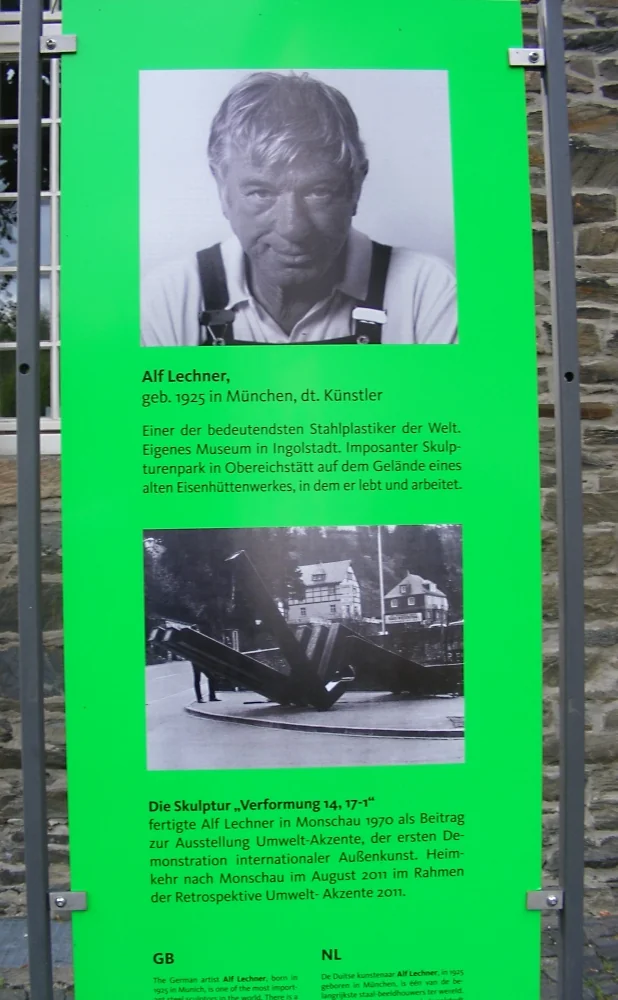
Image from Wikipedia
Image from Wikipedia
Alf Lechner – the Sculptor of Steel, Form, and Uncompromising Reduction
A Life for Material, Space, and Radical Clarity
Alf Lechner (April 17, 1925 in Munich – February 25, 2017 in Dollnstein) is one of the defining German sculptors of the post-war period. His work embodies a sculpture that views steel not merely as a material, but as a carrier of tension, rhythm, and energy. Evolving from an early painter and designer, he became an artist who redefined geometric forms with industrial precision and sensual power. ([lechner-museum.de](https://www.lechner-museum.de/de/alf-lechner?utm_source=openai))
Biography: From Drawing, Painting, and Shaping to Sculpture
Lechner's artistic journey did not begin immediately with sculpture. From 1940, he received painting lessons from Alf Bachmann by Lake Starnberg; his training was interrupted by the war and labor service before he returned to his teacher after 1945. Gradually evolving from initially impressionist landscape painting, he developed a more abstract attitude that later transitioned into his sculptural work, sharpening his focus on form, surface, and structure. ([lempertz.com](https://www.lempertz.com/de/kataloge/kuenstlerverzeichnis/detail/lechner-alf.html?utm_source=openai))
In the late 1960s, Lechner emerged as a sculptor in an environment still strongly influenced by figurative sculpture in Munich. It was precisely here that his reduced, analytical art gained definition: he dissected simple geometric bodies, manipulated steel with cutting, sawing, bending, rolling, and hammering, and developed a distinct, unmistakable visual language. This consistency made him an authority in constructive and abstract sculpture in Germany. ([lechner-museum.de](https://www.lechner-museum.de/de/alf-lechner?utm_source=openai))
Career: Awards, Teaching Position, and Museum Establishment
Lechner's career is closely linked to recognition by institutions and the professional community. In 1988, he won first prize in the competition “City Sculptor in the City Park Philippsruhe” in Hanau, in 1990 he received the “München leuchtet” gold medal, and in 1991 he was awarded the Critics’ Prize for Fine Arts from the Association of German Critics in Berlin. In 1992, he was honored with the Piepenbrock Prize for Sculpture, in 1994 he was a guest of honor at the Villa Massimo in Rome, and in 1995 he was appointed a full member of the Bavarian Academy of Fine Arts. ([lechner-museum.de](https://www.lechner-museum.de/de/alf-lechner?utm_source=openai))
Between 1990 and 1991, Lechner taught as a visiting professor at the Academy of Fine Arts in Munich. In 1999, he founded the Alf-Lechner Foundation, and a year later the Lechner Museum was established in Ingolstadt as a dedicated space for his work. The museum and the sculpture garden in Bavaria's Altmühltal continue to showcase how Lechner not only occupied space but understood it as an active component of his art. ([lechner-museum.de](https://www.lechner-museum.de/de/alf-lechner?utm_source=openai))
Development of Work: Steel as a Stage for Geometry, Tension, and Transformation
Alf Lechner's oeuvre is characterized by groups of works that often vary greatly in form yet follow the same intellectual discipline. Geometric analysis, rational penetration of forms, and reduction to elemental principles of form form the core of his art. Squares, rectangles, discs, beams, and cut volumes appear in ever-new constellations, without ever devolving into decorative randomness. ([storms-galerie.de](https://www.storms-galerie.de/kuenstler/alf-lechner/biografie?utm_source=openai))
Lechner's approach to industrial production and processing methods was particularly significant. The conversion of a former industrial building in Geretsried into a residence and studio opened up new opportunities for large-scale works. Here, a central feature of his work becomes evident: the intertwining of workshop, machine, material, and artistic decision. His sculptures do not appear manufactured in the classical sense, but emerge from a process of physical and mental condensation. ([lechner-museum.de](https://www.lechner-museum.de/en/alf-lechner?utm_source=openai))
Discography? No – a Sculptural Oeuvre with Exhibition History
Since Alf Lechner was a sculptor and not a musician, there is no discography in the traditional sense. Instead, his artistic development can be traced through exhibitions, museum presentations, and groups of works. Between 1998 and 2002, the Institute for Foreign Cultural Relations held a special exhibition featuring sculptures and graphics in eleven venues in Germany, Italy, France, Poland, the Czech Republic, Russia, and Hungary. This demonstrates the international reach of his art beyond the studio location. ([lechner-museum.de](https://www.lechner-museum.de/en/alf-lechner?utm_source=openai))
His membership in the German Artists' Association and participation in numerous annual exhibitions between 1969 and 1992 further attest to the continuity and visibility of his work within the contemporary art scene. His art was not perceived as a marginal phenomenon, but as a serious contribution to sculpture after 1945. The presence in museums, collections, and public spaces established Lechner as an artist whose work is intended to endure. ([dewiki.de](https://dewiki.de/Lexikon/Alf_Lechner?utm_source=openai))
Critical Reception: Recognition by the Art World and Professional Audience
The reception of Alf Lechner is characterized by respect for the consistency of his visual language. Sources describe his works as precise, strict, and simultaneously imbued with remarkable inner tension. The combination of constructive thinking and physical material processing distinguishes him from a purely intellectual minimal aesthetics and explains why his sculptures appear so present in space. ([storms-galerie.de](https://www.storms-galerie.de/kuenstler/alf-lechner/biografie?utm_source=openai))
Art journalism and museum communication repeatedly emphasize Lechner's ability to transform steel into a language of condensation. His works achieve impact not through narrative motifs, but through proportion, edge, weight, cut, and emptiness. This ascetic clarity lent him cultural weight far beyond the regional art scene and made him a reference point for abstract, material-based sculpture. ([archiproducts.com](https://www.archiproducts.com/de/news/schlosser-industriedesigner-bildhauer-alf-lechner_106224?utm_source=openai))
Cultural Influence: An Artist Between Industry, Space, and German Post-War Art
Lechner's significance lies in his ability to translate the industrial material steel into an almost musical order of rhythm and variation. His sculptures possess an architectural presence that structures rather than merely complements squares, halls, and outdoor spaces. Thus, he became an important representative of art that creates not illustration but immediate spatial experience. ([lechner-museum.de](https://www.lechner-museum.de/de/alf-lechner?utm_source=openai))
His influence extends into discussions about the role of sculpture in public spaces. Public commissions, museum foundations, international exhibitions, and his academic activities showcase an artistic life that cannot be reduced to individual masterworks. Lechner embodies that rare stance where craftsmanship, conceptual rigor, and physical presence merge into a cohesive artistic identity. ([lechner-museum.de](https://www.lechner-museum.de/de/alf-lechner?utm_source=openai))
Conclusion: Why Alf Lechner Continues to Fascinate Today
Alf Lechner remains captivating because his work transforms the seemingly hard, cold, and industrial into something highly concentrated and poetic. His sculptures do not ask for loud interpretation but for attentive encounter: with space, light, weight, and form. Anyone who experiences Lechner's art live immediately understands why he is considered one of the most distinctive German sculptors of the 20th century. ([lechner-museum.de](https://www.lechner-museum.de/de/alf-lechner?utm_source=openai))
Official Channels of Alf Lechner:
- Instagram: No official profile found
- Facebook: No official profile found
- YouTube: No official profile found
- Spotify: No official profile found
- TikTok: No official profile found
Sources:
- Lechner Museum – Alf Lechner
- Lechner Museum – Biography of Alf Lechner
- Wikipedia – Alf Lechner
- Walter Storms Gallery – Biography of Alf Lechner
- Lempertz – Biography of Alf Lechner
- Südwestgalerie – Art Lexicon Alf Lechner
- ArchiProducts – Smith, Industrial Designer, Sculptor Alf Lechner
- DeWiki – Alf Lechner
- Wikipedia: Image and text source