How Ingolstadt Is Changing – New Museum & Art
How Ingolstadt Will Change – New Cultural Venues and Ideas
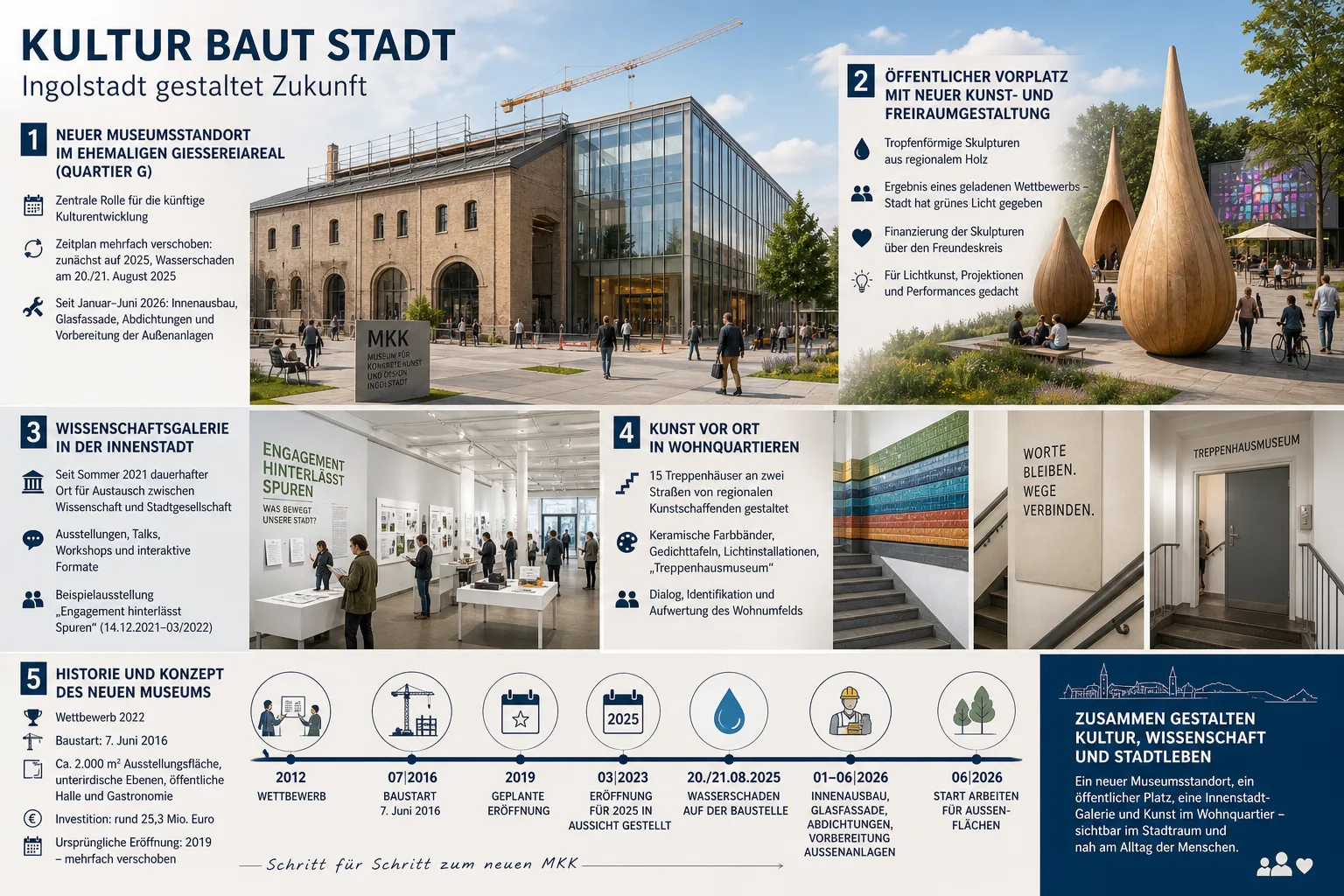
In the coming years, several cultural and educational venues will be created in Ingolstadt, aiming to more closely connect everyday life in the city with art, design, and science. The focus is on the future cultural quarter at the former foundry site, a new museum for concrete art and design with a publicly accessible forecourt, a science area near the city center with dialogue formats, as well as art projects that deliberately extend into residential and everyday spaces.
City in Transition: Culture as a Long-Term Process
Urban development is rarely noticeable as a single big leap. It often consists of many decisions: construction phases, new uses, participation formats, and small projects that gradually take effect. For Ingolstadt, it is becoming apparent that culture should in the future be understood even more as part of urban design – not just as an offering for special occasions, but as something that shapes paths, squares, and routines.
An important principle here: schedules, programs, and construction stages can change. Anyone wishing to follow the upcoming projects should therefore always check the current information from the responsible institutions.
From Industrial Site to Cultural Quarter: What Is Planned for the Foundry Area
A new quarter is expected to emerge around a former industrial site, bringing culture, design, public spaces, and urban life closer together. The goal is to gradually develop an area that was long primarily functional into a place where people consciously spend time: for exhibitions, events, education, and informal encounters.
For the city, this will mean shorter distances between cultural offerings, public open spaces, and everyday uses. For visitors, it can become an additional destination, complementing Ingolstadt’s city center with another, clearly visible cultural center.
The Planned Museum for Concrete Art and Design: Spaces, Ambition, and Use
A central element of future development will be the Museum for Concrete Art and Design. It is expected to be a building that not only offers classic exhibition spaces, but also flexible areas for education, events, and formats that connect art and design with contemporary issues.
What the Building Should Stand For
- Concrete art and design as a focus – with the ambition to make design visible as part of social debates.
- Openness through areas that can function even without a classic museum visit (e.g., lounge areas, supporting programs, possible gastronomy or meeting point offers).
- Cooperation with educational and cultural actors – for example, with universities, initiatives, and institutions from the region.
Thus, the museum will be understood less as a “quiet place” in the future, but rather as a platform: for changing exhibitions, discussions, workshops, and programs that are intended to appeal to different target groups – from school classes and students to people who use cultural offerings more spontaneously in everyday life.
A Public Square in Front of the Museum: Open Space, Light, and Art Outdoors
The development is not intended to end at the building’s edge. A public forecourt is planned, connecting the future museum with the quarter and the city. Such open spaces often determine whether a cultural venue is accepted in everyday life: as a meeting point, as a thoroughfare, as a place for pop-up formats – or as a quiet area to linger.
For the square, artistic and design approaches are conceivable that make the outdoor space itself part of the program: temporary installations, projections, light art, or smaller performances. What will be crucial is that the place remains easily accessible, clearly designed, and can actually be used – even without special prior knowledge.
Science in the City Center: Dialogue Formats That May Gain Importance in the Future
In addition to art and design, science can also become more visible in public spaces in the future. Formats are planned or can be expanded that make research understandable and at the same time enable real feedback: exhibitions with questions instead of ready-made answers, discussion evenings, interactive stations, or workshops where visitors can join the discussion.
Such offerings work particularly well when they are low-threshold: short distances from the pedestrian zone, clear language, clear entry points, and topics that are directly related to city life – such as mobility, climate resilience, health, digitalization, or social cohesion.
Art in Everyday Life: When Living Spaces, Stairwells, and Neighborhoods Become Exhibition Spaces
Another building block for the future is art that deliberately does not take place in the classic cultural space, but where people are every day: in residential complexes, stairwells, or semi-public passageways. Such projects can make design tangible as part of living together – without a ticket, without fear of thresholds, and without the expectation of having to “explain art.”
When a stairwell becomes a designed space – for example, through texts, color bands, light objects, or ceramic elements – the use changes: people are more likely to pause, conversations start more easily, and people become more aware of their surroundings. In the long term, this can create local added value that does not depend on major events, but on repetition and everyday contact.
What These Developments Could Mean for Ingolstadt in the Future
When the museum, public square, science formats, and art-in-everyday-life projects interlock, a network is created instead of individual beacons. For Ingolstadt, this could have several effects in the coming years:
- Higher quality of stay through spaces that not only “function,” but are gladly used.
- New reasons to visit the city – through changing programs and outdoor formats.
- Stronger exchange between universities, culture, administration, and urban society.
- Everyday participation, when offerings are accessible without major entry barriers.
Whether these goals are achieved will depend mainly on three points in the future: reliable communication about construction and program status, real participation opportunities, and a design that is low-barrier, safe, and inviting.
Sources and Further Information
- City of Ingolstadt (official website) — Project and administrative information (accessed 2026-06-24)
- Wikipedia: Concrete Art (Overview) — Classification of the art concept as background (accessed 2026-06-24)
- Federal Ministry for Housing, Urban Development and Building (BMWSB) — Background on urban development and public spaces (accessed 2026-06-24)