Film Production in Ingolstadt: Film & Television On Site
Film & Television made in Ingolstadt (2026+): Which Moving Image Projects Could Be Created Next
What could Ingolstadt look like in the coming months and years if moving images not only "join in" but become a fixed part of communication, culture, and education? This outlook shows which formats are likely to gain importance, how local productions can be planned, and which standards for quality, accessibility, and trust will be decisive in 2026+.
Which Formats Are Likely to Grow in Ingolstadt in 2026+
In the coming years, moving image formats will likely be developed even more along clear goals: reach, recruiting, sales, knowledge transfer, or community building. For Ingolstadt, the following types of projects in particular may be suitable:
- Recruiting and Employer Branding Series (multiple episodes instead of a single clip), to provide insights into teams, training, projects, and values.
- Product and Tech Storytelling with short, reusable modules: demo, application, benefits, FAQ, "behind the scenes".
- Explainer and Training Formats for internal communication, onboarding, and customer knowledge – with clear chapters, subtitles, and searchability.
- Short-Form Content (vertical, fast, precise), derived from larger productions.
- Cultural and City Formats that bundle events, places, and people in recurring episodes.
The key will be to build formats so that they can be reused over months (modularity), instead of relying solely on a single release day.
How Projects Will Be Planned in the Future: From Idea to Release
To ensure that moving images have a measurable impact in 2026+, planning will likely become more standardized. For projects in Ingolstadt, the following approach may prove effective:
- Define goal & target group: What should happen after the video (application, registration, purchase, donation, participation, understanding)?
- Core message in one sentence: A sentence that is checked again in every editing decision.
- Define distribution channels: Website, LinkedIn, Instagram, YouTube, internal platforms, trade show screens, press.
- Plan format set: A "hero" video plus several derivatives (15–30 seconds, teaser, vertical format, statements, chapter clips).
- Rights, approvals, data protection: Consents, music licenses, trademark rights, filming permits, and a clear approval process.
- Quality criteria before filming: Audio intelligibility, image look, subtitle strategy, corporate design, accessible design.
- Release plan: Publication rhythm, community management, update cycles, and success measurement.
Those filming in Ingolstadt will particularly benefit in the future if locations, interview partners, and schedules are chosen so that several versions can be created in a short time (e.g., an interview day results in a website video, social clips, and quotes for text at the same time).
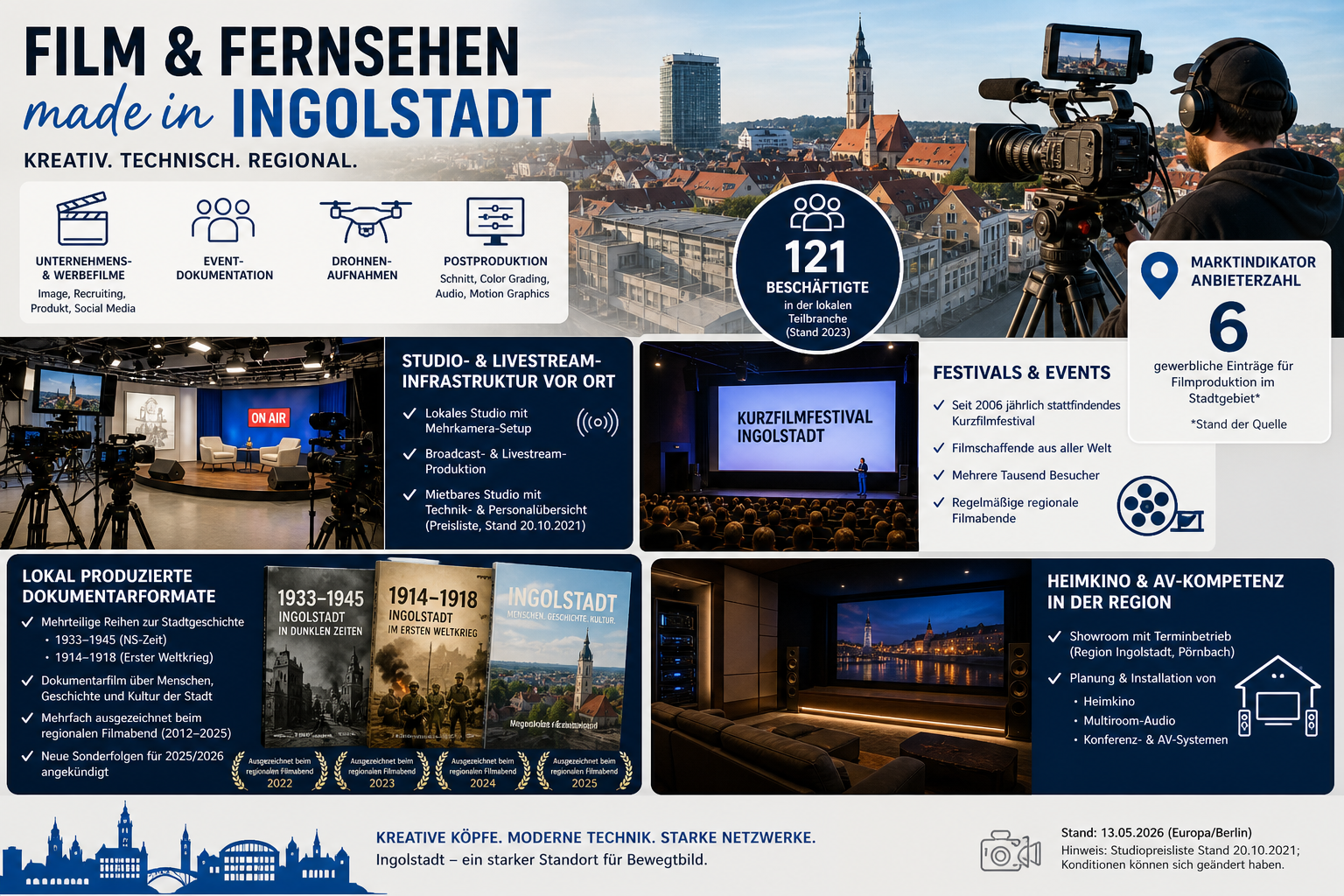
Studio & Livestream: How Hybrid Events Can Work in the Future
Hybrid events are expected to become even more professionalized in the coming years: not as "the camera is just running," but as their own broadcast with dramaturgy. For Ingolstadt, three models may be suitable:
- Studio format: Moderation, guests, inserts, graphics, clear schedule – suitable for town halls, panels, product updates.
- On-location livestream: Stage or conference room with additional direction to serve a live audience and online viewers equally.
- "Live-to-tape": Recording in a live setup, followed by a brief fine cut for a more stable release.
What Can Be Expected as Standard in 2026+
- Editorial: Briefing, run-of-show, moderation cards, speaker coaching.
- Technology: Multi-camera, consistent lighting, redundant audio, clear signal paths, secure inserts.
- Accessible distribution: Easily readable lower thirds, sufficient contrasts, subtitles (live or provided shortly after).
- Reuse: Chapter clips, highlight reels, quote snippets, blog or newsletter integration.
This turns a single event into a content package that can continue to generate reach and value in the weeks after the event.
Postproduction 2026+: Subtitles, Versions, Short-Form, and Corporate Design
In postproduction, two requirements will dominate in the future: platform suitability (multiple formats per channel) and intelligibility (audio, subtitles, structure). For projects in Ingolstadt, the following delivery packages may become established:
- Master (e.g., 16:9, 4K or Full HD as needed) plus social versions (9:16, 1:1) with adapted image sections.
- Subtitles as a burned-in version for social as well as a separate file (e.g., WebVTT) for websites and platforms.
- Brand template: recurring lower thirds, intro/outro, chapter layout, color scheme, typography.
- Sound polish: intelligible speech, controlled loudness, consistent music beds with clean licensing.
- Versioning: different lengths, languages, or target group variants (e.g., recruiting vs. sales).
Those who want to keep their content up to date in the long term will also work more often with "review appointments": short, planned updates instead of complete new productions.
Skills & Entry: What Young Talents and Career Changers Can Prepare For
For people in Ingolstadt who want to get into moving images in 2026+, hybrid profiles will likely become more important: technical understanding plus storytelling plus platform knowledge. Those who prepare can focus on the following areas:
- Camera & lighting: Basics that ensure stable quality even with small teams.
- Audio: Record and post-process speech intelligibly (often the biggest quality lever).
- Editing & motion: Clean dramaturgy, fast social derivatives, graphic standards.
- Production: Calculation, scheduling, rights/consents, set organization.
- Editorial: Conducting interviews, script, fact-checking, clear messages without exaggeration.
A convincing portfolio will in the future be less about quantity and more about traceability: goal, role in the team, result, learning effect, and (if possible) a metric for impact.
Festivals, Film Nights, Screenings: How the Scene Can Become More Visible
If film nights, short film programs, or festival editions take place in Ingolstadt in 2026+, their impact can increasingly extend beyond the screen. Examples of formats that could be included in future programs:
- "Meet the Crew": short workshop talks about filming, editing, sound, financing, and distribution.
- Pitch-&-Match Nights: Projects are presented, teams find camera, audio, locations, postproduction.
- School and university windows: Curated programs plus teaching materials or Q&A sessions.
- Audience formats: Thematic series (e.g., city, technology, family, sports, migration) with discussion rounds.
This way, events can become recurring hubs: visible, plannable, and connectable for new collaborations.
Documentary City Stories: How Ingolstadt Can Explain Itself in the Future
In the coming years, documentary formats could be particularly convincing if they do not just "illustrate" Ingolstadt, but use it as a narrative space: people, professions, places, language, change. Robust approaches are suitable for future documentary projects:
- Portraits: Individual people or teams as a reflection of larger topics (work, training, volunteering, culture).
- Places as chapters: Each episode explains a place and its significance for everyday life, the economy, or city life.
- "How it works": Infrastructure and processes (e.g., mobility, event technology, crafts, research) as understandable stories.
- Participatory projects: Citizens provide material, professionals curate and verify, so that trust and quality come together.
For credibility, it will be central in the future to make sources, filming circumstances, and possible conflicts of interest transparent – especially when clients are involved.
Checklist for Clients in Ingolstadt
Anyone planning a film or livestream project in Ingolstadt 2026+ can use this short checklist to avoid typical friction losses:
- Goal clear? A primary action (e.g., apply, register, buy) and a secondary one (e.g., inform).
- Target group concrete? Who decides, who uses, who influences?
- Format set defined? Master + social + website version + subtitles.
- Approval process fixed? Who is allowed to approve what by when (and who is not)?
- Rights clarified? Music, people, brands, locations, archive material.
- Accessibility planned? Legibility, contrasts, subtitles, clear language.
- Measurement prepared? KPI per channel (e.g., applications, registrations, watch time, click rate).