Discover Spiritual Places & Meditation in Ingolstadt
Spiritual Places & Meditation in Ingolstadt: Ideas for Your Next Quiet Appointments (from Fall/Winter 2026)
This guide helps you find suitable places and formats in Ingolstadt and the surrounding area for the coming weeks and months – from quiet church times to mindfulness in the studio to planned monastery days. All information is intended as an outlook: Please always check specific times directly with the providers.
Upcoming Meditation Formats: Sound, Breath, Guided Relaxation
In and around Ingolstadt, courses and sessions are regularly offered that are well suited as an introduction or for deepening your practice. For the coming months, these formats are particularly practical – because they are clearly structured and work without much prior experience:
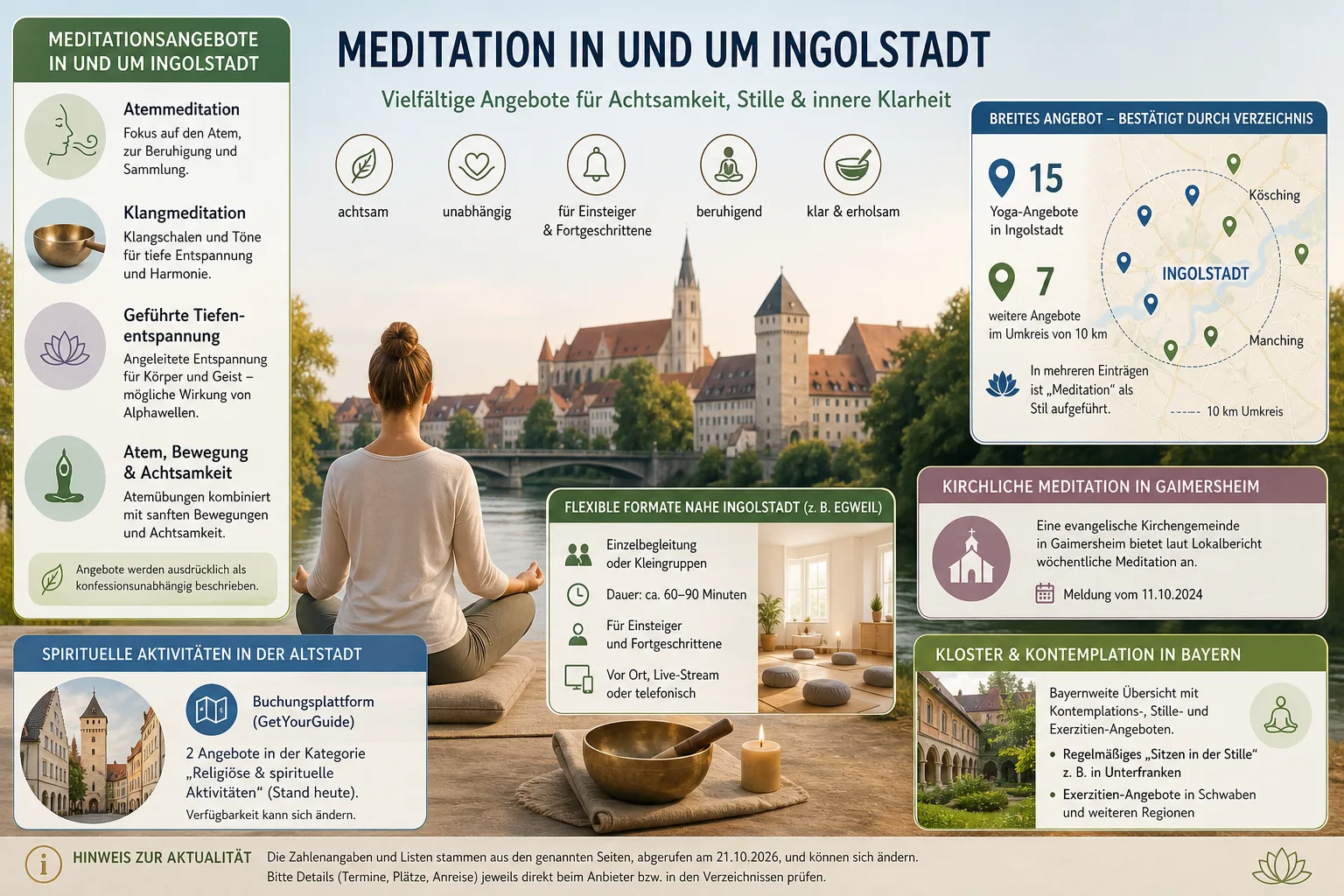
Sound Meditation (e.g., Singing Bowls)
In sound formats, you lie or sit comfortably while sounds and vibrations (e.g., singing bowls) focus your attention. If you are looking for a "gentle introduction" in the coming weeks, sound is often low-threshold: You don't have to "achieve" anything, just perceive.
- Suitable if your mind races quickly and you need an external focus.
- Practical tip for your next appointment: Eat lightly beforehand, plan 15 minutes afterwards without obligations.
Breath Meditation & Mindful Sitting
Breath-based meditation is one of the most robust foundations for a long-term practice: You train to bring your attention back without forcing anything. For the winter months 2026/2027, this is ideal because you can easily transfer the exercise to your home.
- Sit upright, comfortably, and stably.
- Breathe normally and observe the breath at one point (nose, chest, abdomen).
- If thoughts arise: notice them, return to the breath – kindly, without judgment.
Guided Deep Relaxation (Body Scan, Progressive Relaxation, Yoga Nidra-Oriented)
Guided relaxation techniques can be a good supplement during stressful phases (end-of-year rush, project phases, exam times). For your next appointments, it is worth paying attention to reputable course descriptions: It should be clearly stated what will be done, how long the session lasts, and who it is suitable for.
- Good if you want to get a handle on sleep pressure and inner restlessness – without having to "meditate hard."
- For starters, choose short formats (45–75 minutes) before booking longer sessions.
- 2× per week: 10 minutes of breath meditation at home.
- 1×: a guided format (sound or deep relaxation) on-site or live online.
- 1×: a silent visit to a place (church space or quiet path) with no performance goal – just arrive.
Places in the City: Church Spaces, Old Town, Quiet Paths
Churches as Silent Anchor Points (Planning Idea for the Coming Weeks)
If you are specifically looking for "windows of silence" from fall/winter 2026, churches in downtown Ingolstadt that are open during the day can be a simple starting point: short distances, clear atmosphere, no course commitment. For your next visits, a small routine is worthwhile:
- Set a time frame: 10–20 minutes is enough.
- Enter without a program: sit down, arrive, count breaths (e.g., up to 10, repeat).
- Conclusion: 1 minute of conscious standing up and slow walking before returning to everyday life.
Old Town as "Walking Meditation"
For the coming months, a walking meditation in the old town can be a realistic alternative if sitting is difficult. Choose a short round (15–30 minutes) and keep your attention on:
- the contact of your feet with the ground,
- the rhythm of your steps,
- the breath accompanying your walk.
Important: The goal is not to block out the city, but to remain calm while moving through it consciously – a skill that pays off especially in everyday life.
Studios & Course Rooms: Meditation as a Fixed Appointment
If you need commitment in the coming weeks, a recurring studio appointment is often more effective than "just occasionally." When choosing, pay attention to transparent information: course leader, duration, target group, costs, cancellation policies, contraindications (e.g., for sound/relaxation).
Many providers also offer formats for individual guidance or small groups. This can make sense for the coming months if you:
- start with strong stress symptoms and need structure,
- want to clarify questions about technique (sitting, breathing, dealing with thoughts),
- want to build a practice that fits your work schedule or family life.
Planning for the Coming Months: How to Find Reliable Appointments
Since course schedules and opening hours can change, it is most reliable to approach your next steps like a small research project. This way, you will have a coherent, realistic plan for the coming weeks – without disappointment at closed doors.
- Set a time window: e.g., "Tuesdays 19:00–20:30" or "Saturday mornings."
- Choose a format: sound, breath, body scan, yoga + meditation, or silent place visit.
- Quality check: clear course description, verifiable qualification/experience, transparent conditions.
- Gentle start: initially book single appointments or short course blocks.
- Follow-up: after each appointment, write down 3 sentences (What helped? What was difficult? What will I try next time?).
If you practice regularly in winter 2026/2027, a noticeable effect often arises not from intensity but from repetition: small, plannable units – but consistent.
Excursions from Ingolstadt: Monasteries & Contemplation (Planning 2026/2027)
If you are looking for a deeper retreat in the coming months, monastic offerings in Bavaria can be a suitable addition. Many houses offer forms of "sitting in silence," contemplation, or retreats – sometimes with guidance, sometimes as a clearly structured silent framework.
For your planning from now on, the rule of thumb is: The quieter and longer the format, the more important good preparation and a suitable time (e.g., not directly after an extremely stressful work phase).
- Short retreat (1 day/1 night): good for getting to know.
- Weekend: good depth without being overwhelming.
- Several days: rather if you already have experience or are well accompanied.
For a reputable selection in 2026/2027, make sure that the house or organizing body clearly describes the content, daily structure, costs, and requirements.
Safety & Boundaries: What You Should Pay Attention To
Meditation can be very helpful – but it is not a substitute for medical or psychotherapeutic treatment. For the upcoming appointments, the following is especially true:
- If you are currently suffering from severe anxiety, depression, trauma-related symptoms, or acute crises, choose more stable, guided formats and, if necessary, clarify professionally in advance what is suitable for you.
- For sound formats: If you are very sensitive to noise, ask in advance about volume, instruments, and break options.
- A good offer always gives you the option to modify an exercise or to opt out – without pressure.
Health-related effects are being researched; individual experiences can vary greatly. Take changes seriously and seek support if exercises noticeably destabilize you.
Sources
- NCCIH (National Center for Complementary and Integrative Health): Meditation and Mindfulness — Overview of effectiveness and safety (accessed 2026-10-21)
- American Psychological Association (APA): Meditation — Classification from a psychological perspective, opportunities and limitations (accessed 2026-10-21)
- NHS (UK): Mindfulness — practical advice, precautions, introduction (accessed 2026-10-21)