Neighborhood Festivals & Team Events in Ingolstadt
Neighborhood Festivals & Community Events in Ingolstadt: Ideas, Venues, and Planning for the Coming Months
Whether it's a courtyard party, winter rally, or joint neighborhood action: This guide shows how you can strengthen neighborhood and community in Ingolstadt in the future – with practical formats, suitable venues, and planning that remains legally and organizationally sound.
Digital Event Calendars: Find Inspiration, Avoid Scheduling Conflicts
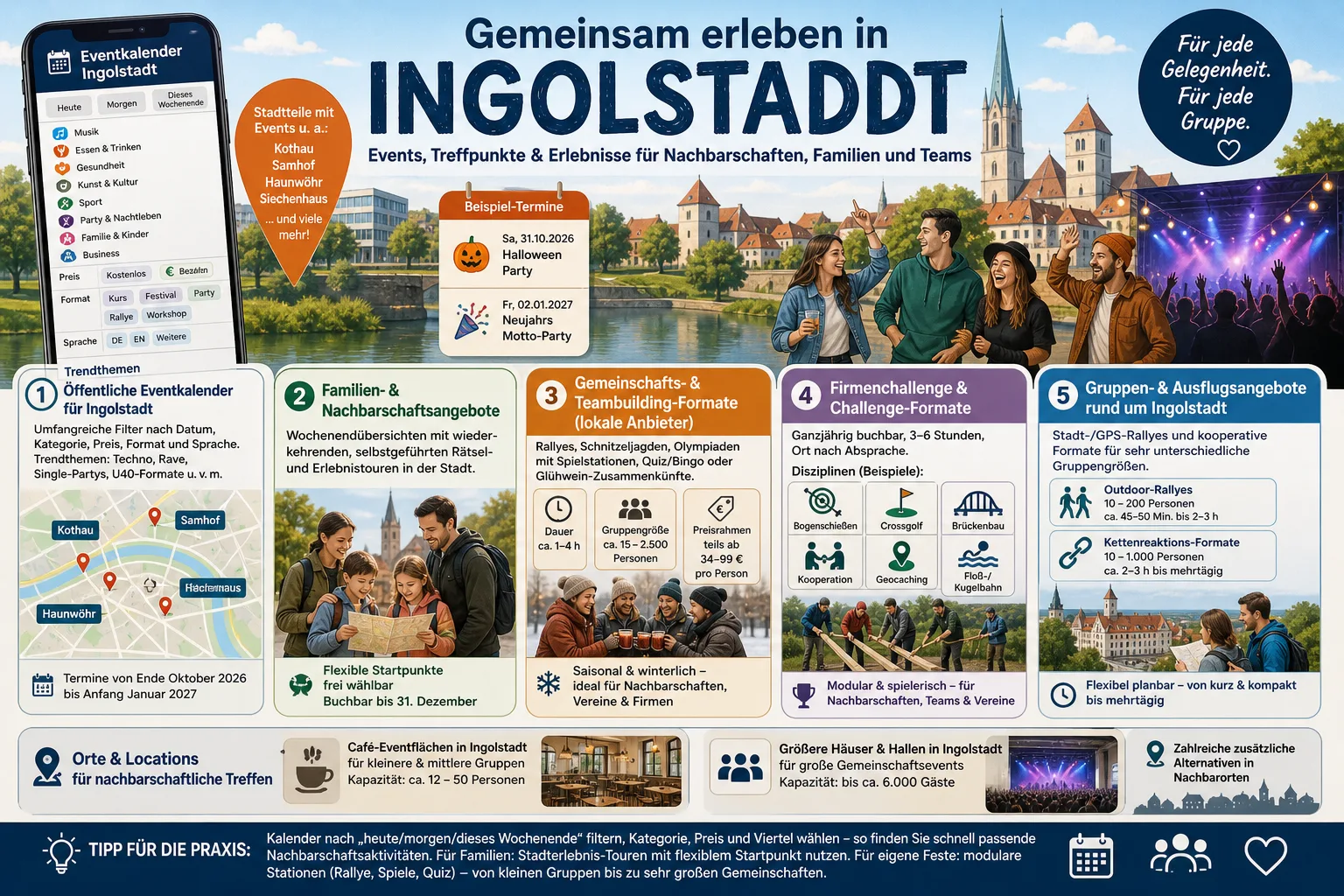
If you are planning a future event in Ingolstadt, it is worth first taking a look at digital event calendars. They help you find suitable time slots, avoid overlaps, and gather ideas that can be adapted for a neighborhood festival (e.g., theme evenings, small workshops, open participation activities).
When researching, pay particular attention to:
- Time Period Filters (e.g., weekends, holidays, Advent season) – helpful for choosing a realistic date for your next meeting.
- Categories (Culture, Children & Family, Sports, Food & Drink, Music) – good for defining a theme for your neighborhood.
- Price/Cost Information – so your format matches the target group (free, cost-sharing, donation box, or ticket model).
Practical tip: Deliberately schedule your neighborhood festival on a date when there are fewer major events in your immediate area. This increases the chance of participation and reduces parking and noise conflicts.
Family-Friendly Formats: Flexible, Low-Threshold, Repeatable
For the coming months, formats that do not require complicated registration and can adapt to different daily rhythms have an advantage. This is especially true for families – and for neighborhoods where shift work, daycare times, or caregiving duties must be considered.
Proven Ideas You Can Implement at Short Notice
- Mini Scavenger Hunt in the Neighborhood (30–90 minutes): 6–10 stations, simple clues, finish in the courtyard or park.
- Neighborhood Quiz Night (60–120 minutes): Questions about Ingolstadt, the neighborhood, hobbies – in the community room or café.
- “Bring & Share” Picnic (Summer/Early Fall): Everyone brings a little something, allergens are clearly labeled.
- Winter Rally (Late Fall/Winter): Short outdoor stations, warm drinks afterwards, reflective elements for children's groups.
To ensure no one feels excluded, always plan a quiet alternative (e.g., craft table, conversation corner) and design tasks in at least two levels of difficulty (children/adults).
Learning from Team Event Methods: Game Formats that Connect Neighborhoods
Many methods from team events can be transferred to future neighborhood festivals – not as a “corporate program,” but as a light framework that facilitates encounters. The common denominator is simple: short cooperative tasks that create opportunities for conversation.
Building Blocks that Scale Especially Well for Neighborhoods
- Cooperation Games (10–20 minutes): e.g., “Paper Tower,” “Marble Run from Everyday Materials,” “Bridge Building.”
- Bingo/Quiz (20–45 minutes): e.g., bingo with statements like “knows the names of three neighbors” (voluntary, data-sparing).
- Station Run (45–120 minutes): 5–8 stations, small point scoring, group photo at the end (only with consent).
- Joint Mini Project: Decorations for the next Advent celebration, planting campaign, swap shelf start (with clear rules).
Important for trust: Communicate transparently in advance whether photos will be taken, how long the event will last, whether there will be loud program items, and who will be available on site as a contact person.
Rallies, Challenges & Mystery Formats: Making Collaboration Playful
For future community events, rallies and “challenge” formats are particularly suitable because they can activate different age groups and provide structure at the same time. The trick is to keep tasks short and plan routes safely.
Three Formats for Your Next Neighborhood Event
-
Rally Through the Neighborhood:
Teams (e.g., per house or entrance) solve tasks at stations such as playground, park entrance, or courtyard. Plan a maximum route of 2–3 km so that children can easily keep up.
-
Light Mystery Game:
Short role or clue cards that do not require private data. The solution is revealed together at the end (e.g., at the punch stand).
-
Chain Reaction / Marble Run:
Each group builds a section, everything is connected at the end. The result is visible and strengthens the “we” feeling – ideal as a program item for the next neighborhood celebration.
For safety and acceptance: Avoid tasks that require entering private property, and use public, well-lit paths – especially for winter and evening formats.
Places of Encounter: From Courtyard to Hall
The right location determines whether an event remains relaxed. For upcoming neighborhood festivals in Ingolstadt, there are basically three practical categories – depending on group size, weather, and noise sensitivity:
1) Small Gatherings (approx. 8–40 people)
- Café or side room (quiet conversation atmosphere)
- Community room in the building (short distances, good for games/quiz)
- Courtyard (in good weather, with clear quiet times)
2) Medium Events (approx. 40–200 people)
- Club rooms, multipurpose rooms, suitable outdoor areas
- School/sports-related areas (only with permission and coordinated use)
3) Large Community Actions (200+)
- Halls/event venues with professional infrastructure (sanitary facilities, escape routes, fire protection)
- Cooperation of several groups (e.g., clubs) with a clear responsibility structure
For every size: Clarify usage conditions early (noise, end time, cleaning, waste, electricity) and name a responsible contact person for residents.
Planning Checklist: From Idea to Safe Execution
With this checklist, you can prepare your next neighborhood festival or community event in Ingolstadt in a structured way – without unnecessary stress shortly before the date.
Concept & Communication
- Goal & Target Group: Who do you want to reach (building, street, neighborhood, club, mixed age groups)?
- Format & Duration: Plan realistically (2–4 hours is often enough).
- Invitation: Notice + digital message; should include start/end, location, cost model, contact.
- Quiet & Consideration: Communicate noise level and end time in advance.
Law, Safety, Neighborhood
- Permits: Check if a permit is required for your location/size (public space, street use, larger structures).
- Music: For public music use, rights/registrations may be relevant.
- Youth Protection: If alcohol is involved, set clear rules (distribution, times, responsible person).
- First Aid: At least a small kit and a clearly named contact person; for larger events, also a defined procedure.
- Hygiene: For food distribution, pay attention to cleanliness, allergens, and the cold chain (especially for perishable foods).
Program That Really Works
- Gentle Start: Arrival, optional name tags, brief welcome.
- Active Core: Rally/station run/quiz (clear time frame, simple rules).
- Quiet Conclusion: Food/drinks, conversation corner, music at an appropriate level.
- Feedback: A simple question at the end (“What was good? What should we do differently next time?”) helps plan the next meeting even better.
Note: This article is a general guide for planning future events and does not replace individual legal or safety advice. If in doubt, check the applicable regulations of the relevant authorities.