Music Festivals in Ingolstadt: The Most Beautiful Festival Highlights
Music Festivals in Ingolstadt: The Highlights in the Coming Festival Year
What does a city feel like where almost all year round a stage is shining somewhere, a bass is thumping, or a string quartet fills the evening sky in Klenzepark? Ingolstadt demonstrates it impressively: From classical music under the open sky to electronic nights in indoor format, the Danube city spans a musical arc that appeals to both locals and guests alike.
This guide bundles the most important annually recurring music festivals in Ingolstadt, explains what makes them special, and helps you with planning, tickets, and visiting – without fixed date commitments, as the concrete dates are published separately by each organizer's website.
Audi Summer Concerts: Classical, Crossover and Festival Café
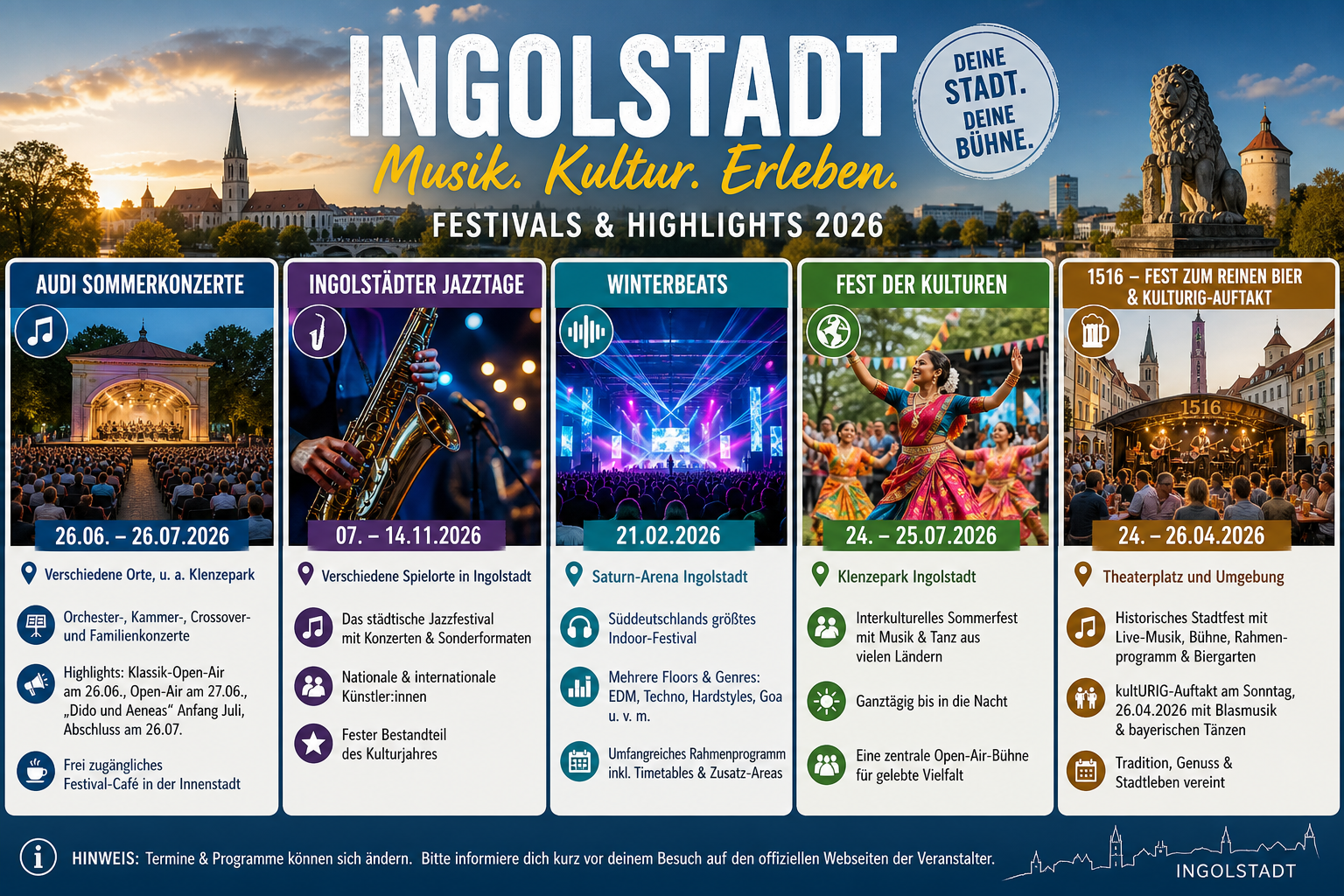
The Audi Summer Concerts are among the most well-known musical summer formats in the city. Depending on the year, the range extends from classical music to crossover projects and concerts that are deliberately curated to be low-threshold for a broad audience. It is precisely this mix that makes the format attractive: it is both sophisticated and accessible.
Characteristic is the combination of concert evening and relaxed festival atmosphere. Those who arrive early can enjoy the surroundings, secure a spot, and start the evening with a drink or conversation before the actual program begins. The combination of high-quality repertoire and summery lightness shapes the special appeal.
Since the summer concerts are often in high demand, it is worth keeping an eye on presale starts and possible contingents. Those who remain flexible often find various program lines suitable for both regular classical fans and the curious.
Ingolstadt Jazz Days: Jazz, Soul, Funk & Improv
Later in the year, the Ingolstadt Jazz Days often take over the musical direction. The festival usually brings together a mix of international jazz, the regional scene, and projects that open genre boundaries towards soul, funk, world, or improvised music.
Typical is the distribution across several locations: from concert halls to club formats to special venues that are transformed into jazz spaces for the festival period. It is precisely this change of atmosphere that creates the appeal, when an evening begins with an intimate set and later transitions into an energetic club concert.
For club nights with limited capacity, presale is often crucial. At the same time, many festival programs also offer formats suitable for beginners, such as moderated concerts or themed evenings.
Winterbeats: Electronic Indoor Festival
If you are looking for electronic music, Winterbeats offers a distinctive indoor format: while it is cold outside, the festival typically transforms a large venue into several floors with different musical directions – depending on the year, ranging from EDM to techno and hardstyles to Goa/trance-like sounds.
The concept thrives on parallel stages, light and show elements, as well as a line-up that often combines well-known acts and regional DJs. For many, Winterbeats is a fixed date in their personal music calendar – as a concentrated night in winter instead of open-air in summer.
Practically important: For nighttime indoor festivals, good planning determines comfort. Pay attention early to ticket tiers (e.g., early-bird/regular), entry rules, cloakroom, arrival and departure, as well as official information on awareness, safety, and youth protection.
Festival of Cultures in Klenzepark: Music as a Bridge
In summer, Klenzepark often becomes a colorful panorama of stands, scents, and sounds during the Festival of Cultures. Music and dance take center stage as a common language – from folklore to modern pop and band formats to intercultural program items that invite participation.
The open-air stage is a meeting point for families, clubs, and initiatives. The program is typically designed so that coming and going is easy. For many, the festival is a low-threshold entry to live music, because atmosphere and encounters are just as important as the individual act.
Depending on the setup, admission can be free or very low-threshold. For details (admission, times, program), rely on the official publications of the city or organizers.
1516 – Festival for Pure Beer & kultURIG: Tradition with Live Music
When Ingolstadt celebrates its historical heritage in the city center, live music is usually a matter of course. The 1516 – Festival for Pure Beer combines brewing culture and city history with a stage program that, depending on the year, ranges from brass music to regional bands to evening open-air sets.
In this setting, the kultURIG series is also often visible: Traditional elements such as costumes, dances, and folk music stand alongside an audience that ranges from beer garden regulars to casual passersby. This is precisely what creates the character of a city festival, where people come for the market and encounters – and stay for the music.
Many program points in city festival concepts are freely accessible; individual special events may still have ticketing or access restrictions. Binding information is always provided by the official program.
Planning, Tickets and Trends: How to Make the Most of the Festival Year
-
Calendar View & Presale
Start with official overviews (city event calendar, festival websites). For highly sought-after concerts or club nights, early booking is worthwhile. At the same time: multi-day festivals often offer alternatives if a desired evening is sold out.
-
Read the Line-up – and Discover Consciously
The line-up reveals what an evening will sound like. Those who plan openly often find newcomers, local acts, or special collaborations that later become personal highlights.
-
Experience the City through Music
Festival visits in Ingolstadt are often also a city tour: routes between venues lead through historic alleys, modern districts, and along the Danube. Plan buffer times – especially when changing locations and for evening programs.
-
Safety, Accessibility, Consideration
Inform yourself in advance about accessibility, entry rules, hearing protection (especially for indoor floors), nighttime travel, and official awareness/safety concepts. Consideration for residents, the environment, and fellow festival-goers is part of responsible celebration.
Conclusion: Musically, Ingolstadt is much more than a stopover. Those who keep an eye on upcoming festival programs can experience an astonishingly broad spectrum – from classical to electronic, from jazz to world music, from city festivals to intercultural open-airs – and a city that visibly brings culture into public space.