Discovering Industrial Heritage & Architecture in Ingolstadt
Industrial Heritage & Architecture in Ingolstadt: Your Program for Upcoming Discoveries
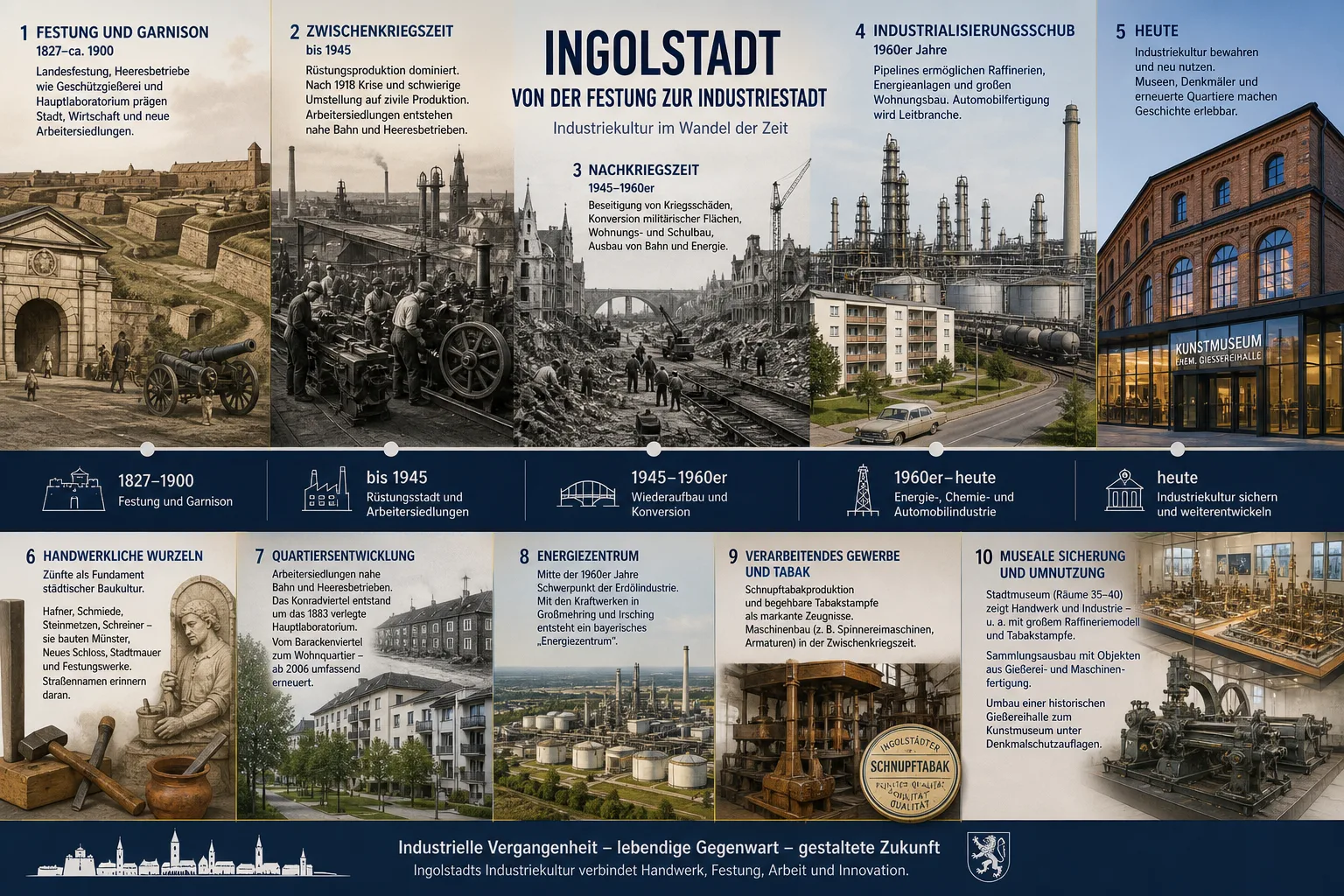
Ingolstadt can be experienced in the coming weeks and months as an “open-air archive” of industrial heritage: on city walks along former military and production sites, in museums, at architecture stops, and through neighborhoods whose layouts are still shaped by work and infrastructure. This article is designed as a forward-looking planning and experience guide: You’ll get an actionable program, booking tips, and a route that you can flexibly follow in the future.
Program Ideas for Your Next Visit
1) Upcoming Themed Walk: “Infrastructure & Change” (approx. 90–120 minutes)
Plan a walk focusing on transport, energy, logistics and the question of how these systems shape neighborhoods and architecture. The goal is not to “tick off” individual years, but to recognize in the urban space why certain building types and areas look the way they do.
- Observation task: Where can you spot wide axes, proximity to tracks, loading yards, or large-scale halls?
- Architecture notes: Material changes (brick/concrete/steel), functional facades, large spans, reduced ornamentation.
2) Upcoming Museum Block: “Craft, Technology, City” (approx. 60–120 minutes)
If you plan to visit a museum in the near future, it’s recommended to go with a clear question: How does craft become industrialized production – and how does that shape urban space? This makes the museum visit tangible even without prior knowledge.
- Pre-check: Check opening hours, ticket info, and special exhibitions on the official website.
- On-site check: Clarify photography/filming and baggage rules in advance to ensure a smooth visit.
3) Upcoming Architecture Focus: “Old Meets Reuse” (approx. 2–3 hours)
For a future visit, plan specific stops at places where existing structures and new uses visibly interact (e.g., at cultural venues, renovated areas, neighborhood edges). Pay attention to the design of transitions: entrances, courtyards, paths, signage, public spaces.
- Observation task: Which elements remain visible (structure, masonry, grid), which are added (glass, new stairs, new pathways)?
- Discussion question: Does the reuse feel like “building on” or like a contrast?
4) Upcoming Family or Group Plan: “Hands-On Industrial Heritage” (approx. 60–90 minutes)
For families, school classes, or groups, a program that works less through data and more through functions is suitable: living, working, transport, energy, supply. Plan short stations with tasks (sketch, photo, measure sounds/path widths, compare materials).
- Material task: Count three different building materials and note which functions they suggest.
- Space task: Find a spot where you can compare an “old” and a “new” urban building block in one field of view.
Self-Guided Route (2–4 Hours) – Flexible for Upcoming Dates
This route is designed as a future-proof plan: You can walk it on any future day and shorten or expand it depending on the weather, opening hours, and your energy level. Since individual interiors may vary, the route is deliberately designed to work in the urban space, with museum stops remaining optional.
-
Start: City Center / Old Town Edge
Start where the city is dense, small-scale, and walkable. Observe how ground floor uses (shops, gastronomy, services) differ from large-scale functional buildings.
-
Transition Zones: Edges, Axes, Breaks
Walk deliberately along edges: Where does the scale change? Where do spaces open up, where do “leftover spaces” or wide corridor areas emerge? Such transitions are typical traces of infrastructure and later replanning in many cities.
-
Neighborhood View: Living Near Work (without disturbing private areas)
Plan a section where you compare settlement structures: block edges, courtyards, rows, green corridors. Pay attention to path layouts, distances, lighting, and the organization of community spaces.
-
Optional Museum Stop
If you want to include a museum visit in the near future, place it here: It provides context on technology, work, and urban development and makes observations from the route easier to classify.
-
Conclusion: Reflection Point
Finish at a place where you can see several eras or functional layers at once (e.g., an axis with mixed building types). Note three things: What seems “preserved”? What seems “converted”? What seems “newly planned”?
Tip for future visits: If you want to add a guided tour, check the official event calendar of the city, museums, or tourist office for upcoming dates and bookable formats.
Museums & Exhibitions: How to Find Upcoming Offers
To make sure you only plan future offers, this process is recommended:
- Check official websites: Opening hours, special exhibitions, and educational programs are continuously updated there.
- Filter event calendars: Use date filters (from today) for tours, lectures, action days.
- Clarify ticket and group conditions: Especially for groups, it’s worth making an early inquiry for upcoming dates.
- Check accessibility: Elevator availability, paths, seating, quiet areas.
This ensures your visit calendar remains reliable without relying on outdated program info.
What to Look for Architecturally
Industrial heritage rarely appears only in “beautiful” individual buildings. For future explorations, it helps to look for recurring features that you can find in different parts of the city:
- Scale & Grid: Large hall or window axes indicate production, storage, or infrastructure.
- Material logic: Steel/concrete/brick are often used functionally; details like lintels, beams, or column spacing tell a lot about use.
- Paths & Logistics: Wide driveways, maneuvering areas, former loading zones, or proximity to tracks explain building forms.
- Reuse signals: New entrances, glass joints, added staircases, guidance systems, and outdoor design mark the transition to new functions.
- Neighborhood structure: Block edges, courtyards, and green corridors can show how living and working (or their reuse) are spatially organized.
Practical Planning: Arrival, Accessibility, Weather, Photo Rules
- Arrival: For future dates, a combination of train/public transport plus walking is often sensible; check current construction work and detours.
- Accessibility: For longer routes, plan rest points and inform yourself in advance about curbs, slopes, and elevators at indoor stations.
- Weather: Industrial heritage routes also work in the rain if you plan museum or indoor stops as buffers.
- Photography: In public spaces, photography is usually straightforward; museums often have their own rules. Check these before your visit to avoid trouble.
- Respect in the neighborhood: Many interesting structures are in residential areas. Stay on public paths and respect privacy.
Sources & Further Links
- City of Ingolstadt (official website) — Information on the city, culture, and possibly event calendar (accessed 2026-07-08)
- Bavarian State Office for Monument Preservation (BLfD) — Basics on monument protection and preservation in Bavaria (accessed 2026-07-08)
- City Museum Ingolstadt (official website) — Opening hours, exhibitions, programs (accessed 2026-07-08)
- Tourism Ingolstadt (official website) — Tours, guided visits, bookable offers, and current information (accessed 2026-07-08)