Experience Zero Waste & Green Events in Ingolstadt
Zero Waste & Green Events: How Ingolstadt Will Celebrate Sustainably in the Coming Months
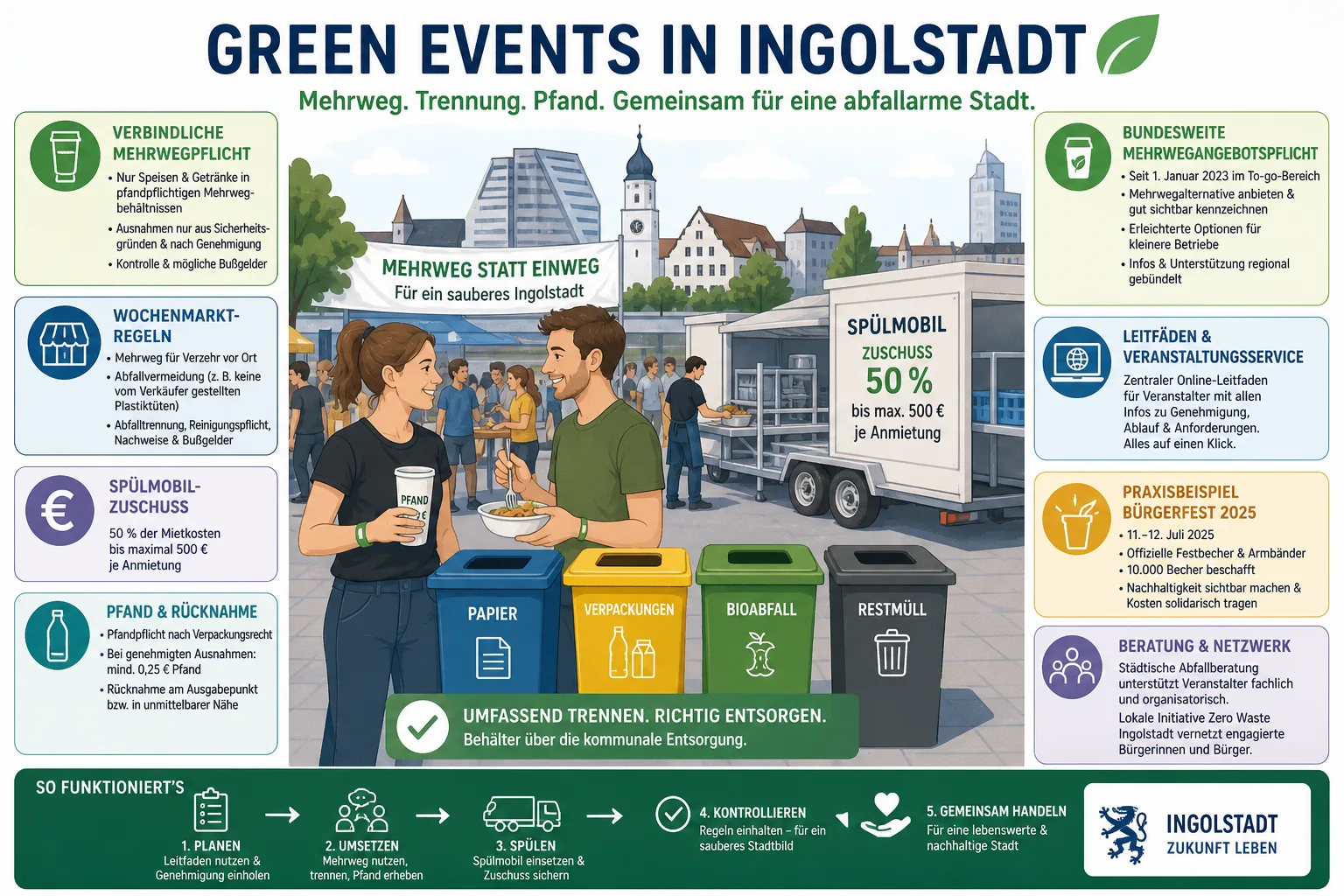
If you are planning to attend a neighborhood festival, club event, cultural open-air, or a market visit in Ingolstadt soon, you can noticeably reduce waste without sacrificing atmosphere or enjoyment. The key factors are a clean reusable setup, clear deposit and return pathways, and highly visible waste separation.
Setting the Framework: Reusables, Deposits, and Waste Concept
1) Reusables as Standard (Consistently Plan for Upcoming Events)
If you are planning an event in Ingolstadt, reusables are the most reliable lever for zero-waste results: sturdy cups, reusable dishes, and a clear return policy. Don’t plan reusables “on top,” but as a fixed part of serving, catering, and logistics.
2) Design Deposits So That Returns Actually Happen
For the next event: Deposits should be well communicated, easy to understand, and above all linked to a short return distance. A deposit system works especially well when:
- The deposit amount is clearly posted (at the stand, at cash registers, on the event map),
- Returns are possible at the stand or at nearby return points,
- Return points are positioned so that they are on the way to exits/toilets/hotspots.
3) Finalize Waste Concept in Advance (Not Just on the Event Day)
For upcoming approval and planning processes, a simple waste concept with three components helps:
- Prevention: Avoid single-use, reduce portion packaging, offer refill options (e.g., water).
- Separate Collection: Clearly separate residual waste, packaging/recyclables, organic waste (if relevant), glass (if relevant).
- Responsibilities: Who monitors collection islands? Who empties them? Who is the contact person on site?
Especially for future events with many food stands, clear assignment (who provides containers, who empties, who cleans the area) is crucial for cleanliness and acceptance.
On-Site Implementation: Returns, Washing Logistics, Collection Islands
Return Design: Visible, Close, Unambiguous
For your next event, returns work best when guests don’t have to search. Rely on:
- Uniform signage (“Reusable Return,” “Deposit Back”),
- Few, central collection points plus returns directly at high-traffic stands,
- Short distances (especially for families and visitor groups).
Washing & Restocking: A Process That Withstands Peak Times
For upcoming event days with high frequency (lunchtime, concert start, after work), washing logistics should be planned so that dishes don’t run short. Proven measures are:
- Reserve buffer of cups/plates/cutlery for peak times,
- Clear routes for “dirty” vs. “clean” (so that returns don’t block serving),
- Fixed time slots for restocking and collection.
Collection Islands: Less Chaos, More Separation
For the next events: Separation works better when the selection remains manageable and each compartment is unambiguous. Good collection islands have:
- Large, high-contrast pictograms (readable from a distance),
- Examples directly on the container (e.g., “Napkins = Residual,” “Fruit peels = Organic” – only if this actually occurs at the event),
- A location at “waste hotspots” (food area, seating, exits).
Green in Everyday Life: How Reusables Work at Your Next Weekly Market Visit
If you visit an Ingolstadt weekly market in the coming weeks and want to enjoy food or drinks on site, these habits will make reusables easier in everyday life:
- Bring your own bag/net to avoid single-use bags.
- Accept reusables: Return cups/bowls directly after consumption.
- Return before moving on: Deposits work best when returns aren’t “put off until later.”
- Observe separation instructions: If collection islands are available, dispose of waste purposefully instead of “everything in residual.”
This way, market visits will remain comfortable in the future: less waste, clean places, and a process that quickly becomes routine.
Checklist for Organizers in Ingolstadt (for Your Next Planning)
-
Firmly commission reusables
Decide early which reusable system will be used (cups, dishes, cutlery) and how returns and washing are organized.
-
Create a deposit and return plan
Define deposit amount, return points, signage, and responsible persons. Plan returns so that they are on walking routes.
-
Waste separation as part of the site plan
Place collection islands where waste actually occurs (food area, seating, exits). Ensure clear labeling.
-
Communication before the event
Inform via website, social media, flyers, and on site: reusables/deposit, return locations, separation system. Short, repeated notices work better than long blocks of text.
-
Brief the team
All stand teams should be able to give the same information about deposit, returns, and reusables. This prevents discussions and improves acceptance.
-
Plan contact with municipal contact points
For upcoming events, early coordination with the event service and waste advisory service of the City of Ingolstadt is worthwhile, so that approval, disposal, and implementation fit together.
Tips for Visitors at Upcoming Events
- Return deposit directly: The faster the return, the fewer cups “disappear” in the process.
- Don’t see reusables as a detour: Return stations are deliberately placed nearby at well-planned events.
- Separate waste when collection islands are offered: This saves costs and improves recycling rates.
- Bring your own water bottle if there are water refill options (where offered).
This way, at the next big or small events in Ingolstadt, there will be more time for celebrating – and less effort for cleaning and disposal.
Sources & Further Links
- Packaging Act (VerpackG) — Legal framework including reusable offers and deposit regulations (accessed 2026-10-28)
- Federal Ministry for the Environment, Nature Conservation, Nuclear Safety and Consumer Protection (BMUV) — Background information on waste prevention, circular economy, and packaging (accessed 2026-10-28)
- City of Ingolstadt (official website) — Contact points/information for events, waste & disposal (accessed 2026-10-28)
- German Environment Agency (UBA) — Technical information on waste prevention and reusables (accessed 2026-10-28)