Experience Citizens' Assemblies & City Politics in Ingolstadt
Citizens' Assemblies in Ingolstadt: How to Make Your Voice Heard Effectively at the Next Meetings
When Ingolstadt convenes the next citizens' assemblies, you can experience city politics directly: participate in discussions, submit motions, vote (if eligible), and follow how issues are further processed in the city council and administration.
Goal of this article: To prepare you so that you can actively make use of upcoming citizens' assemblies in Ingolstadt – from your first contribution to following up at city hall.
This Is How the Next Citizens' Assembly Will Typically Proceed
Leadership and Participants
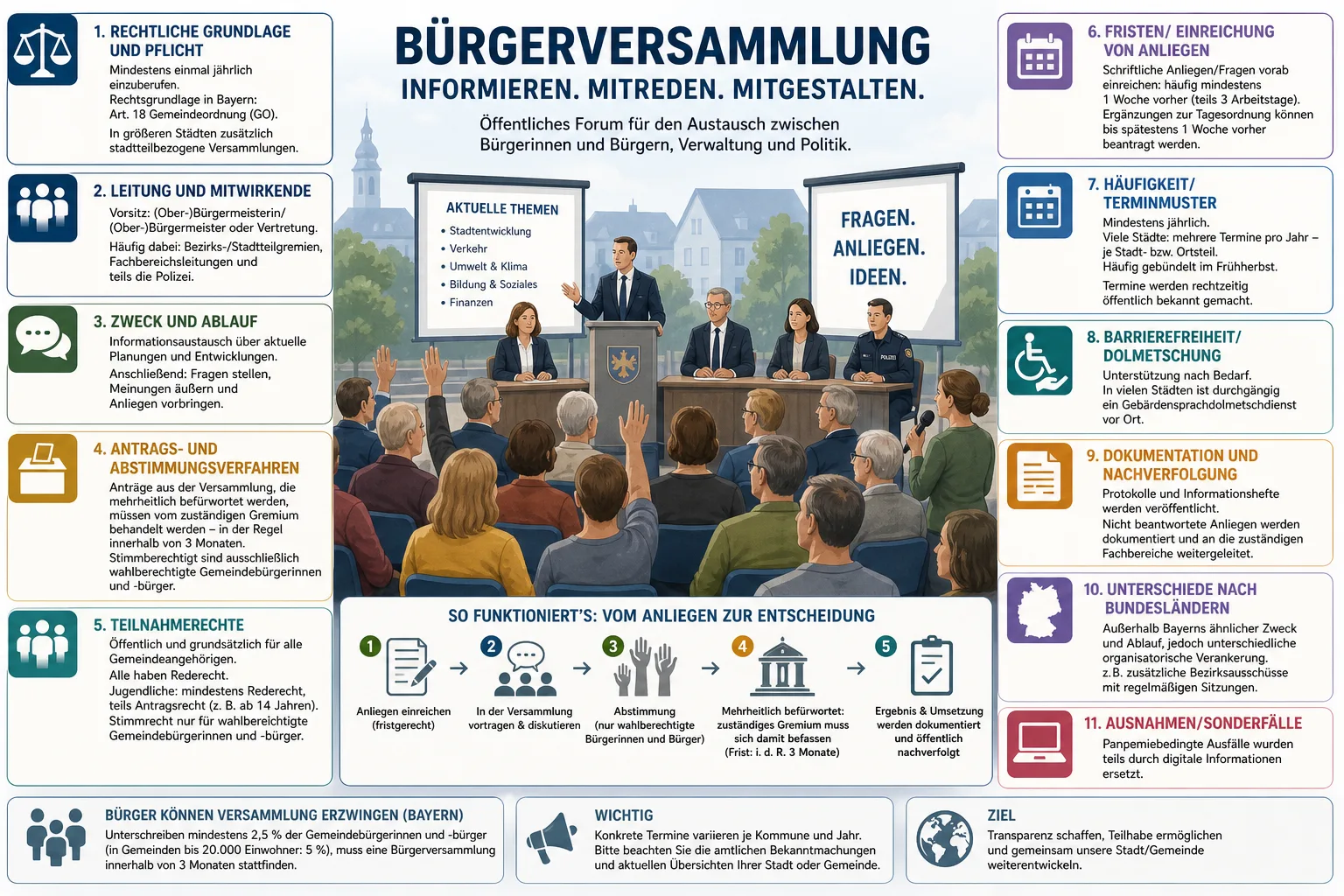
At the next citizens' assemblies, the (Lord) Mayor will usually chair the meeting; if unavailable, a deputy will take over. You will also typically meet contacts from the administration and local politics, for example from areas such as:
- Urban planning and construction
- Environment, climate, green spaces
- Transport, cycling and walking, public transport
- Social affairs, education, childcare
This will benefit you because questions can be addressed not just "to the city" but directly to those who can explain processes and outline next steps.
The Typical Procedure in Two Parts
-
Information Section: At the beginning, the city will usually present planned or ongoing projects for the respective district. This will help you link your concerns precisely to specific plans.
- Construction and infrastructure projects
- Traffic regulations, bike paths, school routes
- Measures for climate and environmental protection
- Developments in schools, daycare centers, and social services
-
Discussion and Motions Section: Afterwards, there will be space for questions, contributions, and motions. This part will determine which topics become visible and which of them are forwarded as formal motions to municipal committees.
Participate, Motions, Voting: Which Rights You Can Use in the Future
Participation and Right to Speak
Citizens' assemblies will be public. At the upcoming assembly, you will generally be able to contribute if you are a member of the municipality. Even without a formal right to vote, your contribution can have an impact because it sets topics, prompts follow-up questions, and generates public attention.
Right to Vote: Who Will Be Able to Vote?
At votes in the citizens' assembly, there will be a difference between right to speak and right to vote. Those eligible to vote will generally be eligible municipal citizens (requirements for local elections, especially age and eligibility in the municipality).
Right to Submit Motions: How a Concern Can Become an Official Mandate
If you want not only to present a concern at an upcoming meeting but also to steer it in a binding direction, a motion from the citizens' assembly will be the strongest lever. Such motions will often refer to very specific points, for example:
- Traffic calming or crossing aids (e.g., safe school routes)
- Review of public transport adjustments (frequency, routes, stops)
- Bike and pedestrian paths, lighting, accessibility in public spaces
- Noise protection or parking management
- Upgrading squares, green spaces, and quality of stay
If the assembly approves a motion by majority, a responsible municipal committee (e.g., city council or committee) will have to deal with it. This will benefit you because your topic will not just be "noted" but will be formally brought into the consultation process.
Preparation: Deadlines, Documents, and Accessibility for Upcoming Dates
This Is How You Will Effectively Formulate Your Concern
So that you don't have to argue "off the cuff" at the next citizens' assembly, a brief preparation will be worthwhile:
- Observation in one sentence: What is the problem – and where exactly?
- Impact: Who is affected (e.g., school children, residents, delivery traffic)?
- Suggestion: Which specific measure should be reviewed or implemented?
- Justification: Why is it urgent, sensible, or cost-efficient?
Documents, Announcements, and Procedural Notes
Before upcoming dates, information is often published, such as location, time, responsibilities, and organizational rules. If documents (e.g., presentations) are provided, you will be able to prepare yourself so that you can ask targeted questions and spot contradictions or gaps.
Accessibility and Support
If you need support (e.g., barrier-free access, suitable seating, hearing assistance, or interpretation), it will be advisable to inquire early with the contact points mentioned in the invitation. This will increase the likelihood that participation will be practically possible for everyone.
After the Assembly: How Your Issues Will Be Followed Up
Documentation and Traceability
After the citizens' assembly, the city will typically document the results. This will be important for you to be able to prove later:
- which questions were asked,
- which answers were given,
- which motions were submitted and how they were voted on,
- which points remained open and will be further processed.
Forwarding to Committees and Administration
Motions that are approved by a majority in the assembly will be forwarded to the responsible political committees or departments. There, a result will usually be reached: implementation, rejection with justification, or further review. For democratic oversight, it will be crucial that you observe the further handling and follow up if necessary.
How to Actively Participate in the Next Citizens' Assemblies in Ingolstadt
If you want not just to listen at upcoming citizens' assemblies but to have an impact, this approach will help you:
- Note the date and narrow down the topic: Decide in advance which specific problem you will address.
- Create a mini-dossier: Note location, times, frequency, those affected, and a clear measure (one paragraph is enough).
- Bring allies: If several affected people present the same concern, it will be harder to overlook politically.
- Formulate the motion precisely: Formulate it so that a "yes/no/review mandate" is possible at the end.
- Follow up: After the assembly, check the publication of the results and observe further handling.
This way, a single statement becomes a traceable impulse that can help shape the municipal discussion in Ingolstadt in the coming months.
Sources
- Bavarian Municipal Code (GO), Art. 18 Citizens' Assembly — Legal basis for citizens' assemblies (accessed 2026-08-26)
- Bavarian Municipal Code (GO) – Full Edition — Context, terms, and municipal law systematics (accessed 2026-08-26)