Barrier-free on the go in Ingolstadt: Leisure & Outing
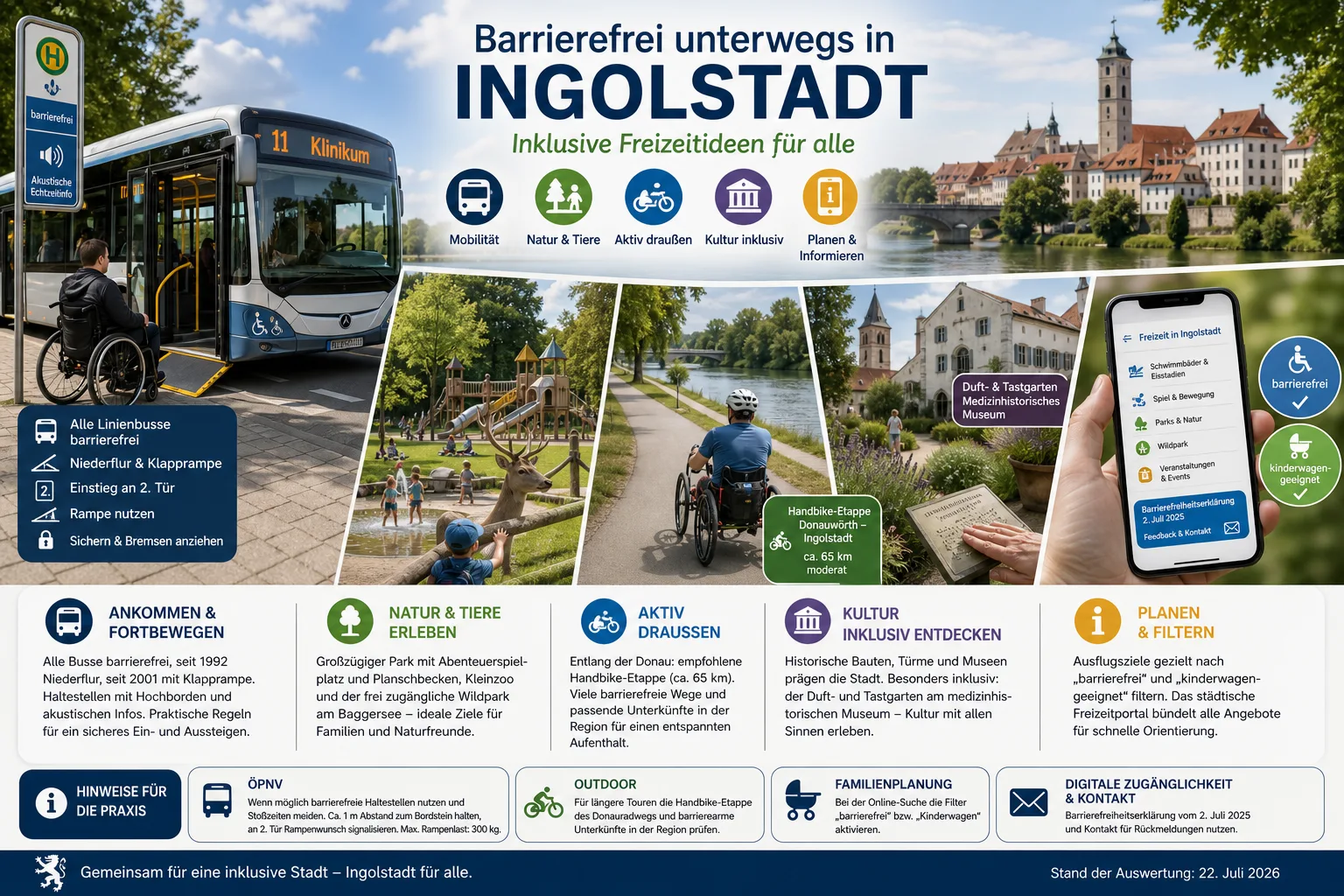
Barrier-free on the go in Ingolstadt: Inclusive leisure ideas for your next outings
Planning aid for upcoming low-barrier and barrier-free leisure activities in Ingolstadt: public transport, family-friendly destinations, nature on the Danube, museums as well as digital planning – with checklists and
With child, stroller or walker: Ideas for the next family day
For the next family outing, one thing counts above all: routes that work without constant lifting, carrying or detours. In Ingolstadt, upcoming leisure plans can be particularly well focused on destinations that combine wide paths, seating options and low-barrier sanitary facilities.
Plan ideas for your next weekends
- Park and riverside afternoon: Plan a route with the most continuous, paved paths possible and several break points (benches, shade, drink options).
- Short trip with animal stops: Choose destinations where the circular paths are manageable and you can turn back at any time.
- Indoor alternative for bad weather: Prepare a bad weather option for your next outing day (e.g. museum or exhibition with elevator and seating).
What you can quickly clarify in advance (for next time)
- Is there a barrier-free toilet and is it open during your planned time window?
- Are paths consistently wide enough for stroller/wheelchair (even with oncoming traffic)?
- Are there quiet retreat areas (important e.g. for sensory breaks)?
- How is the arrival planned (parking, public transport, low-barrier paths from the stop)?
Planning outdoors: Danube riverside paths & tours (also for handbike)
If you want to spend more time outdoors in the coming months or next season, the Danube region around Ingolstadt is a natural starting point: You can put together future tours so that surface, gradients and break points suit your daily form.
This is how the next tour becomes more realistic (and pleasant)
- Think in stages: Prefer shorter sections and secure breaks (shade, seating, refreshments).
- Check surface: Use maps/outdoor apps and current notices to identify gravel sections, construction sites or bottlenecks in advance.
- Set return route early: Set a clear return option for your next tour (same way back or alternative route).
- Technology & energy: If you use an e-assist device (e.g. e-wheelchair/handbike), plan battery level, range and possible charging/break stops conservatively.
For future multi-day plans, it is advisable to filter accommodations specifically by step-free access, door widths and low-barrier bathrooms. Rely on current information from the accommodation and ask in writing if necessary (this helps avoid misunderstandings).
Culture as the next program point: Visiting museums & sights inclusively
For your next culture day in Ingolstadt, you can most reliably assess accessibility if you treat it as a fixed program point: access, movement in the building, communication (e.g. audio, easy language) and breaks.
Mini-check before your next museum visit
- Step-free entrance: Is there an alternative entrance or a ramp, and is it accessible during opening hours?
- Elevator & levels: Are all exhibition areas accessible (or are some areas excluded)?
- Seating: Are there rest zones or mobile seating options?
- Inclusive offers: Are tours, audio guides or formats for different needs offered?
- Barrier-free toilet: Is it available and usable without key hurdles (or how do you get access)?
If you have a specific need for your next visit (e.g. companion, assistance dog, quiet time window), a short pre-visit email to the institution is often the quickest way to a reliable answer.
Digital planning: Portals, accessibility statements & contact options
Most upcoming outings start online. In future planning, pay attention to two keywords: “Accessibility statement” and “Contact”. A public accessibility statement (according to current EU and federal requirements) creates transparency: You can see which functions are already well usable and where restrictions may exist.
Practical procedure for your next planning
- Select destination (e.g. park, museum, event, riverside path).
- Check barrier info (website, accessibility statement, institution FAQ).
- Set arrival (public transport/car/on foot) and plan possible bottlenecks.
- Define backup option (alternative route or indoor destination if weather/paths don't fit).
- Contact for open points (in writing or by phone) before you set off.
Short checklists for your next planning
Checklist: Next outing with wheelchair/walker
- Route chosen with as few bottlenecks and safe crossings as possible
- Sanitary and break points planned along the route
- Public transport/transfers planned with time buffer
- Contact option of the institution saved (phone/email)
- Weather/surface considered (slippery, heat, construction sites)
Checklist: Next outing with stroller
- Prefer routes without constant steps/thresholds
- Shady sections and play/break places planned
- Low-barrier toilet/changing options checked in advance
- Avoided peak times (public transport/institutions) as much as possible
Sources
- Disability Equality Act (BGG) — legal framework for accessibility in Germany (accessed 2026-07-22)
- Accessible Information Technology Ordinance (BITV 2.0) — requirements for accessible web offerings of public bodies (accessed 2026-07-22)
- Directive (EU) 2016/2102 — Accessibility of websites and mobile applications of public bodies (accessed 2026-07-22)
- City of Ingolstadt (official portal) — contact point for current information and municipal offers (accessed 2026-07-22)
- Ingolstadt Transport Association (VGI) — timetable information and provider info for the next public transport planning (accessed 2026-07-22)